

Hybrid search optimization: BM25, dense vectors and late-interaction reranking
Hybrid retrieval is the operating system of modern AI search. BM25 for keyword precision, dense vectors for semantic recall, and optional late-interaction reranking. CTO playbook for production stacks.


Modern AI search systems promise “semantic understanding”, but in production, they fail the moment a user types something oddly specific, misspelled, or extremely literal. Meanwhile, traditional keyword search is precise but blind to meaning.
This tension is why no real-world search stack can rely solely on dense embeddings or solely on BM25.
The future of search is hybrid, where sparse signals (keywords, term frequency, exact matches) and dense signals (semantic meaning, embeddings) reinforce each other. For CTOs and technical leads deploying AI search across knowledge bases, enterprise systems, or AI-driven applications, optimizing this balance is now a core engineering skill.
This article breaks down why both systems are necessary, what each contributes, and how to engineer a retrieval pipeline that optimizes for both signals simultaneously.
1. Why AI Search Needs Both Sparse and Dense Retrieval
BM25 (Sparse Retrieval)
BM25 excels at:
- Exact keyword presence
- High-precision lookup
- Handling domain terms, SKUs, IDs (typos need fuzzy matching or trigram tokenization)
- Queries with names, numbers, and abbreviations
- Filtering out irrelevant content through lexical matching
Weakness: It has no semantic understanding.
“Car charging time” ≠ “EV battery refill duration.”
Dense Retrieval (Embeddings)
Dense retrieval excels at:
- Semantic similarity
- Paraphrases
- Natural language queries
- Long-tail conceptual questions
Weakness: Embeddings struggle with:
- Rare phrases
- Extremely short queries
- OOV terms, product codes, legal references
- Multi-intent queries
- Heavy domain-specific jargon
If you rely only on dense search, you will lose recall in all “specific keyword-critical” queries.
If you rely only on BM25, you will lose relevance in all “conceptual or conversational” queries.
This is why top vector databases and AI-powered search stacks (Pinecone, Weaviate, Vespa, Elasticsearch, OpenSearch) have all converged on hybrid systems.
2. Hybrid Retrieval: How the Two Signals Complement Each Other
Hybrid search is not simply combining two rankings, it is about balancing two orthogonal relevance signals:
| Signal Type | Strength | Weakness |
|---|---|---|
| Sparse (BM25) | Precision, specificity | No semantic understanding |
| Dense (Vectors) | Semantics, conceptual similarity | Poor literal recall |
A well-engineered hybrid system:
- Increases total recall (retrieves more relevant items)
- Improves ranking stability across query types
- Reduces hallucinations in generative responses
- Maximizes grounding for RAG pipelines
Published tests show the size of the gain: in Anthropic's retrieval experiments, combining contextual embeddings with contextual BM25 cut the top-20 retrieval failure rate by 49%, and by 67% with a reranker. Measure it on your own queries.
3. Architecture: How Production Hybrid Search Works
Common Hybrid Architectures
1. Parallel Retrieval + Weighted Merge (Most Common)
- BM25 retrieves top N_s results
- Dense vectors retrieve top N_d
- Engine merges and re-ranks based on combined score
Example weighted formula:
final_score = α * dense_score + β * bm25_score
2. Sparse → Dense Refinement
Use sparse first to filter large corpus → apply dense ranking on filtered set.
Better for:
- Highly technical domains
- Tens of millions of documents
- SKU-heavy or log-heavy corpora
3. Dense → Sparse Validation
Dense search retrieves candidates → BM25 validates literal grounding.
Useful in:
- RAG systems that must avoid hallucination
- LLM guardrail pipelines
Also, consider implementing chunking strategies for retrieval to improve candidate selection and recall.
4. How Vector Databases Implement Hybrid Search
Modern vector DBs now support hybrid scoring natively.
Weaviate
- HNSW for vectors + keyword index
- Native hybrid scoring with tunable alpha
- Real-time keyword/vector score fusion
Pinecone
- Full-text BM25 search, generally available since September 2026
- Dense and sparse vectors in one index, balanced client-side with an alpha weight
- Hosted rerankers such as Cohere Rerank 4 Fast and bge-reranker-v2-m3
Qdrant
- Combines vector score and BM25 score during retrieval
- Highly configurable weighting
Elasticsearch / OpenSearch
- BM25 + dense_vector fields
- RRF (Reciprocal Rank Fusion) for hybrid scoring
- Useful when you need complete control of keyword analysis
For multi-modal RAG systems, optimizing visual inputs can further improve retrieval efficiency, see optimizing visual assets in RAG pipelines for actionable strategies.
5. Engineering the Hybrid Signal: How to Optimize Both
Hybrid search is not “set it and forget it.”
You must tune the system based on:
A. Query Type Distribution
Break down your queries. An illustrative split:
- 30% navigational (names, IDs → BM25-heavy)
- 50% informational (mix → hybrid)
- 20% semantic (dense-heavy)
Your weights should reflect this.
B. Similarity Metrics
Dense:
- cosine for normalized embeddings
- dot product for transformer models
Sparse: - BM25 tuning (k1, b parameters)
- Term boosting
C. Vector Quality
Use domain-tuned models:
- bge-m3
- E5-large
- voyage-4 or voyage-4-large
- Qwen3-Embedding or llama-text-embed-v2
For high-precision enterprise RAG, you may use:
- Hybrid SPLADE (sparse) + dense embeddings together.
When dealing with rare phrases, OOV terms, and unusual tokens, it’s crucial to consider handling tokenization challenges in hybrid search, otherwise, these uncommon terms may never surface in your retrieval, even with a hybrid setup.
D. Scoring Strategy
Choose one:
(1) Weighted Sum
Best for predictable queries.
score = 0.7 * dense + 0.3 * sparse
(2) Reciprocal Rank Fusion (RRF)
Best for unpredictable, long-tail queries.
1 / (k + rank)
(3) LLM-based Re-Ranking
Take top 50 hybrid candidates → rerank with cross-encoder.
Best for:
- RAG pipelines
- Agentic workflows
- High-value enterprise use cases

6. Practical Tips for Maximizing Hybrid Retrieval Performance
-
Use BM25 for precision, vectors for meaning
Hybrid search is not about equal weighting, it’s about query intent.
-
Increase N for dense retrieval
Vectors need larger candidate sets to shine.
-
Normalize scores before combining
BM25 and vector scores live on different scales.
-
Cache sparse queries, not dense
Dense queries cost more computationally.
-
For RAG, always hybrid → rerank → threshold
This reduces hallucination and massively boosts grounding consistency.
7. Real-World Example Scenarios
-
Scenario 1: Developer searches error logs
Query:
“timeout error from stripe webhook 524”
BM25 catches:
-
“524”
-
“stripe”
-
“webhook”
Dense catches:
-
related conceptual error messages
-
paraphrased descriptions
-
logs missing exact keywords
Scenario 2: Customer searches product support
Query:
“mic not working after update”
Dense retrieves semantically similar troubleshooting cases.
Sparse retrieves exact device model numbers within those results.Scenario 3: RAG for enterprise knowledge base
Hybrid is mandatory because:
-
BM25 grounds LLM
-
Dense retrieves concepts LLM must reference
Together they avoid hallucination
-
2026 update: late interaction as a reranking stage
Late-interaction models such as ColBERTv2 and ColPali keep a vector for every token or image patch and match query tokens against document tokens. Support is not new: Qdrant added multivector search in July 2024, Weaviate in version 1.29, Vespa ships a ColBERT embedder, and Elasticsearch has a rank_vectors field in preview since 9.0.
The documented pattern is a second stage: retrieve candidates with BM25 and dense vectors, fuse them, then rescore the top results with the late-interaction model.
Plan for storage, since every token keeps a vector. ColBERTv2's compression cut that footprint 6 to 10 times against earlier late-interaction models. Test the accuracy gain on your own queries before adopting it.
Cross-link to the rest of the AI-retrieval stack
Hybrid search is one layer of a larger AI-retrieval architecture:
- Header architecture for vector proximity: the structural rules that make your content retrievable in the first place
- Nested JSON-LD for GraphRAG: the entity graph that augments hybrid retrieval with deterministic relationships
- Information gain vector audit: the orthogonality check that decides whether your content earns a citation when retrieved
- Robots.txt 2026 for AI crawler budgets: which agents can hit your retrievable content in the first place
- Sentiment drift analysis: the listener that tracks how the AI describes your brand once retrieval lands
- AEO vs GEO vs SEO: the strategy layer above all of this, deciding which of the three disciplines each retrieval investment serves
8. Conclusion: Hybrid Search Is Now a Required Engineering Pattern
-
Search is no longer just lexical and no longer only semantic.
Modern AI search must:-
Understand meaning (dense)
-
Respect exact terms (sparse)
-
Balance both dynamically
-
Optimize retrieval for RAG and agentic systems
-
Scale across millions or billions of documents
CTOs and engineering leaders adopting hybrid search achieve:
-
Higher recall
-
Higher precision
-
Far more stable performance
-
Stronger grounding for LLM systems
-
Production-grade reliability
Hybrid search isn’t a workaround. It’s the operating system of modern retrieval.
-
Frequently Asked Questions
-
**Q: What are the top platforms offering hybrid search optimization solutions?**A: Leading platforms include Elasticsearch, Algolia, Pinecone, Vespa, and OpenSearch. They combine keyword and vector-based search to deliver more accurate, context-aware results.
Q: What hybrid search optimization features should I look for in SaaS products?
A: Look for vector embeddings, semantic search, keyword relevance scoring, AI-driven ranking, multilingual support, scalability, and easy API integration.Q: Which hybrid search optimization APIs are suitable for developers?
A: Developer-friendly options include Pinecone API, Cohere Rerank API, OpenAI embeddings + search tools, Elasticsearch API, and Algolia’s hybrid search API.
Let’s Discuss it Over a Call
Key takeaways
- Test hybrid retrieval against either signal alone on your own queries; published tests favor hybrid.
- Use Weighted Sum for predictable queries, Reciprocal Rank Fusion for unpredictable long-tail.
- Normalize BM25 and vector scores before combining; they live on different scales.
- Cache sparse queries, not dense (dense costs more compute per query).
- Consider late-interaction rescoring for precision-critical RAG, and budget for storage: it keeps a vector per token.
Keep reading
Related articles.
More on the same thread, picked by tag and category, not chronology.
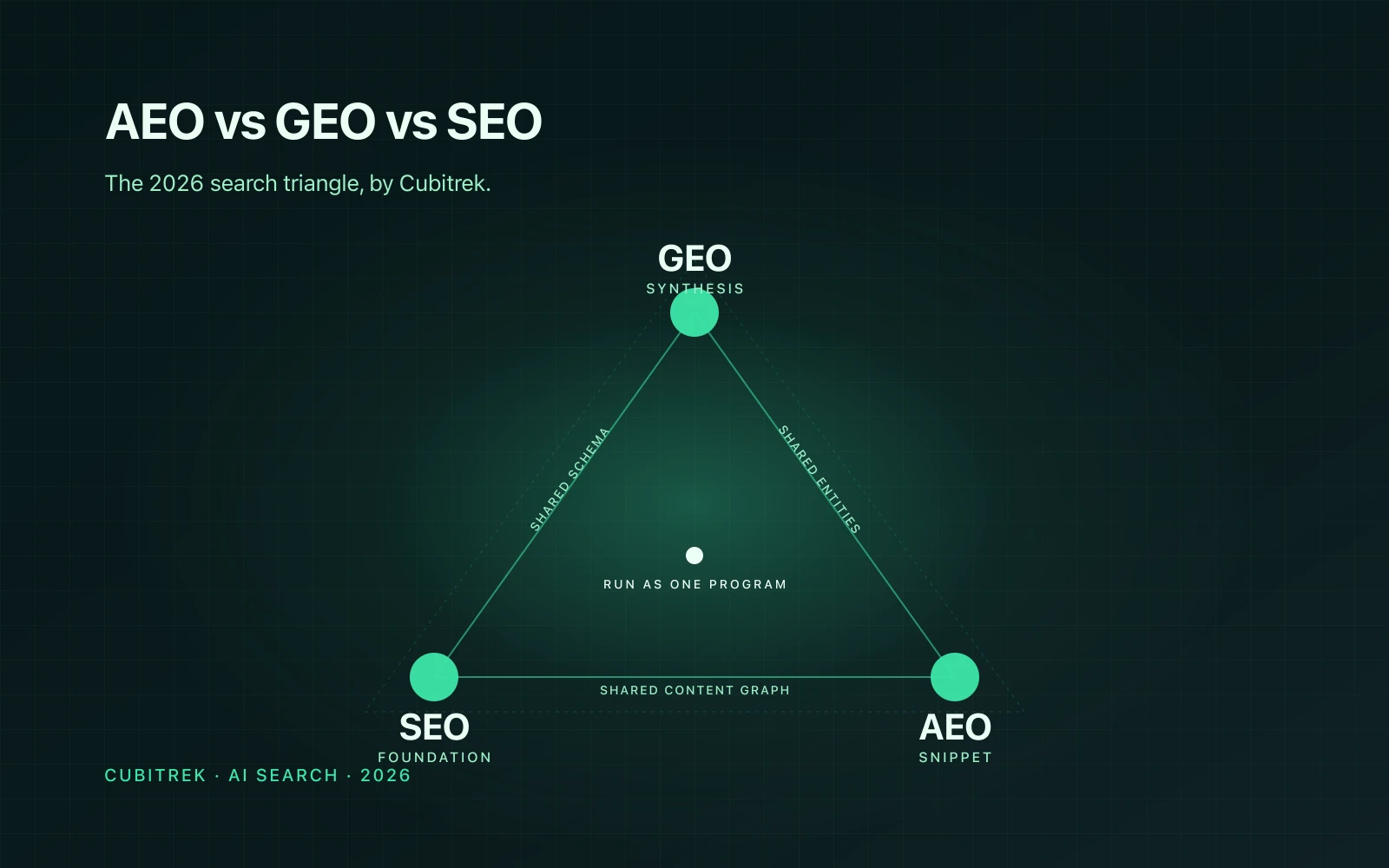
AEO vs GEO vs SEO: The Triangle
SEO is the foundation. AEO is the snippet game. GEO is the synthesis game. They are not competitors. Run them as one program and they compound.
Faizan Ali Khan
Multi-Agent Systems: How to Orchestrate AI Agent Teams
Multi-agent systems coordinate specialized AI agents to handle complex workflows. Learn orchestration patterns, frameworks, and production best practices.
Faizan Ali Khan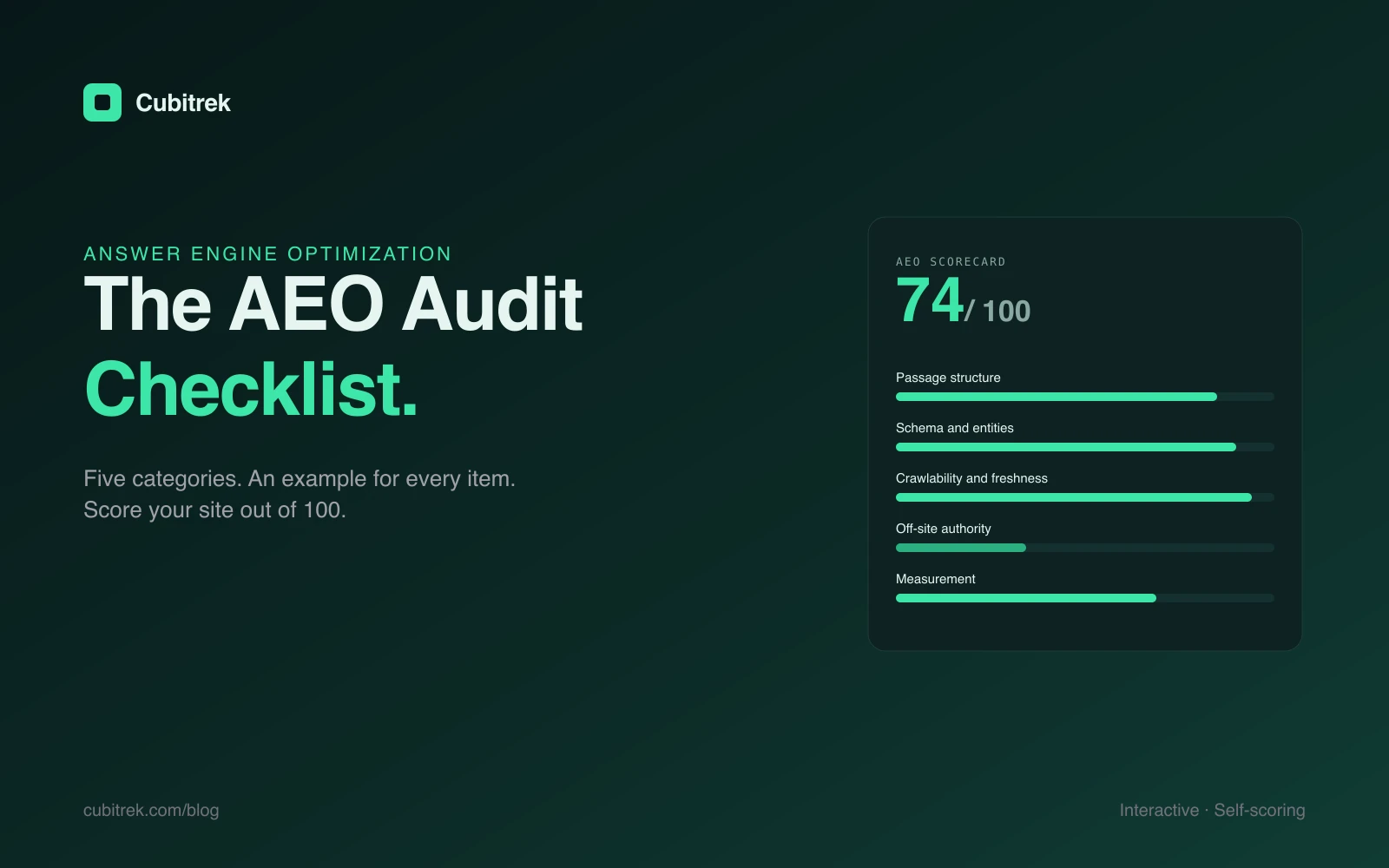
The AEO Audit Checklist
An interactive AEO audit with a weak-versus-strong example for every item, real audit scores, and a live self-scoring widget. Grade your site in five minutes.
Faizan Ali KhanReady when you are
Want Cubitrek to run AEO & GEO for you?
We install aeo & geo programs for growing companies across the US and Europe. Book a call and we'll come back with a one-page plan in 72 hours.