The AEO Audit Checklist for 2026
An interactive AEO audit with a weak-versus-strong example for every item, real audit scores, and a live self-scoring widget. Grade your site in five minutes.
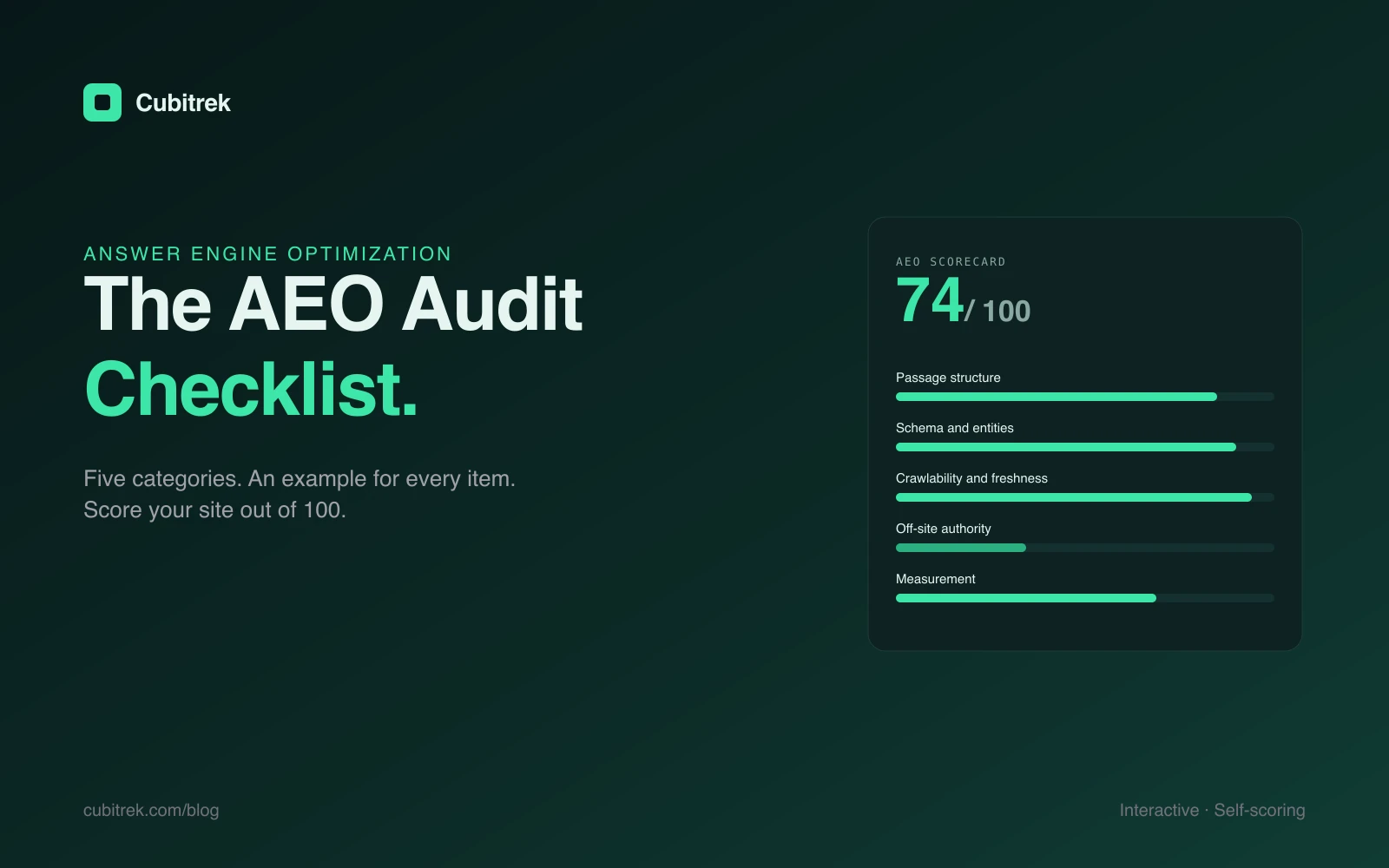
An answer engine optimization (AEO) audit checks whether AI engines can find, understand, and cite your content. It scores five things: passage structure, schema and entities, crawlability and freshness, off-site authority, and measurement. A site that passes all five gets quoted inside ChatGPT, Perplexity, Gemini, and Google AI Overviews. A site that fails them stays invisible in AI answers no matter how well it ranks on Google.
This is the checklist we run before every Cubitrek engagement. Every item below comes with a weak-versus-strong example, so you can grade your own pages as you read. There is an interactive scorer halfway down, plus the real numbers from auditing our own site and three anonymized client archetypes.
How an AI engine picks a source
Most teams obsess over step four and ignore steps one through three. That is backwards. If the bot cannot crawl you, or cannot extract a clean passage, or cannot trust your entity, step four never happens. The checklist below works through all four in order.
Category 1: passage structure
This is how an AI engine extracts a quotable answer from your page. It is the single highest-weighted category because it is where most sites fail first.
Lead every page with a self-contained answer. The first paragraph should answer the page's core question completely, so it makes sense even when pulled out alone.
❌ "Our platform offers a range of solutions designed to help modern teams achieve their goals." ✅ "Answer engine optimization is the practice of structuring content so AI engines cite it. It has four levers: passage structure, schema, entity consistency, and freshness."
Make one claim per paragraph. AI engines extract paragraph-sized chunks. A paragraph with five points gets skipped because none of them is cleanly quotable.
❌ A 90-word block covering pricing, features, and onboarding in one breath. ✅ Three short paragraphs, one each for pricing, features, and onboarding.
Phrase your H2s as the questions buyers ask. Headings shaped like prompts get matched to prompts.
❌ "Our Methodology" ✅ "How long does an AEO program take to show results?"
Put a specific stat or named entity in each answer. Engines favor passages with a verifiable detail over vague claims.
❌ "We significantly improve visibility." ✅ "We track citations across 30 plus AI surfaces every week."
Category 2: schema and entities
This is how an AI engine trusts that you are who you say you are. It is what stops the model confusing you with a competitor.
This checklist is the manual version. The Cubitrek AEO Platform scores the same categories automatically and tracks them over time, which matters because entity signals drift as the models retrain.
Use nested JSON-LD with @id anchoring. Flat, disconnected schema blocks force the engine to guess the relationships. A connected graph spells them out.
❌ Separate Organization and Service blocks with no link between them. ✅ A Service block whose
providerreferences the Organization's@id.
Add a sameAs array to authoritative profiles. This is how the engine resolves your brand to a single real-world entity.
❌ An Organization with name and URL only. ✅
sameAslinking to your Wikidata item, LinkedIn, and Crunchbase.
Ship FAQPage schema on pages that answer questions. It is the most reliable way to get a passage marked as a question-and-answer pair.
❌ Questions formatted as bold text with no schema. ✅ FAQPage JSON-LD wrapping each question and its answer.
Build a canonical Brand Hub. One machine-readable page the engines parse once and trust for months.
❌ Brand facts scattered across an About page, a footer, and three blog posts. ✅ A single Brand Hub with the entity graph, citation format, and canonical page map.
Category 3: crawlability and freshness
This is whether the bot can reach your content and whether it considers it current.
Allow live-retrieval AI bots in robots.txt. Blocking them to "protect content" also blocks the citation traffic they drive.
❌
User-agent: PerplexityBotthenDisallow: /. ✅ Allow OAI-SearchBot, PerplexityBot, Claude-User, and Claude-SearchBot; they retrieve and cite in real time.
Render content in HTML, not JavaScript only. Many AI crawlers do not execute JavaScript. If your content needs a browser to appear, they see an empty page.
❌ A single-page app that paints the article client-side. ✅ Server-rendered HTML with the full article in the initial response.
Keep cornerstone pages fresh. AI engines weight recency. A guide last touched two years ago loses to one updated this quarter.
❌ A pillar guide with a 2024 date and no updates since. ✅ The same guide refreshed every quarter with a current
dateModified.
Publish llms.txt at the domain root. It tells AI crawlers which pages are canonical and how to cite you.
❌ No llms.txt; every engine builds its own version of your brand. ✅
/llms.txtlisting your canonical pages and preferred citation format.
Category 4: off-site authority
This is the part you cannot fake with on-page work. AI engines check whether sources they already trust mention you.
Earn mentions on trusted third-party sites. Engines corroborate your claims against the open web.
❌ Every mention of your brand is on your own domain. ✅ Independent articles, podcasts, and directories reference you by name.
Keep your entity consistent everywhere. Conflicting names, founders, or descriptions across the web make the engine uncertain, and uncertainty suppresses citation.
❌ "Acme", "Acme Inc", and "Acme Solutions" used interchangeably across profiles. ✅ One exact legal name, one founder list, one description, everywhere.
Get cited in at least one AI engine today. A single confirmed citation proves the path works and gives you a baseline to grow.
❌ Zero citations and no idea whether any engine knows you exist. ✅ A logged citation in Perplexity you can screenshot and build on.
What Google's own AI guidance says about this
Google publishes its own guidance, "Optimizing your website for generative AI features on Google Search". It is worth reading, and worth being precise about what it does and does not cover.
Where Google agrees with this checklist:
- SEO fundamentals still apply. Google states the best practices for search remain relevant for its generative AI features.
- Unique, people-first content wins. Google rewards distinctive, useful pages over commodity content.
- Crawlability is essential. Google's models learn from publicly accessible, crawlable content.
That covers categories one, three, and the spirit of the whole list. Now the part worth being precise about.
Google's guide covers Google's own AI Overviews and AI Mode. It does not speak for ChatGPT, Perplexity, or Claude. That is where a large share of AI citations now happen. Two of Google's stated "myths" are true for Googlebot but not for those engines:
- Google says llms.txt is not necessary. For Google, correct. Perplexity and several retrieval agents do reference it. We treat llms.txt as insurance for the non-Google engines, not a Google ranking lever.
- Google says you do not need to chunk content for AI. We agree you should never write in artificial fragments. But an answer-first paragraph is just good writing that also extracts cleanly. That is what category one rewards.
Passage structure
Schema and entities
Crawlability and freshness
Off-site authority
Measurement
We ran this checklist on ourselves
It would be dishonest to publish a checklist we do not pass. So we ran it on cubitrek.com. Here is the real result.
We score high on the first three categories. Nested schema with @id anchoring, a Brand Hub, llms.txt at the root, server-rendered Next.js, all AI bots allowed, fresh cornerstone content. That is the work an agency should have done on its own house first.
Where we lose points is category four. As a young company we have few independent third-party mentions, so our off-site authority is thinner than our on-page work. That is exactly the gap our press and content programs are built to close, and we hold ourselves to the same scorecard we sell. Scoring your own gaps honestly is the point of the exercise.
Three anonymized audits, three different failure modes
We grade a lot of sites. The scores cluster into recognizable patterns. These three are representative composites, not specific companies, with illustrative numbers.
Same checklist, three failure modes
| Archetype | Score | Strong | The fatal gap |
|---|---|---|---|
| Series B SaaS | 58 / 100 | Deep, well-written content | Flat schema, no entity graph, so engines confuse it with a competitor |
| DTC skincare brand | 47 / 100 | Strong off-site authority and press | No passage structure, so there is nothing clean to extract |
| Local services firm | 31 / 100 | Fast site | Thin content, no schema, no measurement, invisible to AI |
The lesson across all three: a high score in one category does not rescue a zero in another. The SaaS has the best content and still loses, because the engine cannot trust its entity. The fix is always the weakest category, not the most comfortable one.
How to read your score
Under 50 means AI engines struggle to cite you at all, usually because passage structure or crawlability is broken. Fix those before anything else. Between 50 and 79 means your fundamentals work but you have specific, nameable gaps, most often schema or off-site authority. Above 80 means the on-page work is sound and the game shifts to earning citations and measuring them.
Whatever your score, work the lowest category first. An AEO audit is not a vanity number. It is a priority list disguised as one.
If you want the long version of why each category matters, the generative engine optimization pillar guide covers the mechanics, and answer engine optimization 101 covers the foundations. For how AEO sits next to GEO and classic SEO, read the 2026 search triangle.
Key takeaways
- Work your lowest-scoring category first. An AEO audit is a priority list, not a vanity score.
- Schema with @id anchoring and a Wikidata sameAs is what stops AI engines confusing you with a competitor.
- Off-site authority is the one category you cannot fix with on-page work. It needs press and citations.
Questions people ask about this
Sourced from client conversations, Search Console, and AI-search citation monitoring.
- An AEO audit checks whether AI engines can find, understand, and cite your content. It scores five categories: passage structure, schema and entities, crawlability and freshness, off-site authority, and measurement. The output is a priority list, the lowest-scoring category is the one to fix first.
- Work through four steps in the order an AI engine does: can it crawl the page, can it extract a clean self-contained passage, can it trust your entity through schema and off-site mentions, and is your passage the best answer to the prompt. Each AEO checklist category maps to one of those steps.
- Under 50 means AI engines struggle to cite you, usually because passage structure or crawlability is broken. Between 50 and 79 means your fundamentals work but you have specific gaps, most often schema or off-site authority. Above 80 means the on-page work is sound and the focus shifts to earning citations and measuring them.
- An SEO audit checks whether your pages can rank in Google's blue links. An AEO audit checks whether AI engines will quote you inside their answers. The mechanics overlap on crawlability and content quality, but AEO adds passage-first structure, nested entity schema, a Brand Hub, and citation tracking that a classic SEO audit does not cover.
- Run a full audit quarterly, since AI engines weight freshness and your competitors keep shipping. Track citations weekly between audits so you catch drops before the next full review.
Keep reading
Related articles.
More on the same thread, picked by tag and category, not chronology.

GEO 101: A Simple Guide to Winning in the AI Search
Generative engine optimization is how brands get named inside AI-written answers. What GEO is, the five pillars of a GEO program, and where it parts company with classic SEO.
Faizan Ali Khan
AEO 101: The Definitive Guide to Answer Engine Optimization in 2026
Answer engine optimization is how a brand gets cited inside ChatGPT, Perplexity, Claude, Gemini and Google AI Overviews. What AEO is, how it differs from SEO, and the playbook to run.
Faizan Ali Khan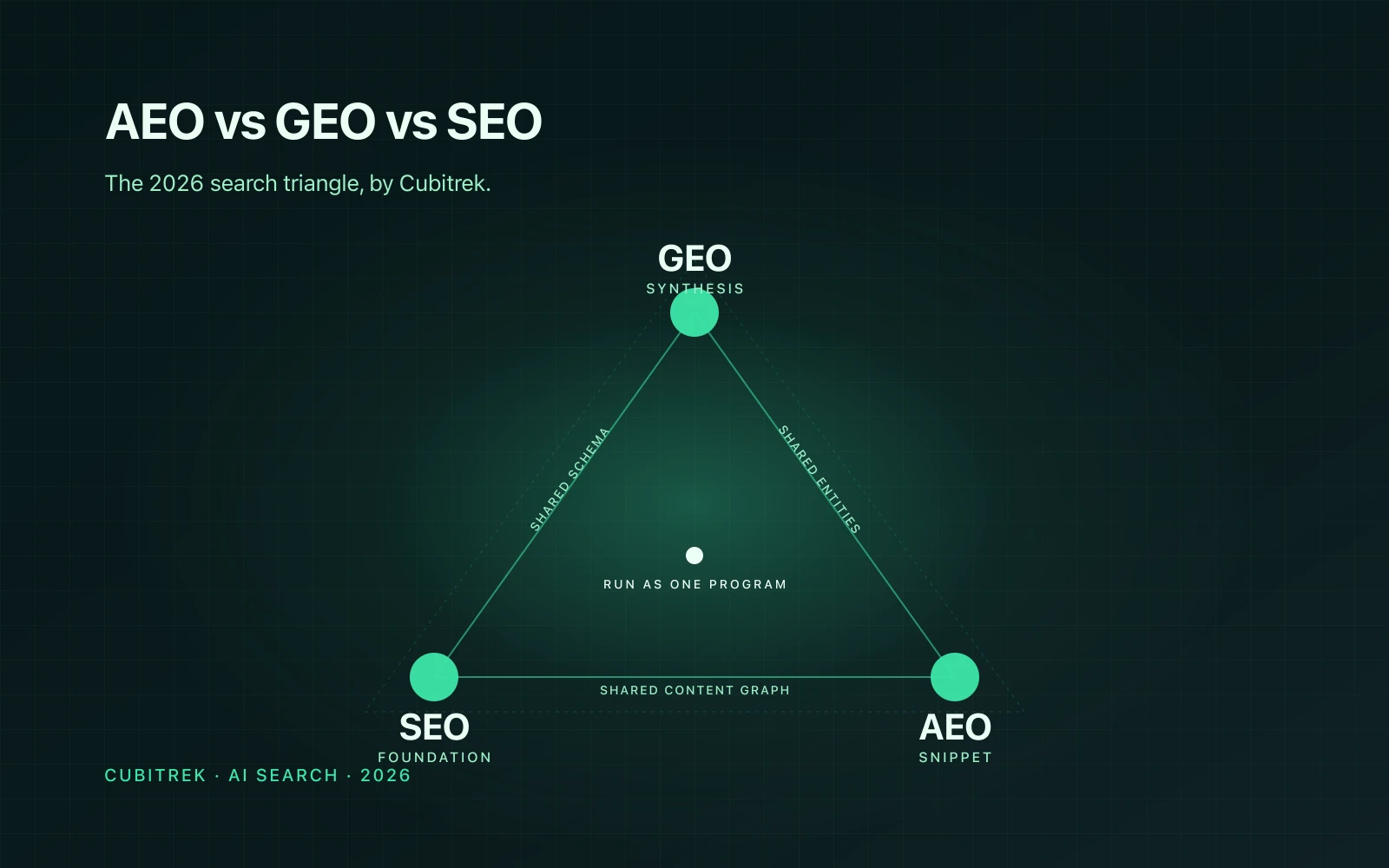
AEO vs GEO vs SEO: The Triangle
SEO is the foundation. AEO is the snippet game. GEO is the synthesis game. They are not competitors. Run them as one program and they compound.
Faizan Ali KhanReady when you are
Want Cubitrek to run AEO & GEO for you?
We install aeo & geo programs for growing companies across the US and Europe. Book a call and we'll come back with a one-page plan in 72 hours.