AEO vs GEO vs SEO: The 2026 Search Triangle
SEO is the foundation. AEO is the snippet game. GEO is the synthesis game. They are not competitors. Run them as one program and they compound.
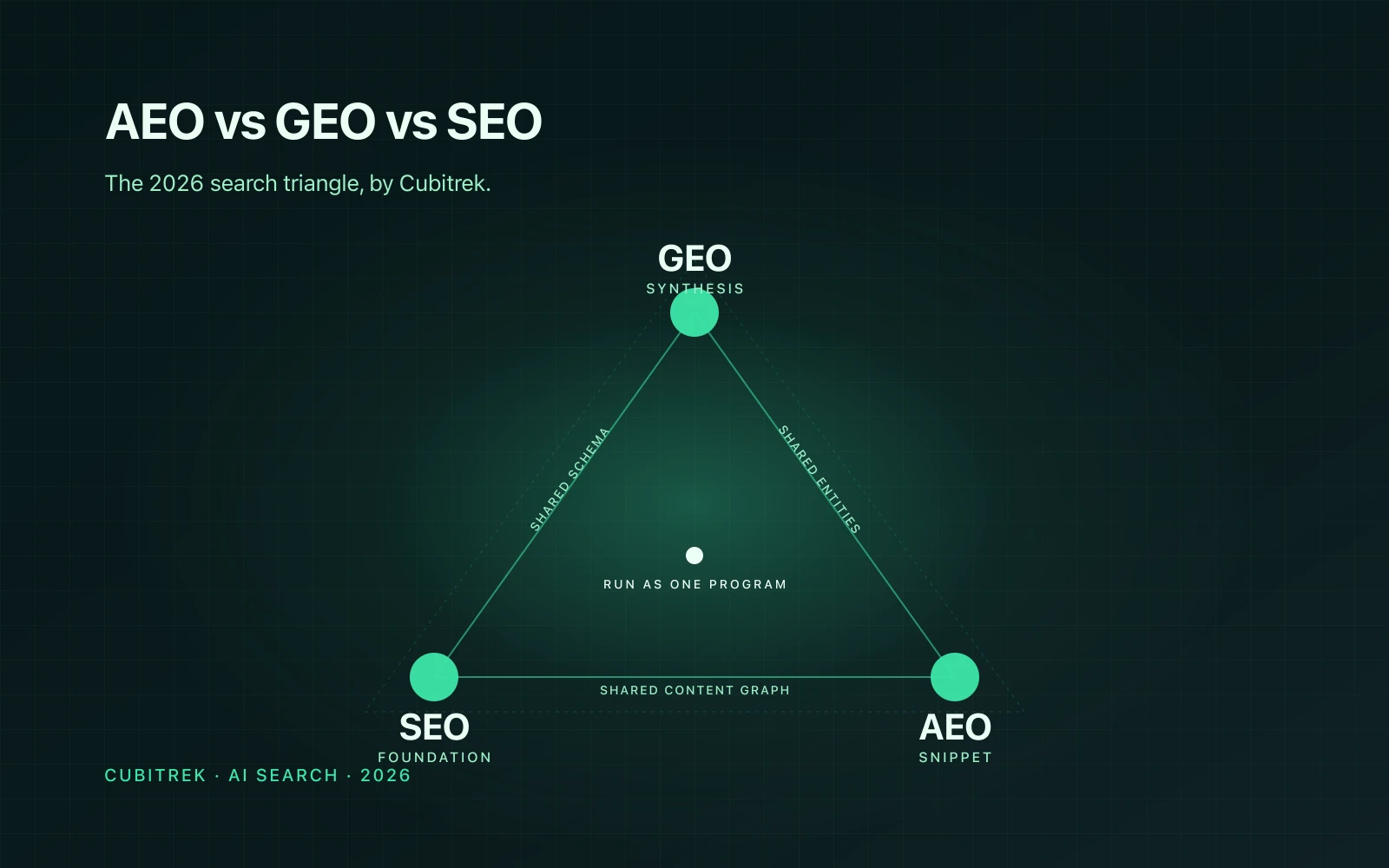
SEO, AEO, and GEO are not competitors. They are three layers of the same modern search stack. SEO gets your pages crawled and ranked. AEO gets you quoted as the snippet for short factual queries. GEO gets your facts woven into longer AI-written answers. Run them apart and you waste budget. Run them as one program and they compound.
This guide breaks down what each one does, where the work overlaps, and what you should ship first depending on where your brand is today.
The three layers of 2026 search
What is the difference between AEO, GEO, and SEO?
SEO is the foundation. It gets your pages crawled, indexed, and ranked on Google.
AEO is the snippet game. It gets your facts pulled as the direct answer to a short factual query inside ChatGPT, Perplexity, Google AI Overviews, and the rest.
GEO is the synthesis game. It gets your brand woven into longer AI-written answers where the model fuses several sources into one verdict.
The same crawl, schema, and content graph feed all three. Splitting the program across three teams or three vendors creates duplicate work, missed signals, and a slower path to citations.
AEO vs GEO: the distinction the industry has not settled
Here is the honest state of the terms. The industry often treats answer engine optimization and generative engine optimization as the same thing. Wikipedia's article on generative engine optimization lists AEO as a synonym, and notes no academic consensus distinguishes them. We think the distinction is real and operational, so here it is in one line each.
Answer engine optimization (AEO) optimizes for the quote. You win when an AI engine pulls one of your sentences verbatim as the direct answer. The unit is a passage. The test is whether the model cited your exact words.
Generative engine optimization (GEO) optimizes for the synthesis. You win when an AI engine folds your brand into a longer answer it composes from several sources. The unit is your entity. The test is whether the model included you in its verdict, even without quoting you.
The practical difference: AEO is won page by page with answer-first passages and schema. GEO is won across your whole entity footprint: consistent facts, third-party corroboration, and a Brand Hub the model trusts. Same foundation, two finish lines.
The triangle: foundation, snippet, synthesis
Picture a triangle. SEO sits at the base. AEO and GEO sit above it. The triangle is held together by three shared edges: schema, entities, and a clean content graph. The center is the canonical proof you publish about your brand, mostly inside a Brand Hub and an llms.txt file.
If you skip the foundation, AEO and GEO have nothing to retrieve. If you skip the upper layers, your traffic falls into a shrinking pool of clickers. If you skip the shared edges, every layer reinvents the same work.
SEO vs AEO vs GEO at a glance
| SEO | AEO | GEO | |
|---|---|---|---|
| Primary goal | Rank pages on Google | Be the quoted snippet | Be cited inside a synthesized AI answer |
| Typical query length | 3 to 6 words | 5 to 12 words | 15 to 30 words |
| Ranking unit | Page | Passage | Entity |
| Primary surfaces | Google, Bing | Google AI Overviews, ChatGPT, Perplexity | ChatGPT, Claude, Gemini, Perplexity, Bing Copilot |
| Core signals | Authority, internal links, technical health | Schema, 50-word answer blocks, entity clarity | Information gain, third-party mentions, RAG-friendly structure |
| Headline KPI | Organic sessions, top-10 keywords | Cited snippet rate, AI Visibility Score | Share of Model, sentiment drift |
| Time to first signal | 8 to 12 weeks | 30 days | 30 to 60 days |
SEO in 2026: still load-bearing
SEO is not dead. It is the layer the other two stand on. AI engines like Perplexity and Google AI Overviews still pull from the open web, and that web is indexed by classical search infrastructure. If your pages cannot be crawled, indexed, or rendered cleanly, you are invisible to the AI layer too.
Three SEO fundamentals matter more than ever in 2026:
- Server-side rendering. Many AI crawlers struggle with heavy client-side JavaScript. Sites that lean on it disappear from retrieval.
- Schema markup. Around 88% of sites still skip it. That is the cheapest edge in modern search. Generate paste-ready blocks with our free Schema JSON-LD builder, then read up on nested JSON-LD for GraphRAG retrieval for deeper graphs.
- Crawler budget control. Let good agents through, block training scrapers. Our robots.txt 2026 guide walks the config.
If your SEO foundation is broken, fix it first. There is no AEO or GEO win waiting on the other side of a crawl error.
AEO: when the snippet wins
Answer Engine Optimization targets the snippet. The user asks a short, factual question. The AI gives a single answer. You want your facts to be that answer.
Three habits do most of the AEO work:
- The 50-word rule. Every page or major section opens with a clean 40 to 60 word answer. LLMs find it, lift it, and quote it.
- Schema on every page. Organization, FAQ, HowTo, Service, Product, Article. Validate every page.
- A Brand Hub plus llms.txt. One canonical page plus a machine-readable index AI crawlers grab first. We built a free llms.txt generator so you can ship one in two minutes.
AEO is the right first move for brands with strong product pages and a clear category. The work is fast, the signal arrives in 30 days, and it pays back inside the same quarter.
GEO: when synthesis wins
Generative Engine Optimization targets the synthesis layer. The user asks a longer, comparative, or research-heavy question. The AI fuses three to ten sources into one answer. You want your brand to be one of those sources.
GEO leans harder on three things AEO does not:
- Information gain. Original data, proprietary research, primary case studies. The AI penalizes redundancy.
- Ambient mentions. Reddit, niche forums, trade journals, Wikipedia. The AI verifies brand truth using human-led data, links optional.
- Semantic depth. A full topic graph instead of one keyword. AI processes concepts, not strings.
GEO is the right first move for brands that already rank but are getting skipped inside longer AI answers. It is also the only layer that helps with consideration-stage queries like "best vendor for X" and "how do I choose Y."
How AEO, GEO, and SEO compound
Most brands run these as three separate budgets. That is the slow path. Run as one program, the same pieces of work create lift across all three layers.
- One schema upgrade improves Google snippets, AEO citations, and GEO entity clarity.
- One Brand Hub feeds AEO snippets and GEO synthesis, and lifts SEO authority via canonical entity signals.
- One content rewrite using the 50-word rule makes a passage citable for AEO and gives GEO a clean chunk to retrieve.
- One link or unlinked mention on a high-authority site lifts SEO domain authority and feeds GEO ambient signal.
This is why Cubitrek runs AEO, GEO, and SEO as a single AEO/GEO/SEO program. Split it and you pay three times for one outcome.
What to ship first: a decision matrix
The right first move depends on where your brand sits today. Map yourself onto one of these four states.
- Broken foundation. Pages render thin without JS. Schema is missing or wrong. Crawl errors in Search Console. Ship SEO basics first. AEO and GEO cannot help you until the AI can crawl you.
- Indexed but invisible. You rank on Google. You are missing from ChatGPT and Perplexity answers. Ship AEO first. Brand Hub,
llms.txt, schema, 50-word answer blocks across the top 20 pages. - Cited but not preferred. You appear in AI answers, but always alongside three competitors. Ship GEO. Information gain content, original data, ambient mentions, sentiment work.
- Strong everywhere except revenue. You are cited, you rank, the traffic does not convert. Ship the conversion layer. Tighter intent matching, deeper bottom-funnel pages, and a sticky AI Visibility loop that feeds gaps back into the content engine.
Most growth-stage brands are in state 2 or 3. The smart move is to run AEO and GEO as one program from day one, because the shared work is more than half of either side alone.
KPIs side by side
Old metrics like "rank one for X keyword" still matter for SEO. AEO and GEO bring new KPIs you cannot pull out of Google Search Console.
- SEO. Organic sessions, top-10 keywords, indexed pages, crawl errors, Core Web Vitals.
- AEO. Cited snippet rate, AI Visibility Score, schema coverage, llms.txt freshness.
- GEO. Share of Model, sentiment drift, information gain per page, AI bot crawl frequency in server logs.
Track all three weekly. Cubitrek's aeo.cubitrek.com platform runs daily across 100+ prompts on ChatGPT, Perplexity, Claude, Gemini, and Bing Copilot, and logs every citation, miss, and competitor quoted.
If you are comparing trackers rather than buying ours, the mechanics are the same across the category and the differences that matter are prompt capacity, engine coverage, and whether you can read the raw answers. How to choose an AEO tool works through that decision.
Common mistakes that slow the program down
A few patterns kill AEO/GEO/SEO programs before they can compound.
- Treating AEO and GEO as separate budgets. Most of the work is shared. Splitting it costs time and money.
- Optimizing only the homepage. AI engines retrieve at the page and passage level. Every top page needs the 50-word rule, schema, and clean entities.
- Blocking AI bots. Some teams default-deny GPTBot, ClaudeBot, and Perplexity. That is digital suicide. Triage instead. The robots.txt 2026 guide walks the config.
- No measurement loop. If you cannot see where you are cited, you cannot improve it. A daily listener across the engines your buyers actually use is the only honest way to track progress.
Conclusion
AEO, GEO, and SEO are one program in three layers. SEO is the foundation. AEO is the snippet. GEO is the synthesis. The shared work, schema, entities, content graph, Brand Hub, llms.txt, is more than half of any single layer alone.
Pick the layer you need first based on where your brand sits today. Run the rest in parallel. Track citations weekly. The AI starts quoting you, and the buyers who do click are pre-vetted by the model.
Are you ready to be the answer, the citation, and the page that ranks?
Frequently asked questions
1) Which one should I do first, AEO, GEO, or SEO?
If your foundation is broken, fix SEO first. AI engines cannot help you if they cannot crawl you. If you rank on Google but are missing from ChatGPT and Perplexity, ship AEO first. If you are cited in AI answers but always behind a competitor, ship GEO. Most brands run AEO and GEO as one program from day one because the shared work is more than half of either side.
2) Is AEO the same as GEO?
No, but they pair tightly. AEO is the snippet game. Be the direct, quoted answer to a short factual query. GEO is the synthesis game. Be the trusted source the AI weaves into longer answers. Most of the work is shared. Cubitrek runs them as one program for that reason.
3) Does SEO still matter in 2026?
Yes. AI engines still retrieve from the open web. If your pages do not crawl, render, or rank, the AI cannot quote you. SEO is the foundation under AEO and GEO, not a competitor.
4) How long does an AEO/GEO/SEO program take to show results?
You see first AI citations inside 30 days if you ship a Brand Hub, fix schema, and publish answer blocks. SEO ranking lift typically arrives in 8 to 12 weeks. The compounding kicks in by month three.
5) Can I run AEO without doing GEO?
Technically yes, but you will leave half the surface area on the table. Most of the work, schema, entities, content structure, Brand Hub, llms.txt, feeds both. Splitting the program means paying twice for one outcome.
6) What is the AI Visibility Score?
It is a 0 to 100 metric we built into aeo.cubitrek.com, our AEO platform, that fuses three signals into one number. AI Answer mentions. AI Output mentions. Crawler page fetches. Across ChatGPT, Perplexity, Gemini, Claude, and Bing Copilot. Recalculated daily.
7) Do I need a separate tool for each layer?
No. The Brand Hub plus llms.txt act as the canonical source AEO and GEO both pull from. The AEO platform tracks citations across the major answer engines and feeds gaps back into the content engine. Classical SEO tools cover the foundation layer. One stack, three layers.
Key takeaways
- SEO, AEO, and GEO are layers, not competitors. They share schema, entities, and a clean content graph.
- The Brand Hub plus llms.txt is the single canonical source AEO uses for snippets and GEO uses for synthesis.
- Track three KPI sets: SEO rankings, AEO citations, and GEO Share of Model. A weekly listener across the major answer engines is non-optional.
Questions people ask about this
Sourced from client conversations, Search Console, and AI-search citation monitoring.
- SEO gets your pages crawled, indexed, and ranked on Google. AEO gets your facts pulled as the direct answer to a short factual query inside ChatGPT, Perplexity, and Google AI Overviews. GEO gets your brand woven into longer AI-written answers where the model fuses several sources into one verdict. The same schema, entities, and content graph feed all three.
- If your foundation is broken (crawl errors, missing schema, JS-only rendering), fix SEO first. If you rank on Google but are missing from ChatGPT and Perplexity, ship AEO first. If you appear in AI answers but always behind a competitor, ship GEO. Most growth-stage brands run AEO and GEO as one program from day one.
- No. SEO is the foundation under AEO and GEO. AI engines still retrieve from the open web. If your pages cannot be crawled, indexed, or rendered cleanly, AEO and GEO have nothing to work with. Run all three together.
- First AI citations land within 30 days if you ship a Brand Hub, fix schema, and publish answer blocks. SEO ranking lift typically arrives in 8 to 12 weeks. The compounding kicks in by month three.
- Technically yes, but you leave half the surface area on the table. Most of the work, schema, entities, content structure, Brand Hub, and llms.txt, feeds both. Splitting the program means paying twice for one outcome.
- It is a 0 to 100 metric inside aeo.cubitrek.com that fuses AI Answer mentions, AI Output mentions, and crawler page fetches across ChatGPT, Perplexity, Gemini, Claude, and Bing Copilot. Recalculated daily.
Keep reading
Related articles.
More on the same thread, picked by tag and category, not chronology.

AEO 101: The Definitive Guide to Answer Engine Optimization in 2026
Answer engine optimization is how a brand gets cited inside ChatGPT, Perplexity, Claude, Gemini and Google AI Overviews. What AEO is, how it differs from SEO, and the playbook to run.
Faizan Ali Khan
GEO 101: A Simple Guide to Winning in the AI Search
Generative engine optimization is how brands get named inside AI-written answers. What GEO is, the five pillars of a GEO program, and where it parts company with classic SEO.
Faizan Ali Khan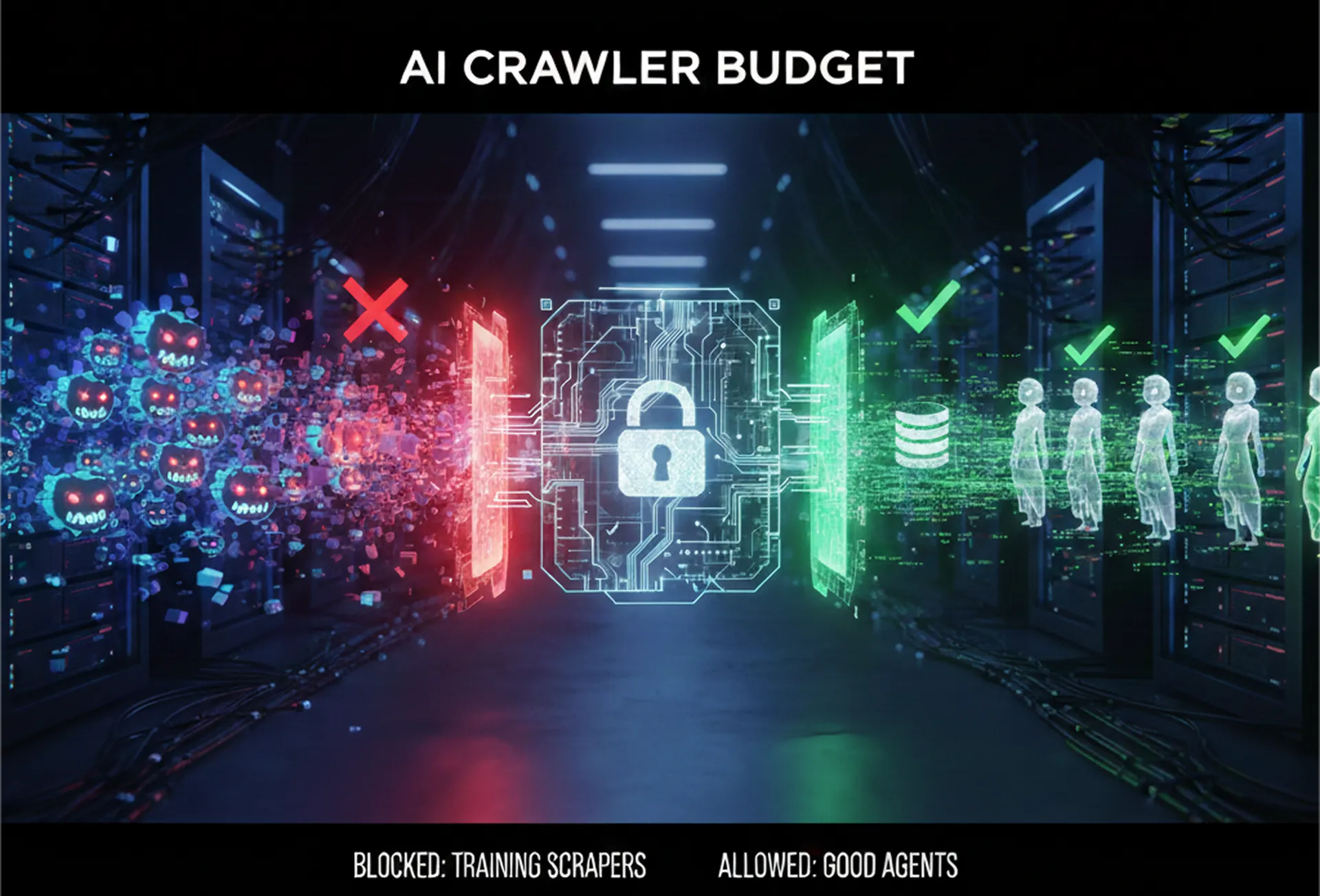
The Robots.txt of 2026: Managing AI Crawler Budgets
Robots.txt now decides which AI companies train on your pages and which cite them. Updated October 2026 with Google's AI Overviews opt-out, Cloudflare's 15 September changes and the agents that may ignore robots.txt.
Faizan Ali KhanReady when you are
Want Cubitrek to run AEO & GEO for you?
We install aeo & geo programs for growing companies across the US and Europe. Book a call and we'll come back with a one-page plan in 72 hours.