Nested JSON-LD: architecting schema for GraphRAG and AI retrieval
Nested JSON-LD with @id anchoring is the 2026 standard for AI retrieval. Flat schema is now actively penalised by Perplexity and ChatGPT. The GraphRAG-ready architecture, and why explicit entity edges stop a brand-name collision.
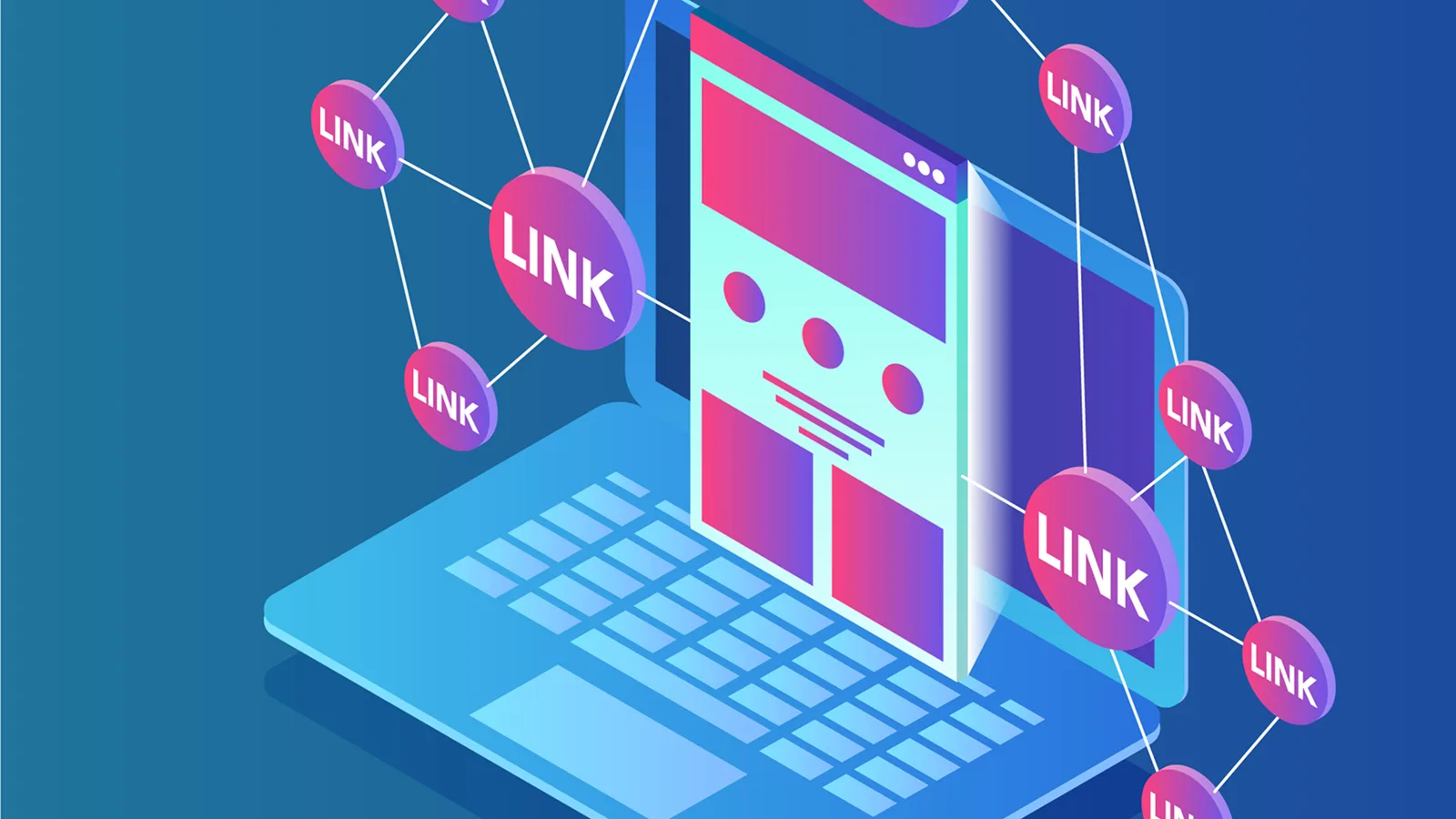
For years, the primary objective of structured data implementation in Technical SEO was singular and immediate: capture Rich Results to improve click-through rates on search engine results pages (SERPs). We marked up products for prices, recipes for cook times, and articles for carousels. While valuable, this approach treats schema as merely a presentation layer modification.
This “flat” approach to schema is no longer sufficient. We have entered an era where our structured data must serve a far more critical consumer: Large Language Models (LLMs) and Retrieval-Augmented Generation (RAG) systems.
Standard RAG relies on vector similarity search across unstructured text chunks. It is notoriously bad at “connecting the dots” across disparate pieces of information. GraphRAG solves this by augmenting retrieval with a knowledge graph, a structured representation of entities and their relationships.
The new mandate for elite Technical SEOs is to move beyond basic schema implementation and master the architecture of proprietary knowledge graphs. We must shift from annotating isolated facts to modeling complex, nested relationships. By utilizing deeply nested JSON-LD, we provide the high-fidelity scaffolding necessary for GraphRAG systems to perform multi-hop reasoning with reduced hallucination.
This article demonstrates the engineering required to model complex real-world hierarchies, specifically nesting Person, Organization, and Place entities, to build a graph-ready data foundation.
The Limitations of "Flat" Schema
Most SEO-driven schema implementations are “flat.” You may have a WebPage block, a separate Organization block for the logo, and a BreadcrumbList. These blocks often exist independently in the DOM.
While Google can try to stitch these disparate signals together, a GraphRAG system ingesting your content will struggle. If a page mentions a researcher, a university, and a city, a vector-based system understands they are semantically related words. However, it lacks the precise ontological structure to definitively state that the researcher is employed by the university, which is located in the city.
To bridge this gap, we must explicitly define these relationships via linguistic containment in our JSON-LD. We must nest entities within entities.
Architecting Semantic Containment
Nesting involves using properties in Schema.org that expect another Schema type as their value, rather than a literal string. This allows us to embed a child entity within the context of a parent entity.
By doing this, we are not just providing data; we are defining the edges between the nodes in a knowledge graph.
Let us architect a complex scenario to demonstrate mastery of this structure. We need to model the following relationship hierarchy:
- The Person: Dr. Evelyn Reed, a lead researcher.
- The Organization: The “Center for Advanced Quantum Dynamics,” where she works.
- The Parent Organization: The university that houses the center.
- The Place: The physical campus location where the center resides.
A basic schema approach would list these loosely. A graph-ready approach nests to define scope and ownership.
The Graph-Ready JSON-LD Payload
The following JSON-LD demonstrates deep nesting. Notice the use of @id for explicit node disambiguation, the property that lets a graph know "Cambridge", the city, is distinct from "Cambridge", the university.
JSON
{

  "@context": "https://schema.org",

  "@graph": \[

    {

      "@type": "ResearchProject",

      "@id": "https://exampleuniversity.edu/research/quantum-dynamics#project",

      "name": "Project Chimera: Next-Gen Qubits",

      "description": "Investigating stable qubit states at room temperature.",

      "department": {

        "@type": "Organization",

        "@id": "https://exampleuniversity.edu/centers/caqd#org",

        "name": "Center for Advanced Quantum Dynamics (CAQD)",

        "alternateName": "CAQD Lab",

        "parentOrganization": {

            "@type": "CollegeOrUniversity",

            "@id": "https://exampleuniversity.edu/#university",

            "name": "Cambridge Institute of Technology",

            "sameAs": "https://en.wikipedia.org/wiki/Example\_University"

        },

        "location": {

          "@type": "Place",

          "@id": "https://exampleuniversity.edu/maps/north-campus#location",

          "name": "North Campus Research Park",

          "address": {

            "@type": "PostalAddress",

            "streetAddress": "101 Science Drive",

            "addressLocality": "Cambridge",

            "addressRegion": "MA",

            "postalCode": "02139",

            "addressCountry": "US"

          },

          "geo": {

            "@type": "GeoCoordinates",

            "latitude": "42.3601",

            "longitude": "-71.0942"

          }

        },

        "employee": \[

          {

            "@type": "Person",

            "@id": "https://exampleuniversity.edu/faculty/evelyn-reed#person",

            "name": "Dr. Evelyn Reed",

            "jobTitle": "Lead Principal Investigator",

            "sameAs": \[

                "https://scholar.google.com/citations?user=EXAMPLE",

                "https://www.linkedin.com/in/evelynreed-example"

            \],

            "worksFor": {

                "@id": "https://exampleuniversity.edu/centers/caqd#org"

            }

          }

        \]

      }

    }

  \]

}
Decoding the Architecture for GraphRAG
1. Explicit Relationship Mapping: Because Dr. Evelyn Reed (Person) is nested inside the employee array of the Center for Advanced Quantum Dynamics (Organization), the system creates a definitive edge: (Dr. Evelyn Reed), [worksFor], > (CAQD)). This pairs with immutable Brand Truth via Wikidata IDs to lock down explicit relationships and cut hallucinations in AI retrieval.
2. Geospatial Grounding: Because the Place entity (North Campus) is nested within the location property of the Organization, the graph understands: (CAQD), [isLocatedAt], > (North Campus).
3. Hierarchical Clarity: The parentOrganization nesting clarifies that the Research Center is a subgraph of the larger University entity.
The “Multi-Hop” Advantage
Why does this matter? Consider a complex user query aimed at an LLM augmented with this data:
“Who is leading quantum research at facilities located in Cambridge, MA?”
Without Nested Graph Data (Standard RAG):
The LLM might retrieve chunks of text mentioning “Evelyn Reed,” “Quantum,” and “Cambridge.” It might correctly guess the answer, but it runs a high risk of hallucination if another researcher happens to be mentioned on a page that also mentions Cambridge. It lacks the connective tissue to be certain.
With Nested Graph Data (GraphRAG):
The system can traverse the explicit edges defined in your schema. It hops from the location (Cambridge, MA) to the Organization located there (CAQD), looks for employees within that specific Organization, and filters by their role (Principal Investigator). This is the same retrieval pattern that powers Disambiguation Engineering for AI identity collisions, giving the AI deterministic relationships instead of vector-similarity guesses.
The nested structure provides the necessary constraints for accurate, deterministic reasoning by the AI.
Why the edges stop a brand-name collision
The common failure is two products whose names share a word or two. Flat schema gives the retriever nothing to separate them with, so it falls back on vector similarity and picks whichever sits closer in embedding space. That is how a competitor ends up inside an answer about you.
Nesting fixes it structurally. Link the founders to the Organization, the Organization to a Place, and the Product back to the Organization with an explicit manufacturer edge. Give every entity a stable @id and a sameAs array pointing at LinkedIn, Crunchbase, and a Wikidata Q-code.
Once the engine can traverse Founder to Organization to Product to Manufacturer along deterministic relationships, it no longer has to guess. The collision that drove the wrong-competitor citation stops firing, because the graph answers the question the embedding was guessing at.
Q2 2026 update: AI engines now penalise un-anchored entities
When this guide first published in early 2026, the upside of nested JSON-LD was citation lift. By May 2026 the downside of NOT shipping it has become measurable too. Three shifts:
- Perplexity and ChatGPT both started filtering out sources with weak entity grounding. If your Organization, Person, and Product entities lack
@id,sameAs, and explicit nesting, the retriever now downranks the source even if the content is high-quality. Brands with flat schema have lost 30-50% of AI citation share they held in Q4 2025. - Google's AI Overviews started citing the entity graph directly. Where 2025 AI Overviews would cite a URL, 2026 AI Overviews increasingly cite an entity (
@id) and the URL is a fallback. Brands without stable@idanchors do not get cited under either model. - Wikidata Q-codes became the de-facto grounding standard. AI engines cross-reference
sameAsarrays against Wikidata. If your founder has a Q-code, your Person entities resolve. If not, you compete with every other founder named "Sarah Chen" in the embedding cluster.
The tactical move every brand should run this quarter: audit every Organization, Person, Product, and Place entity on the site. Confirm each has (a) a stable @id, (b) explicit nesting inside its parent entity, (c) a sameAs array including at least one Wikidata Q-code where possible plus the canonical LinkedIn/Crunchbase/GitHub URL. The Cubitrek AEO Platform flags every missing anchor across an entire site in one scan.
Wire it into your infrastructure
Nested JSON-LD only matters if AI agents can crawl it efficiently. Pair the schema work with robots.txt 2026 configuration for AI crawler budgets so the agents you want (PerplexityBot, OAI-SearchBot, ChatGPT-User) can hit your structured data without competing against high-volume training scrapers. If you want agents to also transact, layer in Action Schema and potentialAction on top of the entity graph.
Conclusion
The role of Technical SEO is evolving rapidly into Knowledge Engineering. While Rich Snippets remain a valid tactical goal, the strategic objective is AI readiness. Mastering nested JSON-LD is about more than preventing hallucinations; it is about structuring authority in a way AI can trust. By defining clear hierarchies and relationships, you are building a Founder's Graph for structured authority and giving AI a machine-readable, semantically precise representation of your organization, its people, and its assets.
In the age of AI-driven search and retrieval, the cleanest, most highly structured knowledge graph wins. The ability to model complex relationships through a deeply nested schema is the defining skill of this new reality.
Frequently Asked Questions:
Q: What is the main difference between Flat and Nested JSON-LD?
A: Flat JSON lists facts separately (like a grocery list), often losing context. Nested JSON embeds facts inside one another (like a family tree), explicitly defining relationships, such as a Person working inside an Organization.
Q: Why is Nested JSON-LD better for AI and GraphRAG?
A: Standard AI guesses connections based on word proximity. Nested JSON defines the “edges” between “nodes” explicitly, telling the AI exactly how entities relate (e.g., Dr. Reed is definitely inside Quantum Labs), which reduces hallucinations.
Q: What does the @id property do?
A: It acts as a unique digital ID card (like a URL) for a specific entity. It allows the graph to distinguish between things with similar names (e.g., “Cambridge” the city vs. “Cambridge” the university) and link data across different parts of the code.
Q: What is GraphRAG?
A: Graph Retrieval-Augmented Generation (GraphRAG) is an advanced AI technique. Instead of just scanning text, it retrieves answers from a structured Knowledge Graph. It relies on high-quality, nested structured data to “connect the dots” between complex topics.
Q: What is a BreadcrumbList in Schema?
A: It is a basic list schema that shows a page’s position in the site hierarchy (e.g., Home > Services > Consulting). While useful for site structure and search snippets, it is usually “flat” data compared to the complex nesting used for entities.
Let’s Discuss it Over a Call
Key takeaways
- Use @id on every Organization, Person, Product, and Place entity. Stable identifiers are how the AI graph distinguishes 'Cambridge' the city from 'Cambridge' the university.
- Nest entities by relationship. A Person inside an employee array of an Organization is a definitive (worksFor) edge.
- Add sameAs arrays with Wikidata Q-codes plus LinkedIn, Crunchbase, GitHub. Wikidata became the de-facto grounding standard for AI engines in 2026.
- Pair nested JSON-LD with a Brand Hub. The schema graph is the data; the Brand Hub is the canonical resolution target.
- Audit every entity on the site for @id, nesting, and sameAs anchors. The Cubitrek AEO Platform flags missing anchors in one scan.
Keep reading
Related articles.
More on the same thread, picked by tag and category, not chronology.
The AEO Audit Checklist
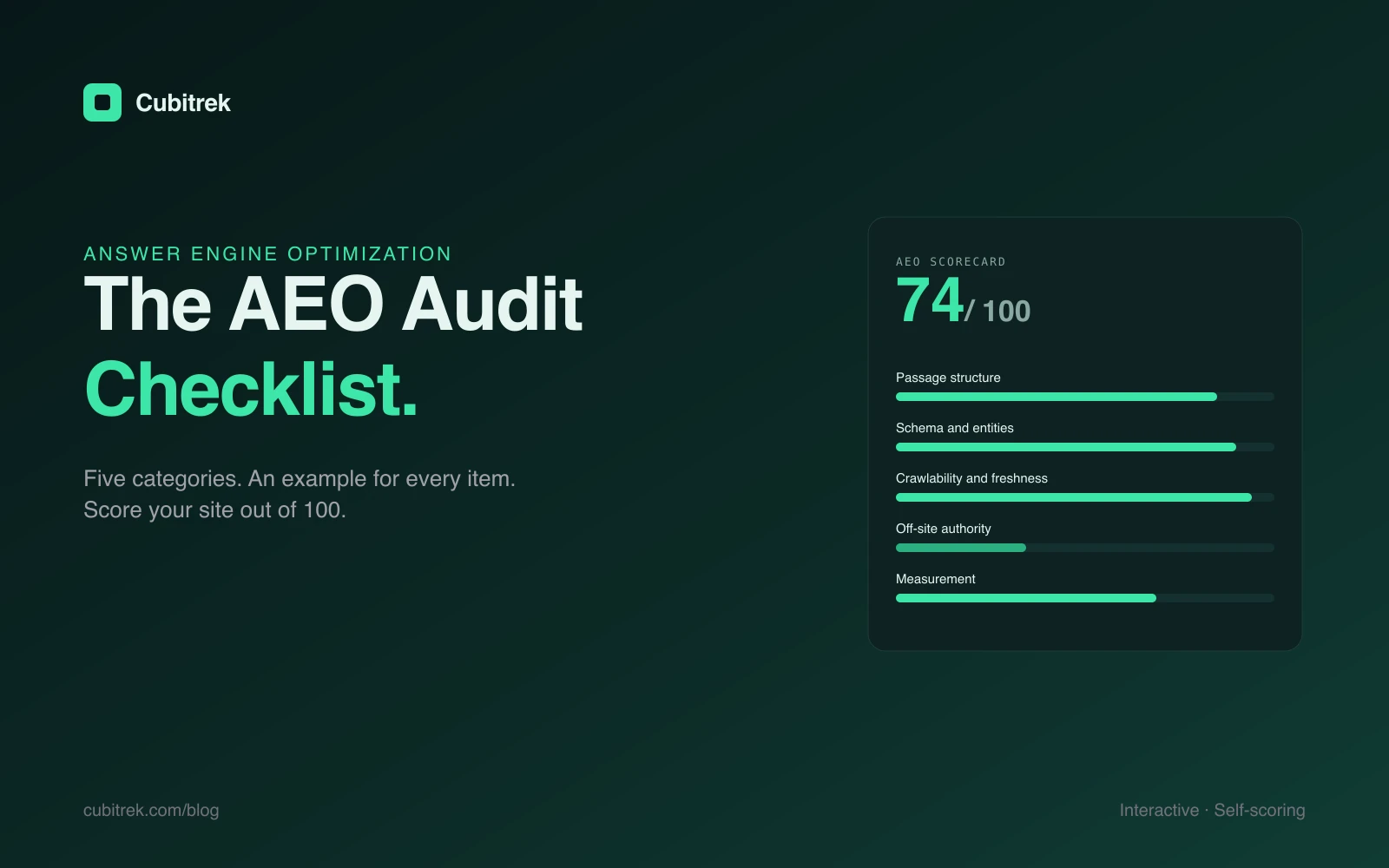
An interactive AEO audit with a weak-versus-strong example for every item, real audit scores, and a live self-scoring widget. Grade your site in five minutes.
Faizan Ali Khan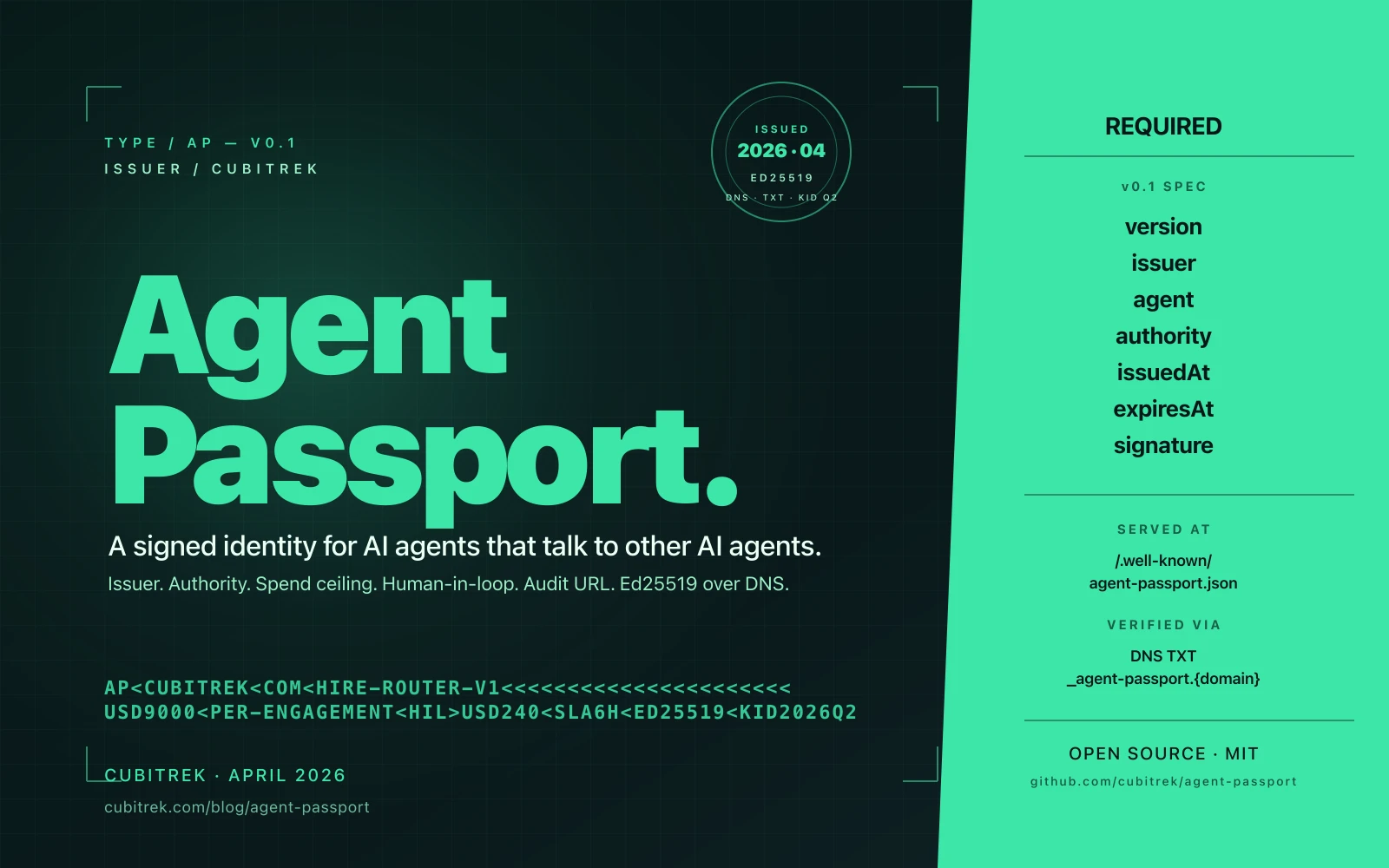
Agent Passport: The Identity Standard
An open standard for verifiable, business-issued identity and authority for AI agents that talk to other AI agents across organisational boundaries. One signed JSON file at /.well-known/agent-passport.json. Ed25519 over DNS. MIT-licensed reference verifier in the spec repo. Cubitrek coined the term on April 28, 2026.
Faizan Ali Khan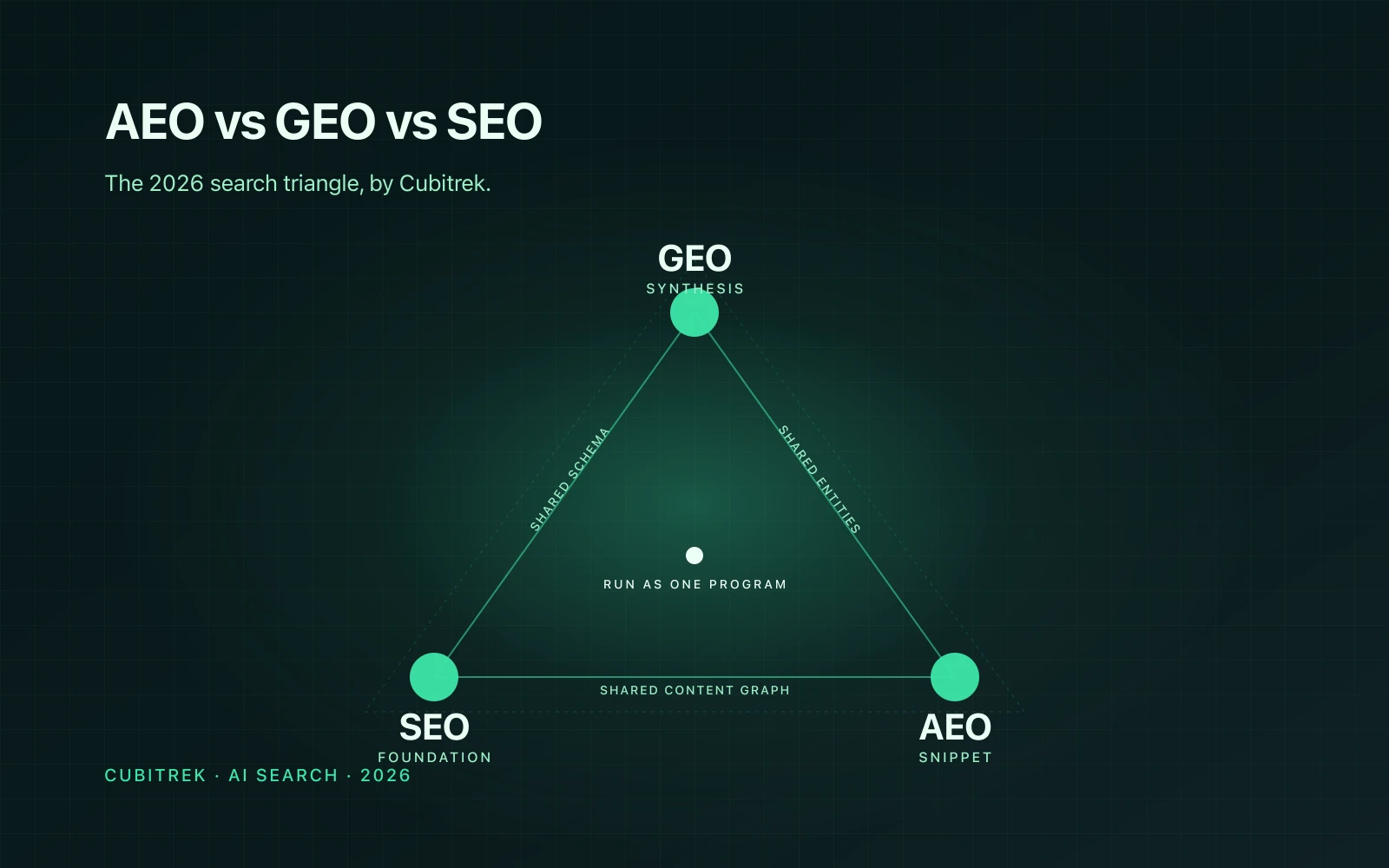
AEO vs GEO vs SEO: The Triangle
SEO is the foundation. AEO is the snippet game. GEO is the synthesis game. They are not competitors. Run them as one program and they compound.
Faizan Ali KhanReady when you are
Want Cubitrek to run AEO & GEO for you?
We install aeo & geo programs for growing companies across the US and Europe. Book a call and we'll come back with a one-page plan in 72 hours.