

What Are AI Agents? A Business Leader's Guide for 2026
AI agents are autonomous software systems that perceive, reason, and act to complete business tasks. Learn what they are, how they work, and why they matter in 2026.


An AI agent is software that takes actions on its own. It reads tickets, qualifies leads, and runs workflows without you babysitting it.
This guide explains what agents are, how they work, and where to deploy them first. Skip to any section using the table of contents.
How AI agents work
Every agent runs the same three-phase loop.
- Perception. The agent reads inputs from its environment. Email, databases, APIs, documents, sensor feeds, user messages.
- Reasoning. An LLM interprets the input. It breaks the goal into sub-tasks, weighs options, and picks a plan.
- Action. The agent calls tools, writes data, sends messages, or triggers workflows in real systems.
The loop is what separates agents from chatbots. A chatbot answers one question and stops. An agent pursues a goal across many steps. It remembers prior context. It changes tactics when something fails.
Picture the difference between a Google search and a research analyst. The search returns links. The analyst reads dozens of sources, synthesizes findings, and delivers a report. Agents are the analyst.
Key components of an AI agent
Five pieces have to work together for an agent to function reliably.
- Language model. The brain. Claude, GPT-4, Gemini, or open-source like Llama. Model choice drives quality, cost, and speed.
- Tools and integrations. APIs, databases, browsers, code interpreters, internal systems. An agent's usefulness scales with what it can call.
- Memory. Short-term (conversation context) and long-term (vector databases, knowledge bases). Memory lets agents stay coherent across sessions.
- Orchestration framework. The control layer that runs the loop. LangChain, CrewAI, OpenClaw, AutoGen all play this role.
- Guardrails. Output validation, human approvals, budget caps, scope limits. These keep the agent from going off-script.
Types of AI agents in business
| Agent Type | Description | Business Example |
|---|---|---|
| Reactive Agents | Respond to triggers without planning | Auto-reply chatbots, alert monitors |
| Goal-Based Agents | Pursue defined objectives with planning | Sales qualification agents, research assistants |
| Utility-Based Agents | Optimize for measurable outcomes | Pricing optimization, ad bidding agents |
| Learning Agents | Improve performance from experience | Recommendation engines, fraud detectors |
| Multi-Agent Systems | Teams of specialized agents collaborating | End-to-end order processing, DevOps pipelines |
Why agents matter for business now
Three forces are converging at the same time.
- Models can finally do real work. Reasoning quality is high enough for multi-step tasks, not just Q&A.
- Integration is solved. APIs, webhooks, and the MCP protocol let agents reach across stacks without custom glue per system.
- Knowledge work is expensive. Talent is scarce. Salaries keep climbing. Automation is no longer optional for growing companies.
McKinsey estimates agents could automate 60 to 70% of knowledge work by 2030. That maps to $6.1 trillion in annual value. Early adopters report 40 to 60% cost reductions in customer service. They see 3x faster document processing and 25 to 35% better sales conversion.
The agent economy is forming now
Big platforms have placed bets.
- Salesforce launched Agentforce.
- Microsoft shipped Copilot agents across its suite.
- Google released Vertex AI Agent Builder.
- Open-source platforms like OpenClaw and LangChain hit critical mass.
If you build agent capability now, you compound an advantage that late movers cannot replicate cheaply.
AI agent use cases across the enterprise
What Are AI Agents · by the numbers
Customer service and support
Agents handle L1 and L2 tickets end to end. They read customer history, diagnose the issue, run the resolution (refund, account change, escalation), and follow up. Klarna's agent handles two-thirds of all chats. They replaced 700 FTEs and improved CSAT.
Sales and revenue operations
Agents qualify inbound leads. They research the prospect's company, score fit, write personalized outreach, and book meetings. They also watch the pipeline. They flag stalled deals and draft follow-up sequences without prompting.
Finance and accounting
Invoice processing. Expense categorization. Month-end close. Audit prep. Agents reconcile accounts, flag anomalies, and prepare journal entries with supporting docs. Cycle times drop from days to hours.
HR and talent operations
Agents screen resumes, schedule interviews, answer policy questions, process onboarding, and manage benefits enrollment. HR scales without new headcount.
Marketing and content
Content production, SEO work, campaign management, social scheduling, performance analytics. Agents handle the repetitive 60 to 70% that eats marketing team bandwidth.
How to evaluate AI agent readiness
Before you deploy, assess four dimensions.
- Process documentation. Are workflows clearly written down? Agents need explicit steps to operate reliably.
- Data infrastructure. Can the agent reach the data it needs through APIs or structured databases?
- Integration capacity. Does your stack expose APIs, or do you need middleware first?
- Governance. Do you have approvals, audit trails, and oversight for autonomous decisions?
Start with high-volume, low-risk processes. FAQ handling, data entry, scheduling, and report generation are the easiest first wins. Build the muscle. Then attack the higher-stakes stuff like procurement and compliance.
The AI agent tech stack
| Layer | Options | Selection Criteria |
|---|---|---|
| LLM Provider | Anthropic Claude, OpenAI, Google Gemini, Meta Llama | Reasoning quality, cost, latency, data privacy |
| Agent Framework | OpenClaw, LangChain, CrewAI, AutoGen | Flexibility, skill ecosystem, learning curve |
| Integration Layer | MCP Protocol, Zapier, custom APIs | System compatibility, maintenance burden |
| Memory / Knowledge | Vector DBs (Pinecone, Weaviate), RAG pipelines | Data volume, retrieval accuracy, cost |
| Observability | LangSmith, Arize, custom logging | Debugging needs, compliance |
| Guardrails | Anthropic guardrails, Guardrails AI, custom rules | Risk tolerance, regulatory environment |
Common mistakes business leaders make
Most failed agent projects share the same root causes.
- Automating everything at once. Pick one process. Prove ROI. Expand from there.
- Skipping the human in the loop. Even strong agents need oversight on edge cases and high-stakes calls.
- Underestimating data quality. Agents are only as good as the data they can reach. Fix the CRM, KB, and process docs first.
- Picking tools before defining problems. Define the work first. Pick the framework second.
Continue reading in this cluster
Key takeaways
- How AI Agents Work: The Perception-Reasoning-Action Loop
- Key Components of an AI Agent
- Types of AI Agents in Business
- Why AI Agents Matter for Business in 2026
- The Agent Economy Is Forming Now
- AI Agent Use Cases Across the Enterprise
Questions people ask about this
Sourced from client conversations, Search Console, and AI-search citation monitoring.
- Costs vary with scope and there is no standard price list. As planning shape rather than a quote: a single-agent deployment on an open platform is a small project, while an enterprise multi-agent system with custom integrations is a substantially larger one. Ongoing cost is LLM API usage, infrastructure and maintenance, and usage is the line that moves most. Scope a pilot, measure its real token and infrastructure spend for a month, and price the rollout from that rather than from any published range.
- Yes, when properly implemented with guardrails. Best practices include: human-in-the-loop for high-stakes decisions, output validation before actions execute, scope constraints that limit what the agent can access, full audit logging, and regular performance reviews. Enterprise-grade platforms include these safety mechanisms by default.
- A basic AI agent for a single use case (e.g., customer FAQ handling) can be deployed in 2-4 weeks. Complex multi-agent systems with enterprise integrations typically take 2-4 months. Ongoing optimization is continuous, expect 3-6 months to reach peak performance.
- AI agents augment human capacity rather than replacing roles wholesale. They handle repetitive, time-consuming tasks while humans focus on judgment, creativity, and relationship management. The most successful deployments create hybrid teams where agents handle 60-80% of task volume and humans handle the exceptions and strategic work.
Keep reading
Related articles.
More on the same thread, picked by tag and category, not chronology.
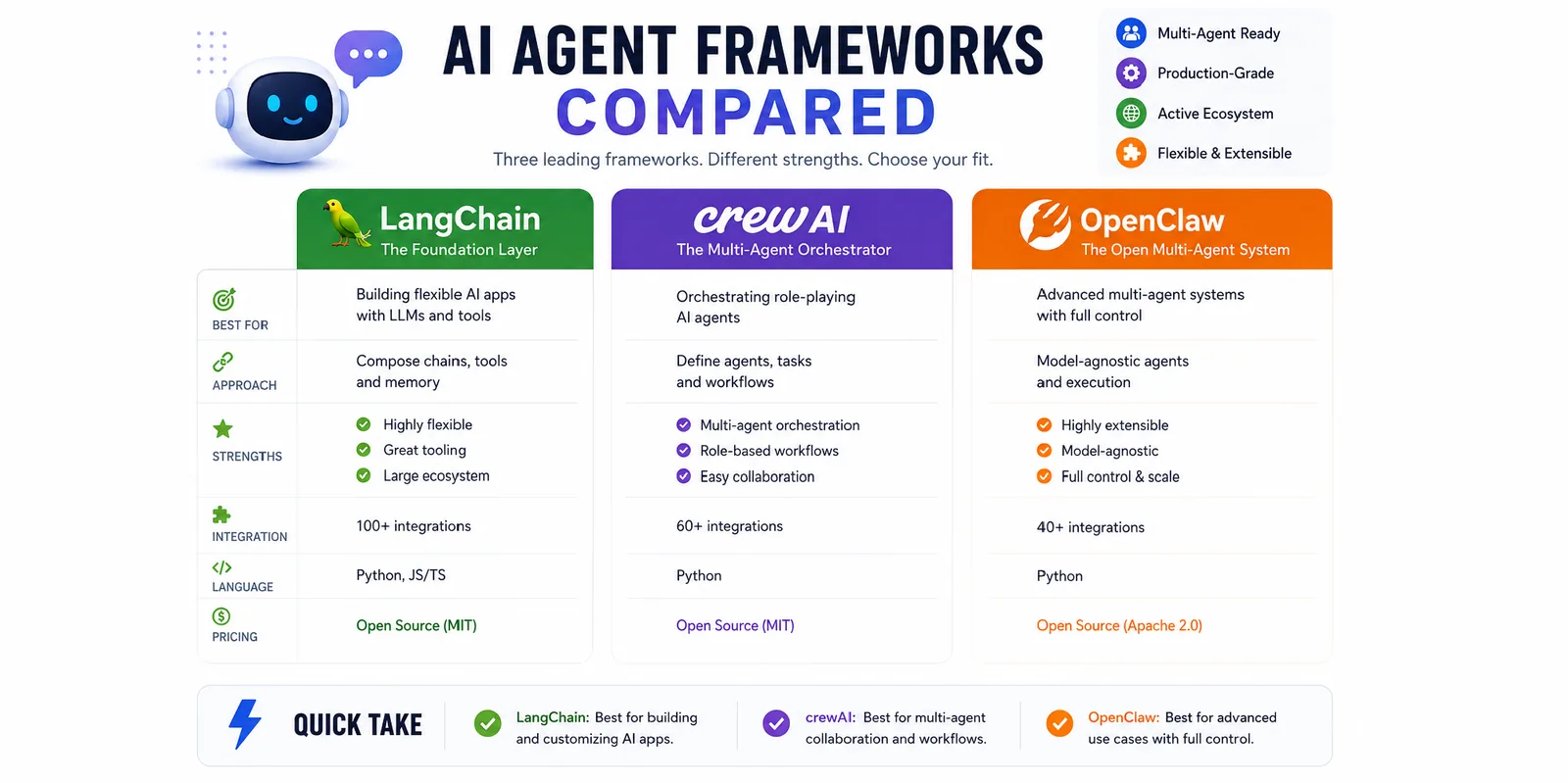
AI Agent Frameworks Compared: LangChain vs CrewAI vs OpenClaw
Detailed comparison of LangChain, CrewAI, and OpenClaw agent frameworks. Features, pricing, operating effort, and use case fit for enterprise AI agent development.
Faizan Ali Khan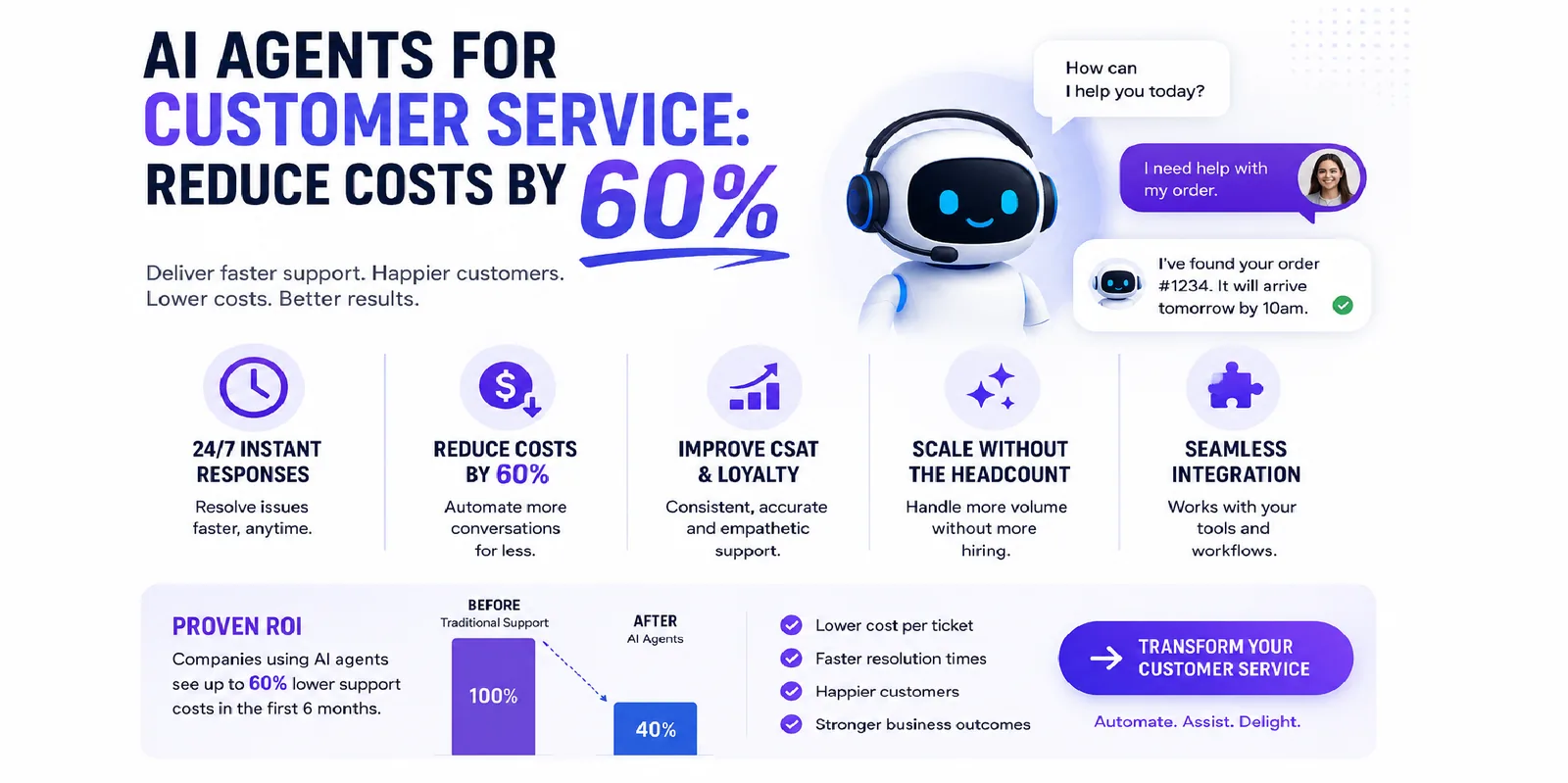
AI Agents for Customer Service: Reduce Costs by 60%
AI agents for customer service resolve 70%+ of tickets autonomously, cutting costs by 60%. Learn implementation strategies, real results, and best practices.
Faizan Ali Khan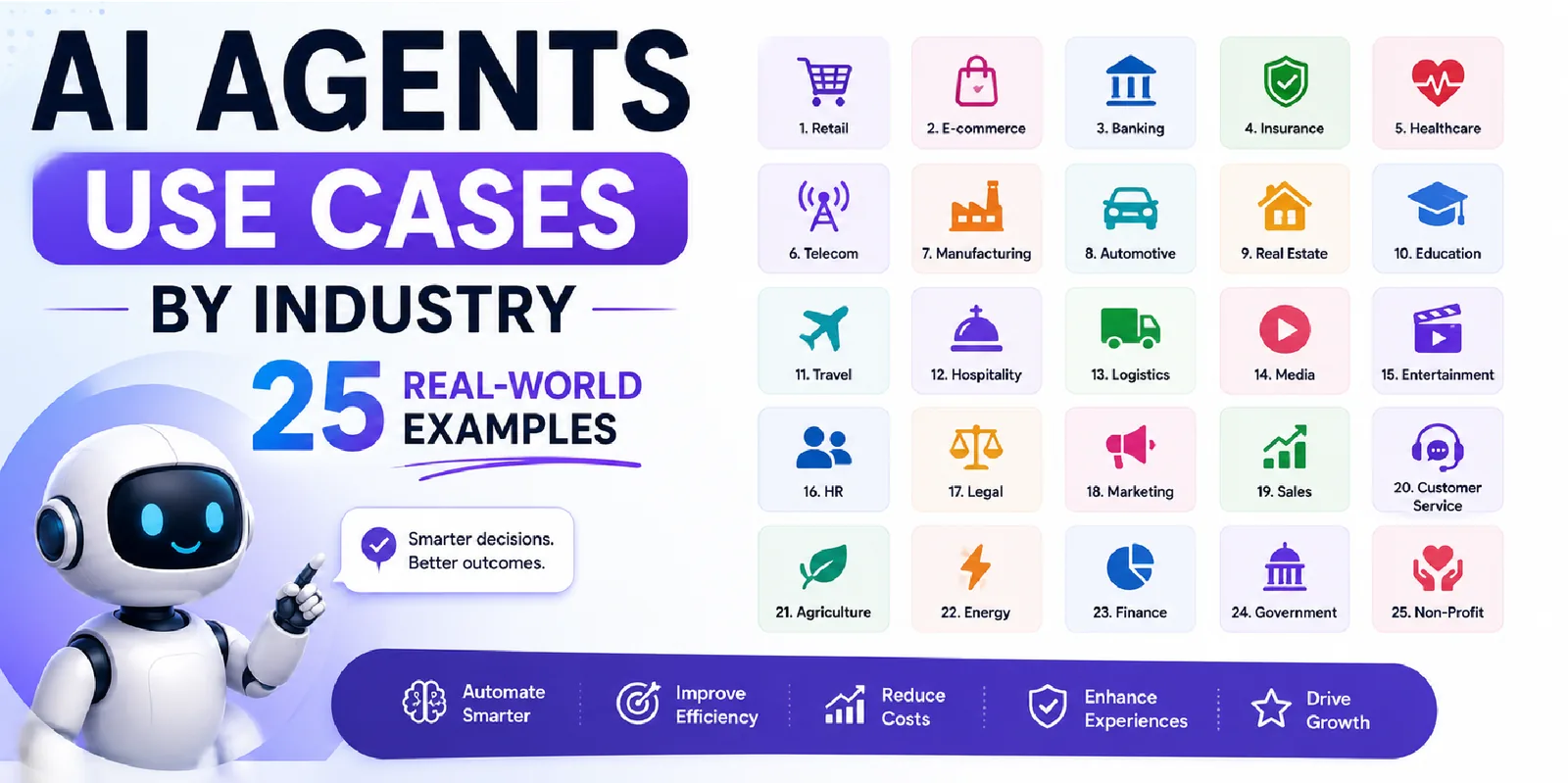
AI Agents Use Cases by Industry: 25 Real-World Examples
25 real-world AI agent use cases across healthcare, finance, retail, manufacturing, and more. See how industries deploy autonomous AI agents in 2026.
Faizan Ali KhanReady when you are
Want Cubitrek to run AI Agents for you?
We install ai agents programs for growing companies across the US and Europe. Book a call and we'll come back with a one-page plan in 72 hours.