
AI Agent Frameworks Compared: LangChain vs CrewAI vs OpenClaw
Detailed comparison of LangChain, CrewAI, and OpenClaw agent frameworks. Features, pricing, operating effort, and use case fit for enterprise AI agent development.

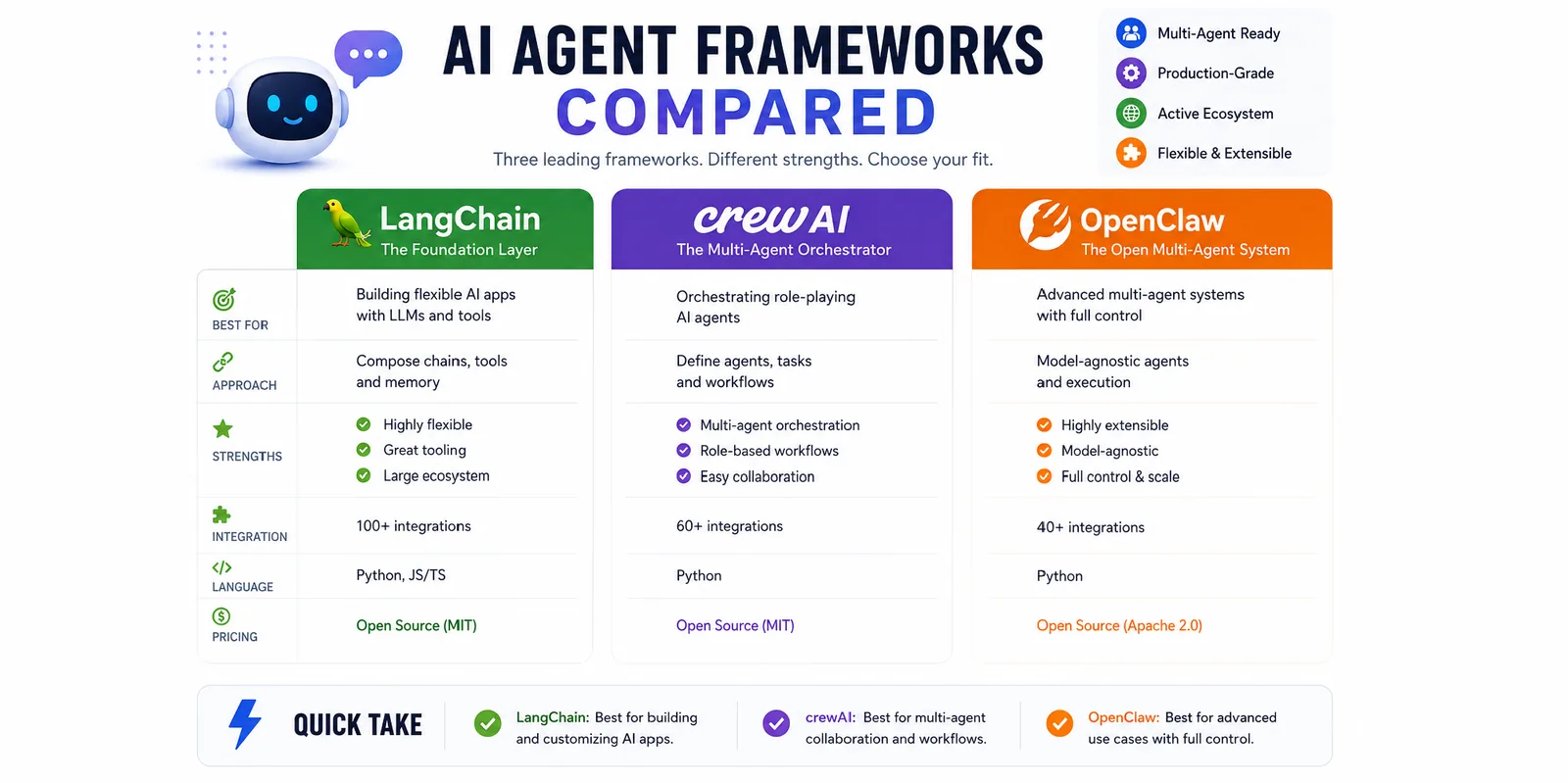
An AI agent framework decides three things. How fast you build. How reliably your agents run. How easily you scale. Pick wrong and you rewrite the architecture 6 to 12 months in.
Three of the most-starred options in 2026 are LangChain (with LangGraph), CrewAI, and OpenClaw. If you are tied to one vendor, also look at Microsoft Agent Framework, which replaced AutoGen, and the OpenAI Agents SDK. Each fits a different team and goal.
This comparison covers eight dimensions that matter in production. Architecture, ease of use, tools, multi-agent support, enterprise readiness, community, pricing, and ideal use cases.
Where the three frameworks differ
Architecture Overview
LangChain / LangGraph
LangChain is a modular framework (LangChain docs). It gives you LLM wrappers, prompt templates, memory modules, tool interfaces, and output parsers. Developers compose them into custom agent pipelines.
LangGraph adds a stateful, graph-based orchestration engine. Workflows are directed graphs. Nodes are actions. Edges are transitions. You get maximum control over flow, branching, and state.
CrewAI
For a broader introduction, read our AI agents business guide.
CrewAI is role-based (CrewAI docs). You define agents with roles, goals, and backstories. Then you organize them into crews that run a sequential or hierarchical process, and use Flows for event-driven steps with typed, persisted state. The orchestration sits behind a simple API. You define the work. CrewAI handles delegation and communication.
OpenClaw
OpenClaw is a self-hosted gateway that connects chat apps such as WhatsApp, Telegram, and Slack to AI agents. It ships with Lobster, a typed workflow runtime with approval gates, a browser-based Control UI, and ClawHub, a public registry of community skills and plugins. It has no visual workflow builder and no official hosted tier.
The architecture splits agent logic from infrastructure. Teams ship without deep platform engineering. Custom code is still there for harder cases.
Sources
Every capability claim above is checked against the vendor's own documentation rather than a third-party roundup. Read on 8 October 2026.
| Framework | Primary source |
|---|---|
| LangChain | python.langchain.com and js.langchain.com |
| LangGraph | langchain-ai.github.io/langgraph |
| CrewAI | docs.crewai.com, Flows |
| OpenClaw | docs.openclaw.ai and the source repository |
These frameworks ship fast. If you are reading this months later, check the current docs before you commit to an architecture: the comparison below was true on the date above and the vendors are the only authority on what is true now.
Feature-by-Feature Comparison
| Feature | LangChain/LangGraph | CrewAI | OpenClaw |
|---|---|---|---|
| Primary Language | Python, JS/TS | Python | TypeScript (Node.js); skills in Markdown |
| Architecture Style | Graph-based, modular | Role-based crews | Chat gateway + Lobster workflows |
| Learning Curve | Steep | Moderate | Low to Moderate |
| Visual Builder | No-code agents in LangSmith Fleet | Visual editor in CrewAI AMP | No |
| Pre-built Components | Moderate (integrations) | Limited | Community skills and plugins on ClawHub |
| Multi-Agent Support | Excellent (LangGraph) | Excellent (native) | Isolated agents per gateway |
| State Management | Advanced (checkpoints) | Persisted state in Flows | Per-agent session history |
| MCP Support | Yes | Yes | Yes (native) |
| Self-Hosting | Yes (you manage) | Yes (you manage) | Yes (turnkey) |
| Enterprise SSO/RBAC | LangSmith Enterprise | CrewAI AMP Enterprise | OpenClaw Enterprise (OIDC sign-in, IAM) |
| Observability | LangSmith (free tier, then paid) | Tracing and OpenTelemetry in CrewAI AMP | Control UI activity and usage views |
| GitHub stars (read 2 Oct 2026) | 147K+ | 59K+ | 391K+ |
| Pricing | Open source + LangSmith | Open source + CrewAI AMP | Open source (MIT); no official hosted tier |
Which framework should you choose?
When to choose LangChain or LangGraph
Pick LangChain when you have strong Python engineers and need maximum flexibility. LangGraph fits workflows with complex branching, conditional execution, retry loops, and fine-grained state.
Ideal use cases:
- Custom research agents with complex retrieval pipelines.
- Agents that need precise control over tool selection and order.
- Teams building proprietary architectures.
- Niche APIs without pre-built connectors.
Limitations. The learning curve adds time to production. LangChain and LangGraph 1.0 (October 2025) promise no breaking changes until 2.0. LangSmith is free for one developer up to 5,000 traces a month, then paid. You own all the infrastructure, scaling, and reliability work.
When to choose CrewAI
Pick CrewAI when the work splits into clear roles. Content production. Analysis. Process automation. The role-based abstraction is intuitive to design and easy to explain to stakeholders.
Ideal use cases:
- Content pipelines (researcher, writer, editor).
- Research and analysis teams (collector, analyst, reporter).
- Customer service escalation chains.
- Any workflow you would staff with different humans.
Limitations. Less flexible than LangGraph for complex, non-linear flows. Crews keep simple state; for branching and persisted state you move to Flows, a second abstraction to learn. The pre-built tool ecosystem is smaller than LangChain or OpenClaw.
When to choose OpenClaw
Pick OpenClaw when you want a self-hosted assistant that people reach through the chat apps they already use, backed by a large skill ecosystem. You run, update, and secure the gateway yourself: the project had published 722 GitHub security advisories, 14 rated critical, by 2 October 2026.
Ideal use cases:
- Enterprise automation across IT, HR, finance, and sales.
- Teams that want agents inside WhatsApp, Telegram, Slack, or Discord.
- Self-hosted agents for compliance reasons.
- Fast prototyping that scales without re-architecture.
- Cases where ClawHub already has the skills you need.
Limitations. The platform approach gives less low-level control than LangGraph. Highly novel architectures may need custom extensions. Skill marketplace quality varies. Always test third-party skills before production.
How much work do they cost you?
We are not publishing latency benchmarks. Response time on an agent is dominated by the model provider and the task, not the framework wrapped around it, so a table of numbers to two decimal places would tell you about our test conditions rather than about your build. Run your own against your own prompts.
What does differ structurally is how much platform work each one leaves you holding:
| Effort | LangChain/LangGraph | CrewAI | OpenClaw |
|---|---|---|---|
| Infrastructure setup | Self-host, or LangSmith Deployment | Self-host, or CrewAI AMP | Self-host only |
| Observability | LangSmith, free tier then paid | CrewAI AMP tracing | Control UI |
| SSO and RBAC | LangSmith Enterprise | CrewAI AMP Enterprise | OpenClaw Enterprise |
| Ongoing maintenance | Yours, unless managed | Yours, unless managed | Yours |
The trade is control against convenience. LangChain and CrewAI are libraries with optional managed platforms. OpenClaw is an assistant you host, update, and secure yourself. CrewAI is still the easiest to explain to a stakeholder.
The Hybrid Approach
Many teams in 2026 run a hybrid stack. A platform handles the bulk of standard enterprise automation where a pre-built skill already exists, and a code-first framework handles the cases that need a custom architecture. CrewAI shows up for content or research pipelines inside the larger system. The ratio depends entirely on how unusual your work is, so anyone quoting you a percentage is guessing.
The right choice depends on your use case, team, and timeline. Not framework popularity. A well-built agent on the "wrong" framework beats a sloppy agent on the "right" one every time.
Keep exploring
Key takeaways
- LangChain and LangGraph give the most control, and 1.0 promises no breaking changes until 2.0.
- CrewAI fits work that splits into roles, and Flows add persisted state.
- OpenClaw is a self-hosted assistant for chat apps, with no visual builder and no official hosted tier.
- SSO and RBAC come from each project's enterprise layer: LangSmith Enterprise, CrewAI AMP Enterprise, and OpenClaw Enterprise.
Questions people ask about this
Sourced from client conversations, Search Console, and AI-search citation monitoring.
- OpenClaw is the quickest to try if you want an assistant inside a chat app: an install script sets it up and ClawHub has ready-made skills, but it has no visual builder. For developers new to agent development, CrewAI offers the simplest code-based API. LangChain/LangGraph has the steepest learning curve but the most educational value for understanding agent architecture deeply.
- Yes. All three support major LLM providers including Anthropic (Claude), OpenAI (GPT), Google (Gemini), and popular open-source models. LangChain has the broadest LLM integration library. OpenClaw and CrewAI support the major providers natively and allow custom integrations for others.
- All three frameworks are open-source, which minimizes vendor lock-in at the framework level. The lock-in risk comes from the managed add-ons: LangSmith for LangChain and CrewAI AMP for CrewAI. OpenClaw has no official hosted tier, and OpenClaw Enterprise is open source. For maximum flexibility, self-host and use the open-source versions with your own observability stack.
Keep reading
Related articles.
More on the same thread, picked by tag and category, not chronology.
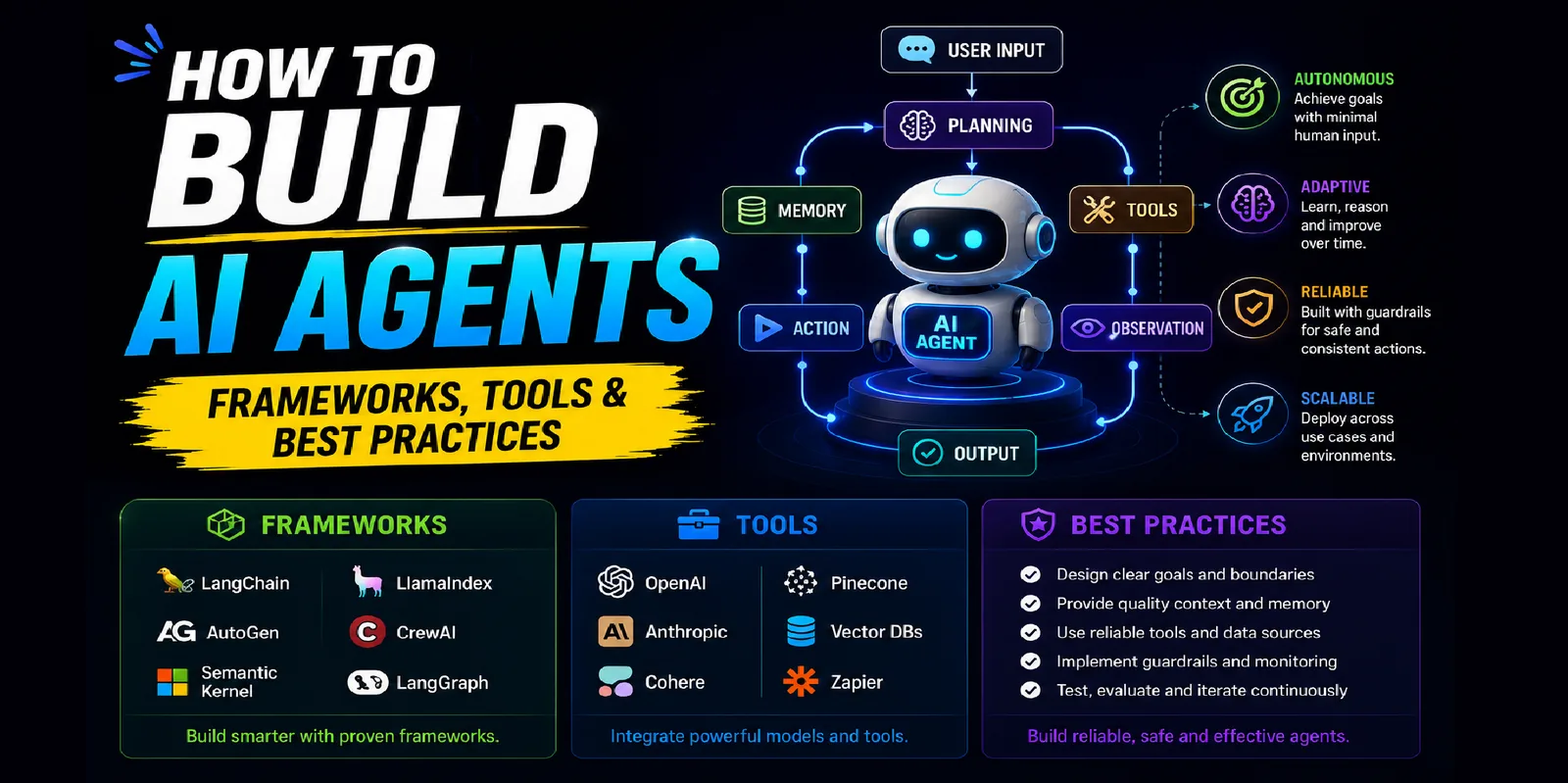
How to Build AI Agents: Frameworks, Tools & Best Practices
Step-by-step guide to building production AI agents. Compare frameworks, select tools, and follow best practices for reliable agent development in 2026.
Faizan Ali Khan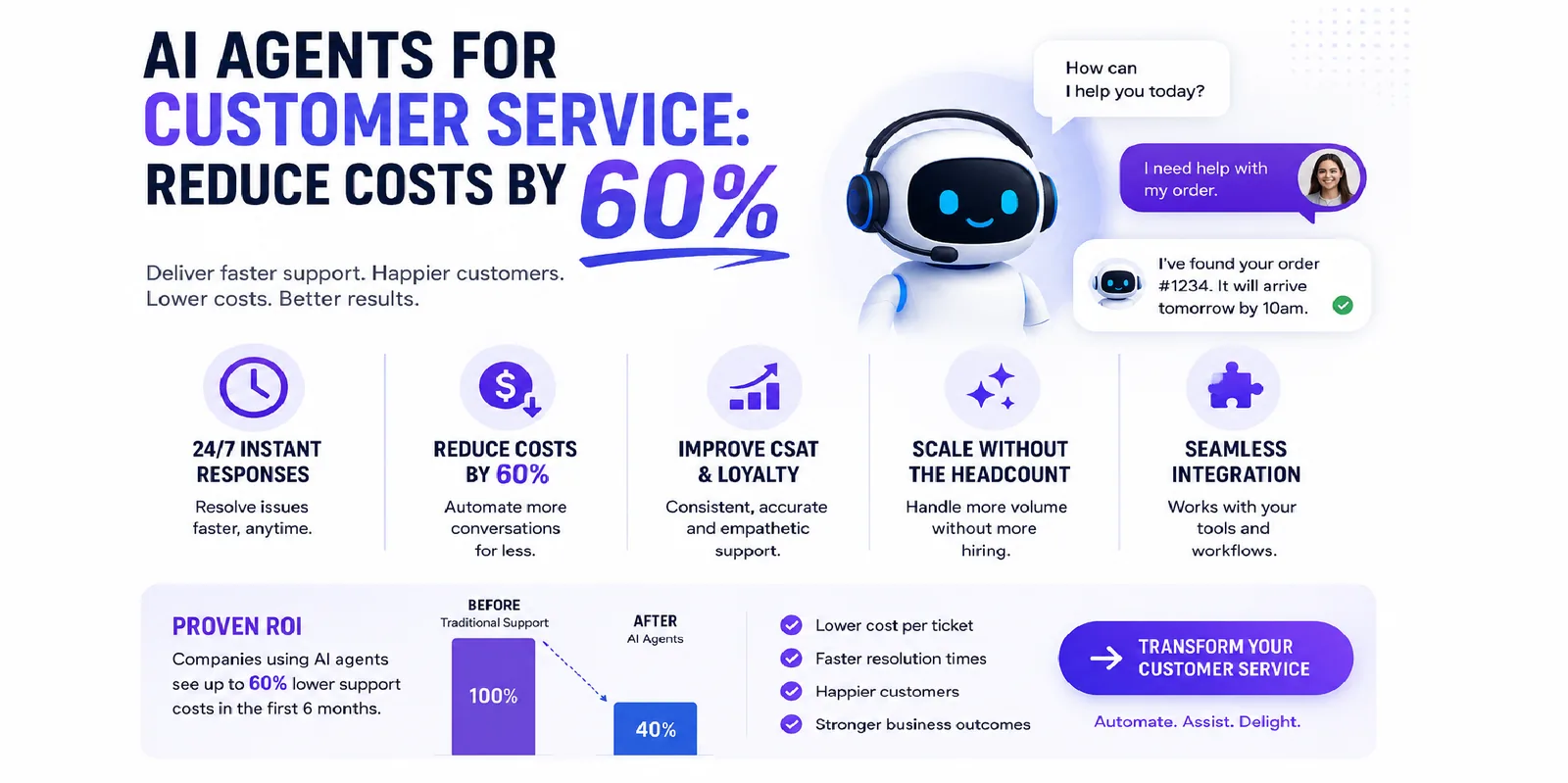
AI Agents for Customer Service: Reduce Costs by 60%
AI agents for customer service resolve 70%+ of tickets autonomously, cutting costs by 60%. Learn implementation strategies, real results, and best practices.
Faizan Ali Khan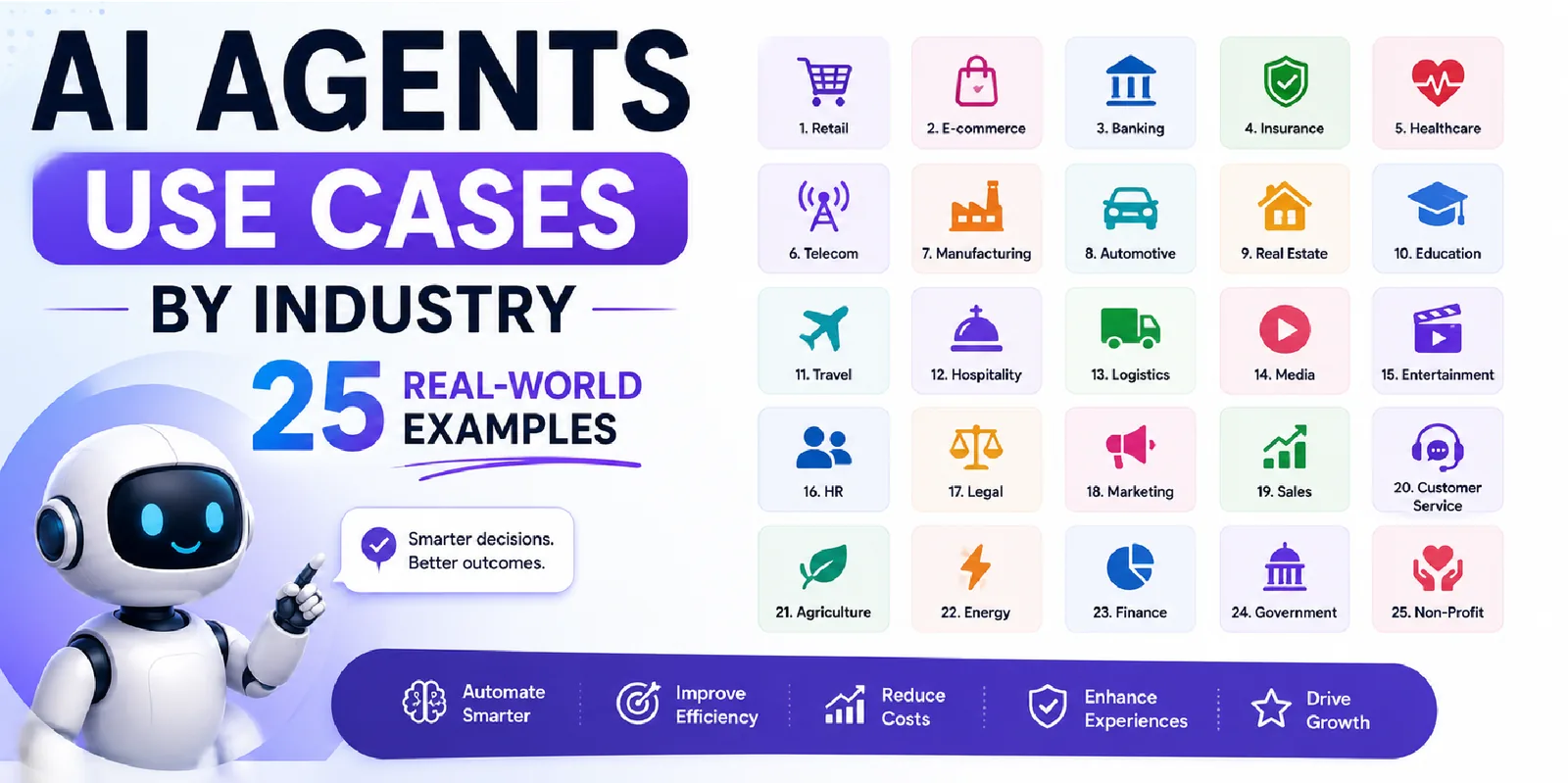
AI Agents Use Cases by Industry: 25 Real-World Examples
25 real-world AI agent use cases across healthcare, finance, retail, manufacturing, and more. See how industries deploy autonomous AI agents in 2026.
Faizan Ali KhanReady when you are
Want Cubitrek to run AI Agents for you?
We install ai agents programs for growing companies across the US and Europe. Book a call and we'll come back with a one-page plan in 72 hours.