

How to Build AI Agents: Frameworks, Tools & Best Practices
Step-by-step guide to building production AI agents. Compare frameworks, select tools, and follow best practices for reliable agent development in 2026.

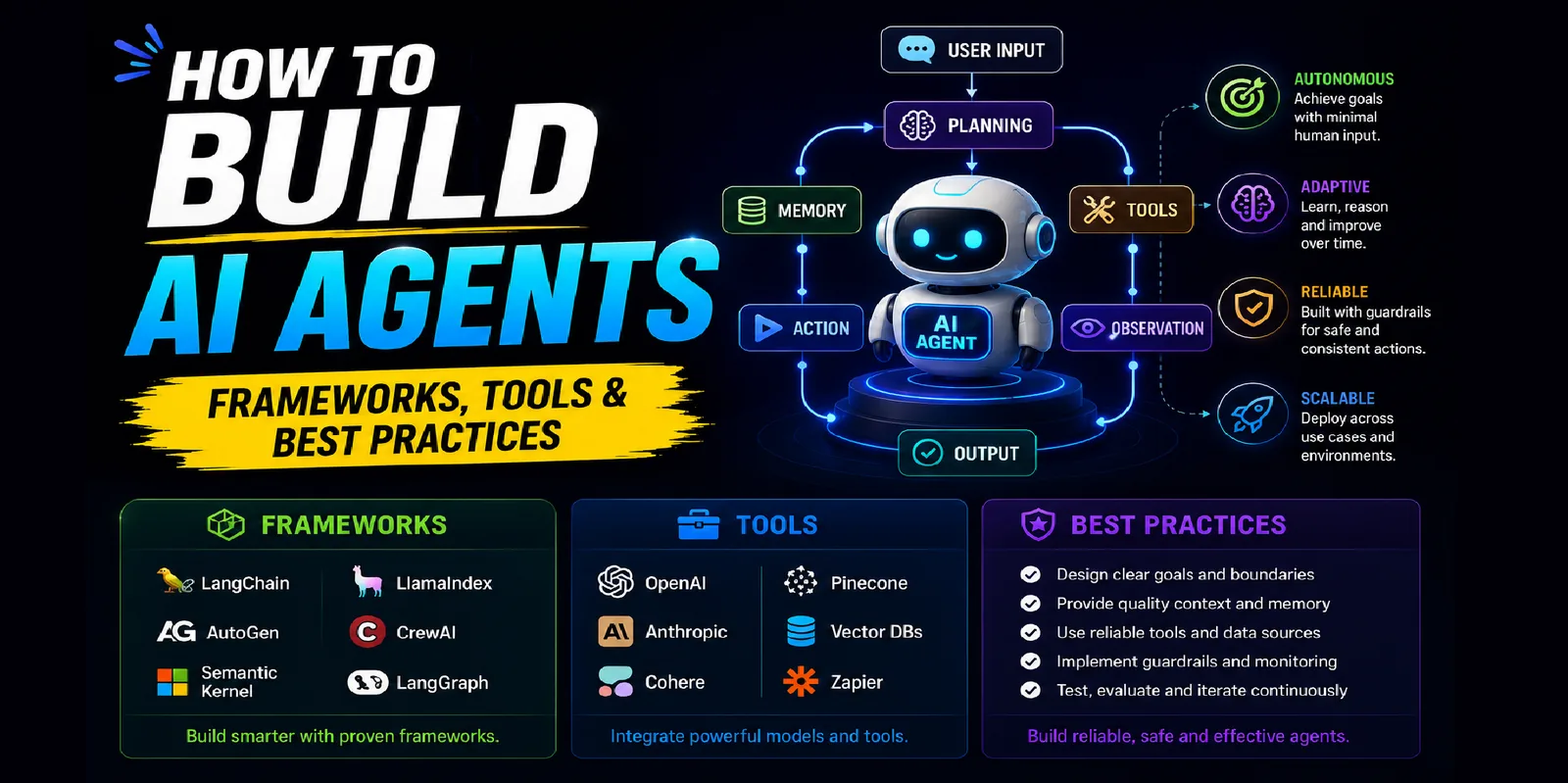
Building an AI agent is not like building traditional software. Agents reason, so the same input can produce different paths.
That breaks normal testing, monitoring, and deployment habits. You have to adapt them.
The tooling is solid now. OpenClaw, LangChain, and CrewAI handle the plumbing. Knowing the underlying architecture is what separates demos from agents that survive production.
Step 1: Define the agent's purpose and scope
Every agent that works starts with a tight scope. Spell out what the agent does, what it does not do, and when it hands off to a human.
"Handle customer inquiries" is too vague. "Resolve billing disputes under $500 by checking charge accuracy, applying credits per policy, and escalating fraud to a human" is the kind of objective that ships.
Document the spec with:
- Trigger conditions (what starts the agent).
- Goal state (what success looks like).
- Tool permissions (which systems it can touch).
- Constraints (budget, time, scope).
- Escalation criteria (when to hand off).
Step 2: Choose your LLM
| Model | Best for | Reasoning | Speed | Cost (output) |
|---|---|---|---|---|
| Claude Opus 4.6 | Complex reasoning, analysis | Excellent | Moderate | $25/MTok |
| Claude Sonnet 4.6 | Balanced production use | Very good | Fast | $15/MTok |
| Claude Haiku 4.5 | High-volume, simple tasks | Good | Very fast | $5/MTok |
| GPT-4o | General purpose | Very good | Fast | $15/MTok |
| Gemini 2.5 Pro | Long context, multimodal | Very good | Fast | $10/MTok |
| Llama 3.3 70B | Self-hosted, privacy | Good | Variable | Infra costs |
Route by task. Use Haiku for classification and routing. Use Sonnet for most production work. Reserve Opus for complex reasoning.
That pattern cuts cost 60 to 70% versus running everything on a premium model.
Step 3: Select your agent framework
The framework gives you the perception, reasoning, and action loop. The 2026 leaders:
- OpenClaw. Most popular open-source platform. 247K+ GitHub stars, 13,700+ pre-built skills on ClawHub. Lobster orchestration engine, self-hosting, visual builder. Best for teams that want a complete platform with minimal custom code.
- LangChain / LangGraph. Most flexible for developers. LangGraph adds stateful, graph-based orchestration on top of LangChain's tool ecosystem. Best for engineering teams building custom agents with complex state.
- CrewAI. Multi-agent collaboration with role-based agents. Simple API for roles, delegation, and inter-agent comms. Best for use cases that decompose into roles like researcher, writer, reviewer.
- AutoGen (Microsoft). Conversational multi-agent patterns. Agents talk to each other in natural language. Best for research workflows and heavy agent-to-agent dialogue.
Step 4: Design the tool layer
An agent without tools is a chatbot. Tools are what let the agent read databases, send emails, update CRM records, or call APIs.
Tool design is arguably the most important part of agent architecture. It defines the agent's real-world reach.
Four principles:
- Make tools atomic. "Send email" is a good tool. "Research prospect, draft email, and send" is a workflow the agent should compose.
- Write clear descriptions. The agent picks tools by reading the description. Write it like you are explaining the tool to a new hire.
- Validate inputs. Tools should reject bad input with clear error messages.
- Define output schemas. The agent needs to parse results reliably.
The Model Context Protocol (MCP), created by Anthropic, is becoming the standard for connecting agents to tools. It works like HTTP did for the web. Most major platforms (OpenClaw, LangChain, Cursor, Windsurf) support MCP natively.
Step 5: Implement memory and state
Production agents need memory. Otherwise they reset every conversation.
Run three layers:
- Working memory (short-term). The current task context. Usually the LLM's context window plus relevant retrieval. Keep it focused.
- Episodic memory (medium-term). Records of past interactions and outcomes. Store in a vector DB so the agent can recall what worked before.
- Semantic memory (long-term). The agent's knowledge base. Product docs, policies, process guides. Build this as a RAG pipeline with chunked docs, embeddings, and a vector store.
Step 6: Build guardrails and safety
Production agents need layered safety.
- Input validation. Reject malformed or malicious prompts.
- Output validation. Check planned actions before they run. Is the email right? Is the refund within policy? Is the API call hitting the right endpoint?
- Human-in-the-loop checkpoints. Define what runs autonomously, what needs approval, and what is out of scope.
- Budget controls. Per-task and daily caps on API calls, tools, and resources.
Step 7: Test like it is non-deterministic
Standard unit tests assert exact outputs. Agent testing measures behavior across distributions.
Build evaluation suites with 50 to 100+ cases per capability. Cover happy paths, edge cases, adversarial inputs, and ambiguity.
Measure success rates, not pass or fail. Use LLM-as-judge for subjective quality. Track task completion, tool selection accuracy, escalation appropriateness, and cost per task. Run regression tests before every deploy.
Step 8: Deploy, monitor, and iterate
Ship with full observability. Log every decision the agent makes:
- Input received.
- Tools considered.
- Tool selected.
- Output produced.
- Outcome.
Use LangSmith or custom logging to debug. Alert on anomalies: error spikes, weird tool calls, cost surges, dropping success rates.
Plan for continuous improvement. Review decisions weekly. Spot failure patterns. Refine prompts. Update tool descriptions. Expand capabilities one step at a time.
Continue reading in this cluster
Key takeaways
- FAQ
- How many tools should an AI agent have?
- Can I build AI agents without coding?
- How do I handle AI agent errors in production?
Questions people ask about this
Sourced from client conversations, Search Console, and AI-search citation monitoring.
- Start with 5-10 well-defined tools for a single-purpose agent. Research shows that agent performance degrades when given more than 15-20 tools at once due to selection confusion. For agents that need broad capabilities, use a hierarchical approach: a router agent selects the right specialist agent, and each specialist has a focused toolset.
- Yes. Platforms like OpenClaw offer visual builders that let you assemble agents from pre-built skills without writing code. n8n, Zapier, and Make also provide low-code agent building capabilities. However, production-grade agents with custom logic, complex integrations, and enterprise requirements typically require developer involvement for at least the initial setup and testing.
- Implement a three-tier error handling strategy. First, automatic retry with backoff for transient errors (API timeouts, rate limits). Second, fallback paths for tool failures (alternative data sources, simplified workflows). Third, graceful escalation to human operators for unrecoverable errors. Always log errors with full context for post-incident analysis.
Keep reading
Related articles.
More on the same thread, picked by tag and category, not chronology.
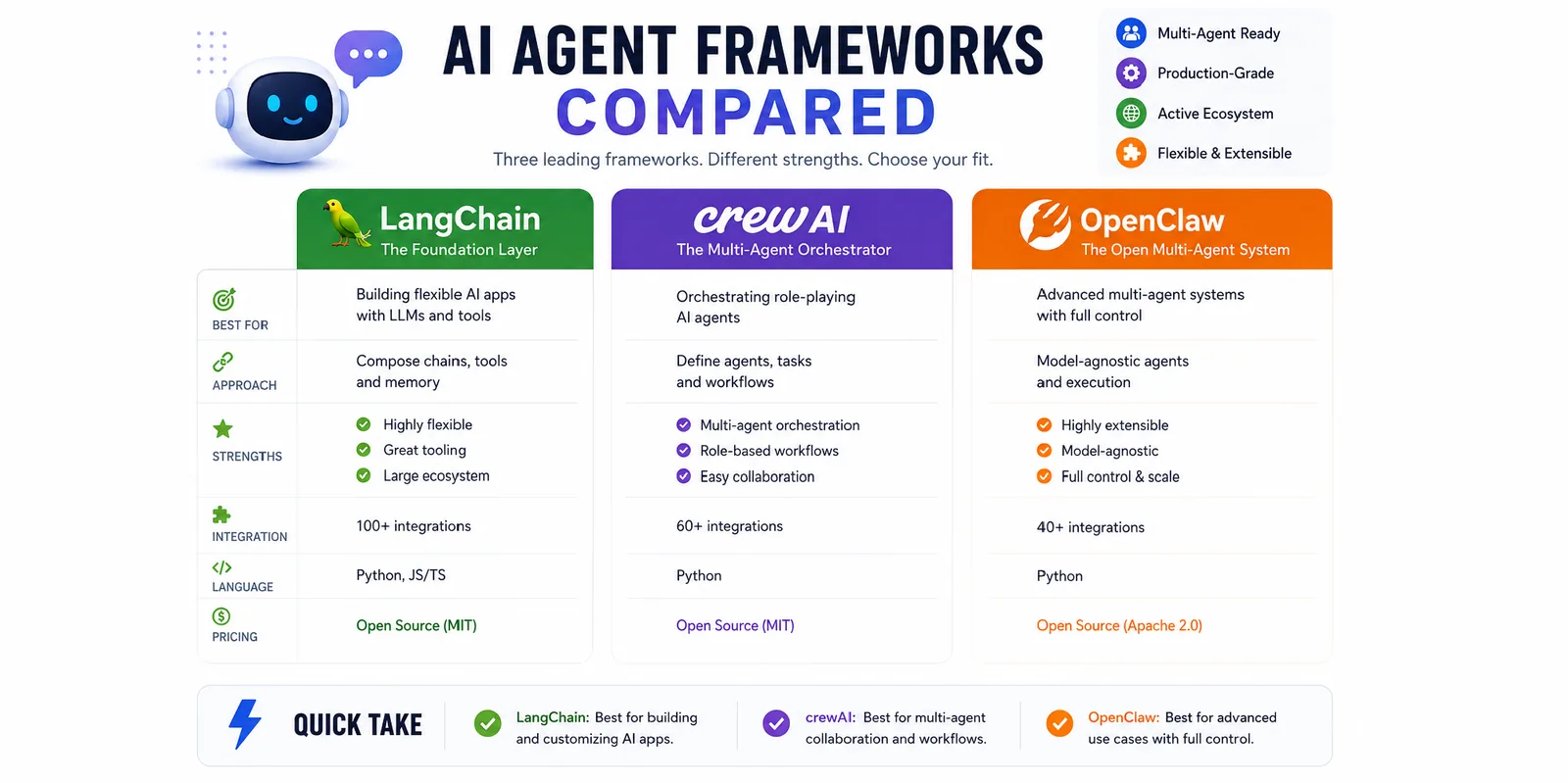
AI Agent Frameworks Compared: LangChain vs CrewAI vs OpenClaw
Detailed comparison of LangChain, CrewAI, and OpenClaw agent frameworks. Features, pricing, operating effort, and use case fit for enterprise AI agent development.
Faizan Ali Khan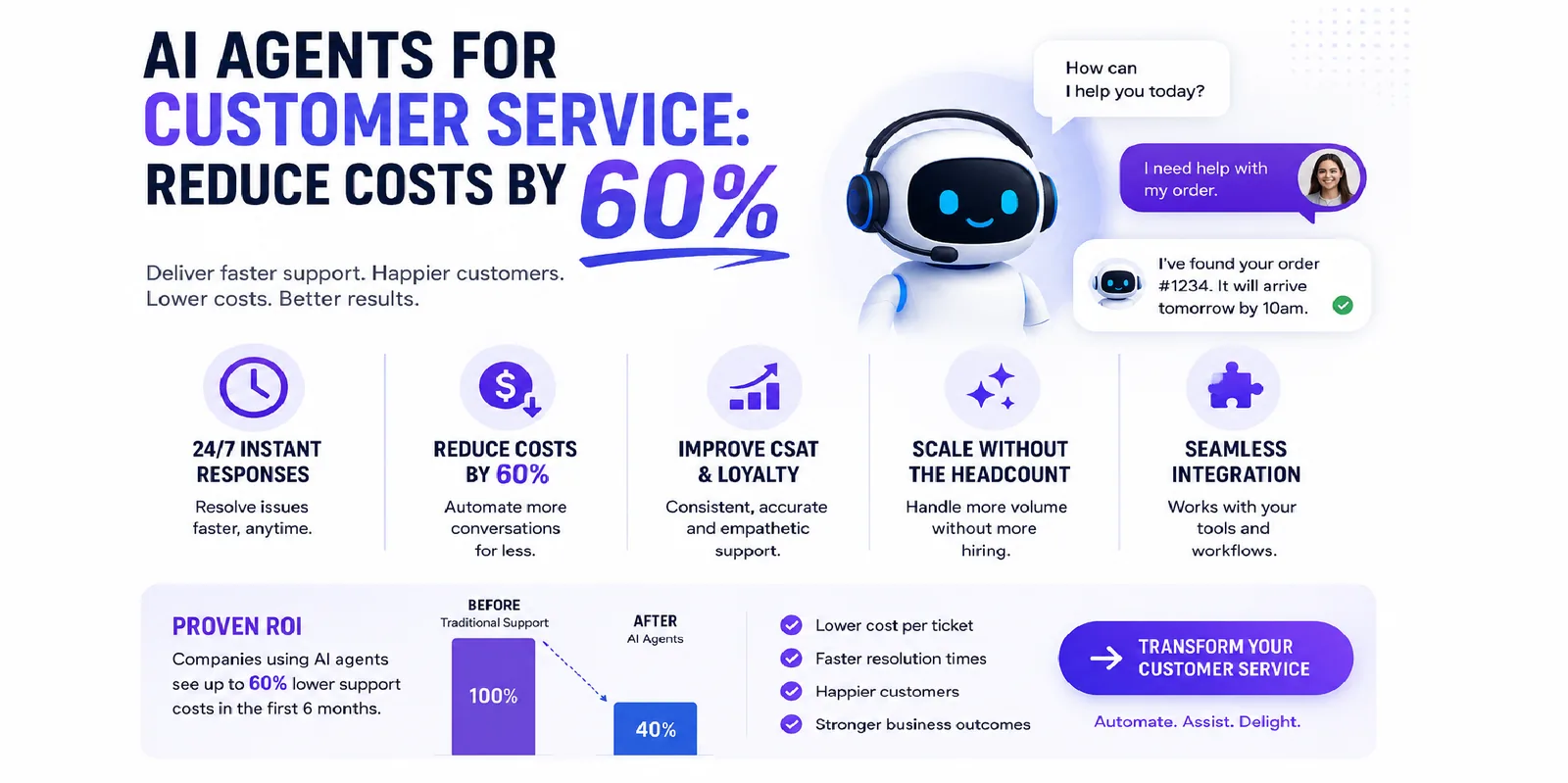
AI Agents for Customer Service: Reduce Costs by 60%
AI agents for customer service resolve 70%+ of tickets autonomously, cutting costs by 60%. Learn implementation strategies, real results, and best practices.
Faizan Ali Khan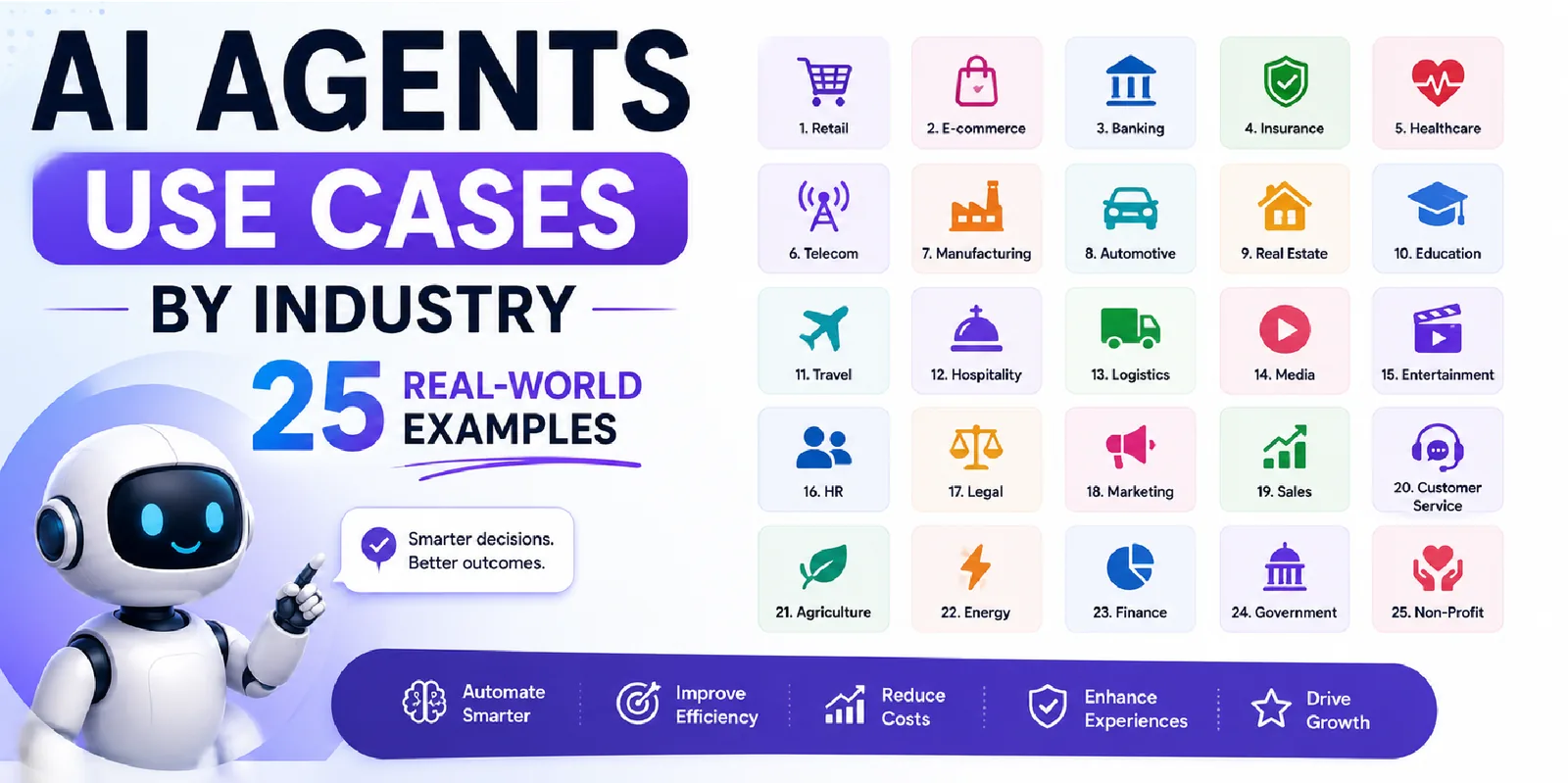
AI Agents Use Cases by Industry: 25 Real-World Examples
25 real-world AI agent use cases across healthcare, finance, retail, manufacturing, and more. See how industries deploy autonomous AI agents in 2026.
Faizan Ali KhanReady when you are
Want Cubitrek to run AI Agents for you?
We install ai agents programs for growing companies across the US and Europe. Book a call and we'll come back with a one-page plan in 72 hours.