
AI SEO Services: What the Work Actually Is in 2026
An agency owner's account of what sits under the AI SEO label: the four kinds of work in a real engagement, which three are verifiable and which one is not, and the cases where you should not buy it at all.

Three years ago nobody sold AI SEO. Now it is a line item, a job title and an agency category, and the label is doing an enormous amount of work. Some of what sits underneath it is the most useful thing you can do for a brand right now. Some of it is ordinary SEO with a new invoice heading, and a little of it is unmeasurable by construction.
I run an agency that sells this work, so read the rest with that in mind. What follows is the version I give people before they sign anything, including the parts that argue against buying.
Why the category exists at all
The honest case for AI SEO is not that search is dead. It is that the click is getting rarer.
Pew Research tracked the browsing of 900 US adults across 68,879 Google searches in March 2025. When an AI summary appeared, people clicked a traditional search result in 8% of visits. When no summary appeared, they clicked in 15% of visits, close to twice as often. Clicks on links inside the summary itself happened in 1% of visits.
Hold both halves of that. A ranking still earns a click most of the time it is seen without a summary. And the summary, when present, takes roughly half of them away. That is a serious change in the economics of a position, not the end of the discipline.
So the work has two jobs now: keep earning the clicks that still exist, and get named inside the answers that replace the rest.
What is actually in the engagement
Strip the branding and a real AI SEO programme contains four kinds of work. Three of them are verifiable. One is not, and you should know which.
1. Making the page machine-readable
Structured data, clean heading hierarchy, unambiguous entity naming, internal links that state relationships rather than just passing authority. This is the least glamorous part and the part that most reliably changes outcomes, because a model cannot cite what it cannot parse.
This is verifiable. You can inspect the markup, validate it, and watch whether the pages start getting retrieved.
2. Answering the question in the first paragraph
Engines quote passages, not pages. A page that buries its answer under 400 words of preamble will rank and never get quoted. Rewriting for extractability is editorial work with a technical test attached: can a passage be lifted out and still be true and complete on its own?
Verifiable. Read the page.
3. Building the evidence a model can lean on
Models repeat what the web agrees on. That means original data, named authors, citable claims, and presence in the places that get scraped and quoted. This is the slowest part and the hardest to fake.
Verifiable, though slowly.
4. Measuring whether any of it worked
Here it gets uncomfortable. You can measure mentions and citations across assistants by sampling prompts and recording what comes back. That is real and it is worth doing. What you cannot do is attribute revenue to it the way you attribute a paid click, because most assistants send no referrer you can trust and many answers produce no visit at all.
Partly verifiable. Anyone who tells you they can close that attribution loop cleanly is selling you certainty they do not have.
What the label hides
Three honest caveats, because they decide whether this is worth your money.
Most of it is good SEO. Clean structure, fast pages, real expertise, clear entities. If an agency's AI SEO proposal looks nothing like a competent SEO proposal, that is a warning, not a differentiator.
The surface moves under you. Assistants change retrieval and citation behavior without notice and without a changelog. A programme built on one engine's current quirks ages badly. Build for being quotable in general, not for this quarter's behavior.
Volume is not the win. Our own reading of search data shows the emerging commercial terms in this category sitting in the hundreds of searches a month, not the tens of thousands. The value is in who is searching, not how many. If someone quotes you enormous volumes for a category this young, ask for the source and the date.
Who should not buy this
If your site has an indexing problem, an AI SEO engagement is premature. Models retrieve from the index. Fix crawling and indexing first, and most of that work is cheaper.
If you sell something with no considered research step, the buyer is not asking an assistant about you.
If you need attributable pipeline this quarter, buy paid media. This work compounds and it is slow, and pretending otherwise is how these engagements end badly.
What good looks like after six months
Not a rankings screenshot. A short list you can check:
- Your pages carry structured data that validates, and the entities on them resolve to the same thing everywhere.
- Named authors, with real credentials, on the pages that make claims.
- A repeatable prompt set, run on a schedule, showing whether and how you get named, with the sample size written down.
- Original material on your site that other people cite, because that is what models end up repeating.
- Branded search going up, which is usually the first honest signal that the answers are working.
None of that requires believing anything about where search is going. It is defensible if AI answers keep growing and it is defensible if they plateau, which is the only kind of bet worth making about a surface this new.
Sources
- Pew Research Center, Google users are less likely to click on links when an AI summary appears in the results, 22 July 2025. Browsing data from 900 US adults, March 2025.
Key takeaways
- The case for AI SEO is not that search died. It is that the click is getting rarer while the position still has value.
- Engines quote passages, not pages, so a buried answer can rank and never be cited.
- Ask a vendor what the report says when an assistant names you and nobody visits. A claimed traffic number is the wrong answer.
- The commercial terms in this category sit in the hundreds of searches a month, not the tens of thousands. The value is who is searching.
- After six months, look for validating structured data, named authors, a scheduled prompt set with its sample size, original cited material, and rising branded search.
Questions people ask about this
Sourced from client conversations, Search Console, and AI-search citation monitoring.
- Four kinds of work. Making pages machine-readable through structured data, clean headings and unambiguous entity naming. Rewriting so the answer sits in a passage that stays true when lifted out. Building evidence that models can lean on, such as original data and named authors. And measuring mentions across assistants with a repeatable prompt set.
- Mostly it is good SEO with a different emphasis. Clean structure, fast pages, real expertise and clear entities matter in both. What changes is that extractability matters more than it used to, because engines quote passages rather than sending a click to a page.
- Not the way it can prove a paid click did. Most assistants send no referrer you can trust and many answers end without a visit. Mentions and citations can be sampled and tracked honestly. Anyone offering clean revenue attribution for assistant answers is offering certainty the data does not support.
- It compounds slowly. Structural work can be verified immediately, but evidence building and the resulting citations take months. If you need attributable pipeline inside a quarter, paid media is the honest answer.
- Three cases. Sites with an unresolved crawling or indexing problem, because models retrieve from the index and that fix is cheaper. Businesses whose buyers do no research step, because nobody is asking an assistant about the category. And teams that need attributable revenue this quarter.
- Build a repeatable set of prompts a buyer would plausibly ask, run it on a schedule, and record whether and how you are named. Write down the sample size. It is a sample, not a census, and reporting it as anything else is misleading.
Keep reading
Related articles.
More on the same thread, picked by tag and category, not chronology.
How to Choose an AEO Agency
The buyer's side of answer engine optimization: the four layers a real program covers, twelve questions with the answers that should worry you, what it costs, and the cases where hiring anyone is the wrong move.
Faizan Ali Khan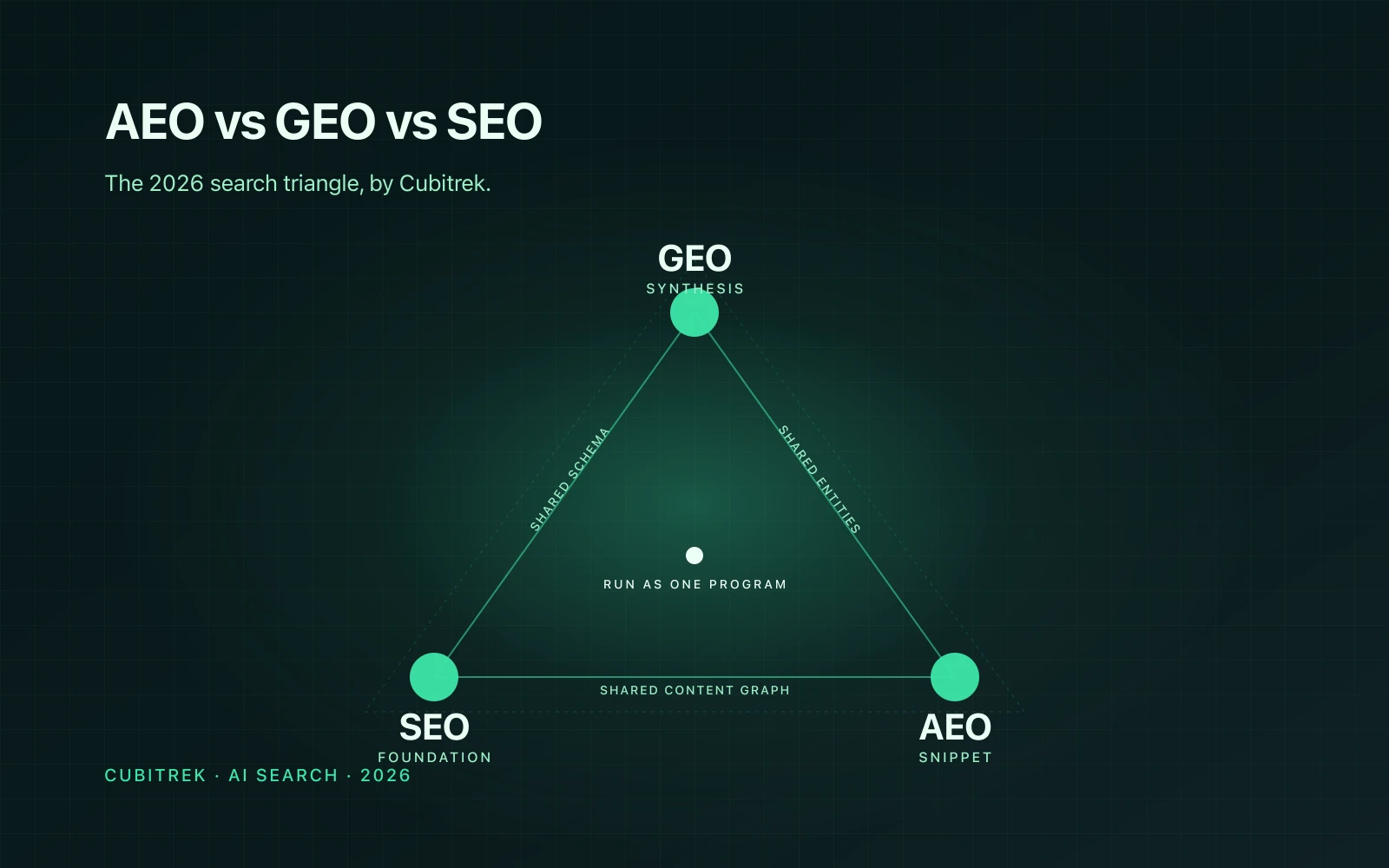
AEO vs GEO vs SEO: The Triangle
SEO is the foundation. AEO is the snippet game. GEO is the synthesis game. They are not competitors. Run them as one program and they compound.
Faizan Ali Khan
Share of Model (SOM): The New Share of Voice
Share of Voice is obsolete. Discover the Share of Model (SOM) and the “Citation Frequency” methodology to measure your brand’s visibility in ChatGPT and Gemini.
Faizan Ali KhanReady when you are
Want Cubitrek to run AEO & GEO for you?
We install aeo & geo programs for growing companies across the US and Europe. Book a call and we'll come back with a one-page plan in 72 hours.