
How to Choose an AEO Agency (and When Not to Hire One)
The buyer's side of answer engine optimization: the four layers a real program covers, twelve questions with the answers that should worry you, what it costs, and the cases where hiring anyone is the wrong move.

An answer engine optimization agency gets your brand named and cited inside AI-generated answers on ChatGPT, Perplexity, Gemini, Google AI Overviews, and Copilot. The work is part technical (entity schema, crawlability, passage structure), part editorial (rewriting pages so a model can lift a clean answer), and part off-site (earning the third-party mentions engines corroborate you against).
That is a genuinely different brief from classic SEO, and the category is new enough that anyone can print "AEO agency" on a website this afternoon. This guide is the buyer's side: what the work actually consists of, the twelve questions that separate an operator from a reseller, what it should cost, and the cases where hiring anyone at all is the wrong move.
What you are actually buying
Before you hire anyone: three cases where the answer is no
Agencies rarely publish this part, so here it is first.
There is also a fourth case: you do not need an agency yet. If you want the measurement before the retainer, the Cubitrek AEO Platform starts free and tells you where you stand across the major answer engines.
Your site fails the fundamentals. If pages are slow, thin, blocked, or render their content only in JavaScript, no amount of AEO strategy will help, because the engine cannot read you in the first place. Fix crawlability and content depth first. That is a technical SEO job and usually cheaper.
You have no answer worth citing. Engines quote sources that say something specific and verifiable. If your pages restate what every competitor says, the honest problem is positioning, not optimization. A good agency will tell you this and lose the sale. Most will not.
You need attributable pipeline this quarter. AEO compounds over months, and a large share of its value arrives as answers that never produce a click. If your board needs traceable revenue inside 90 days, put the budget into paid or outbound and start AEO alongside it, not instead of it.
The twelve questions, and the answers that should worry you
Ask these in the first call. The wrong answers are more informative than the right ones.
- What did you find when you ran our brand through the engines before this call? Worrying: they have not. Anyone selling AEO can spend ten minutes producing specifics about your brand before pitching you.
- Which engines will you measure, and will I see them split out? Worrying: a single blended visibility score. Engine-to-engine variance is large, and a blended number hides where you are actually losing.
- Who writes the prompt list, and can I change it? Worrying: the agency owns it and will not show you. The prompt list is the measurement instrument. If they choose it and grade themselves against it, the score is decorative.
- What will you change on my site in the first 30 days? Worrying: only an audit deliverable. Audits are cheap. Ask what ships.
- Who writes the content, and does a subject expert touch it? Worrying: unsupervised generation at volume. Engines cite specificity, and volume without expertise produces the exact undifferentiated text that never gets quoted.
- How do you handle off-site authority? Worrying: link buying, private networks, or seeded reviews. Those are risk transfer, not authority. Legitimate answers involve digital PR, expert commentary, community participation, and getting your entity right on third-party profiles.
- What does the reporting look like in month three? Worrying: screenshots of AI answers. Ask for mention rate and citation share by engine, on a fixed prompt list, with the raw answers attached.
- What happens if the number does not move? Worrying: no answer, or an immediate offer of more content. A real answer names the diagnostic path.
- Which of my competitors are you already working with? Worrying: evasion. In a niche category, prompt panels overlap directly.
- What do you need from my team, and how many hours a month? Worrying: "nothing". Entity facts, expert review, and approvals all require your people. An agency that promises zero involvement is planning to publish things nobody checked.
- Do I own the deliverables, the prompt panel, and the data if we stop? Worrying: anything other than yes.
- What is the exit? Worrying: an indefinite retainer with no handover. The good version has a defined point where your team can run it and the agency moves to advisory.
What it costs, and what actually drives the number
Pricing in this category is unsettled, but the shape is consistent.
How AEO engagements are usually priced
| Shape | Typical range | What you get | Fits |
|---|---|---|---|
| Audit and roadmap | One-off, low four figures | Baseline measurement, gap analysis, prioritized fix list you implement | Teams with in-house capacity who need direction, not hands |
| Entry retainer | Several hundred a month | Measurement panel, light content and schema work, monthly reporting | One brand, one market, proving the channel before committing |
| Standard retainer | Low to mid four figures a month | Full four layers shipped continuously, weekly tracking, expert-reviewed content | The common case for growth-stage and mid-market brands |
| Enterprise program | Mid four figures a month and up | Multi-brand or multi-market panels, procurement and security review, integration work | Regulated or multi-entity organizations |
Three things move the price far more than headcount: how many markets and languages you need panels for, whether your site needs engineering work before content can land, and whether off-site authority has to be built from scratch. A brand with clean technical foundations and existing press coverage is a fraction of the work of one starting from nothing.
Agency, in-house, or hybrid
Where each model wins
| Model | Strongest when | Weakest when |
|---|---|---|
| In-house | You already run SEO well and have writers with real domain expertise | Nobody owns measurement, so the panel quietly stops being run |
| Agency | You need the four layers running now and have no spare senior capacity | Your product is technical and nobody on their side understands it |
| Hybrid | Your experts write, the agency handles entity work, measurement, and structure | Ownership of the content calendar is left undefined between the two |
What we see on the buying side
Patterns from the engagements and audits we run. These are proportions rather than counts, taken across engagements rather than any single one, and directional rather than benchmarks.
Most sites fail on the same layer first. In the audits we run, the majority score lowest on passage structure, not schema and not authority. The pages are perfectly good for a human reader and contain no self-contained answer a model can lift. It is also the cheapest layer to fix, which is why a proposal that opens with a link-building budget is usually mispriced.
A meaningful share of "we are invisible in AI" briefs turn out to be measurement problems. The brand is being surfaced; nobody was counting it, and classic analytics showed flat traffic because the answers resolved without clicks. Establishing the baseline is not a formality, it is sometimes the entire finding.
Authority is the slowest layer, and the one most quietly omitted. On-page work shows movement in weeks. Third-party corroboration takes months and cannot be done from inside your own domain, which is exactly why proposals skip it. If an agency's plan is entirely on-site, they have scoped the comfortable half of the problem.
The involvement question predicts the outcome. Engagements where a named internal expert reviews drafts consistently outperform ones where the client approves in bulk. Engines quote specificity, and specificity comes from someone who actually knows the subject.
What good looks like in the first 90 days
- 01
Days 1 to 14: baseline and diagnosis
Prompt panel agreed with you and run across engines, results split by engine, plus a technical and entity audit. You should end this phase knowing exactly which of the four layers is weakest and why.
- 02
Days 15 to 45: entity and passage work ships
Schema with stable @id anchoring, a Brand Hub and llms.txt, and the first cohort of pages rewritten so each answers one question completely. Shipped, not just recommended.
- 03
Days 46 to 75: authority and coverage
Third-party corroboration begins: expert commentary, profile and directory consistency, and genuine community participation. Slower to show, and the reason month three matters more than month one.
- 04
Days 76 to 90: second measurement and a decision
Re-run the original panel, unchanged, and compare. The honest output is a direction and a reason, not a victory lap. This is the point to decide whether to scale, adjust, or stop.
The short version
Ask for specifics about your brand before you sign anything. Insist on seeing engine-level numbers on a prompt list you control. Check that all four layers are in the plan, especially the off-site one. Treat guarantees about model output as disqualifying. And be honest with yourself about whether your problem is visibility, measurement, or positioning, because only one of those is an agency's to solve.
If you would rather see the mechanics than the pitch, start with the AEO audit checklist to grade your own site, and AEO vs GEO vs SEO to work out which discipline your budget actually belongs in.
Key takeaways
- Ask what the agency found running your brand through the engines before the call. Anyone selling AEO can produce specifics in ten minutes.
- The prompt list is the measurement instrument. If the agency owns it and grades itself against it, the score is decorative.
- An agency promising zero involvement from your team is planning to publish content nobody with domain expertise checked.
- Passage structure is the most common weakest layer and the cheapest to fix, so a proposal that opens with link building is usually mispriced.
Questions people ask about this
Sourced from client conversations, Search Console, and AI-search citation monitoring.
- An AEO agency gets your brand named and cited inside AI-generated answers on ChatGPT, Perplexity, Gemini, Google AI Overviews, and Copilot. The work spans four layers: entity (schema, stable @id anchoring, a Brand Hub and llms.txt), passage (rewriting pages so a model can lift a clean self-contained answer), authority (third-party corroboration off your domain), and measurement (a prompt panel run across engines on a schedule).
- As of August 2026, one-off audits run in the low four figures, entry retainers in the several-hundred-a-month range, standard retainers in the low to mid four figures a month, and enterprise programs above that. Price is driven mostly by how many markets and languages need prompt panels, whether the site needs engineering work before content can land, and whether off-site authority has to be built from scratch.
- Ask what they found running your brand through the engines before the call, which engines they measure and whether results are split out, who owns the prompt list, what ships in the first 30 days, who writes the content and whether a subject expert reviews it, how they handle off-site authority, what happens if the number does not move, whether they work with your competitors, how many hours they need from your team, whether you own the deliverables and data, and what the exit looks like.
- No. Nobody controls model output, and any guarantee of citation should end the conversation. The same applies to promises of AI Overviews inclusion within 30 days, since engines re-crawl and refresh on their own schedule. Weeks to months is the honest range.
- In-house works when you already run SEO well and have writers with real domain expertise. An agency works when you need all four layers running now and have no spare senior capacity. Hybrid is the most common shape that succeeds, because the scarcest input is subject expertise and that usually lives inside your company. The failure mode for hybrid is leaving ownership of the content calendar undefined.
- Three cases. If your site is slow, thin, blocked, or renders content only in JavaScript, fix crawlability first because engines cannot read you. If your pages restate what every competitor says, the problem is positioning rather than optimization. And if you need attributable pipeline inside 90 days, fund paid or outbound for that and run AEO alongside it, since AEO compounds over months and much of its value arrives as answers that never produce a click.
Keep reading
Related articles.
More on the same thread, picked by tag and category, not chronology.
How to Choose an AEO Tool
Every AEO tool runs the same mechanic: a sampled prompt list against a few engines. Here is what they actually measure, the sampling problem nobody prices honestly, and the free cycle to run before you subscribe.
Faizan Ali Khan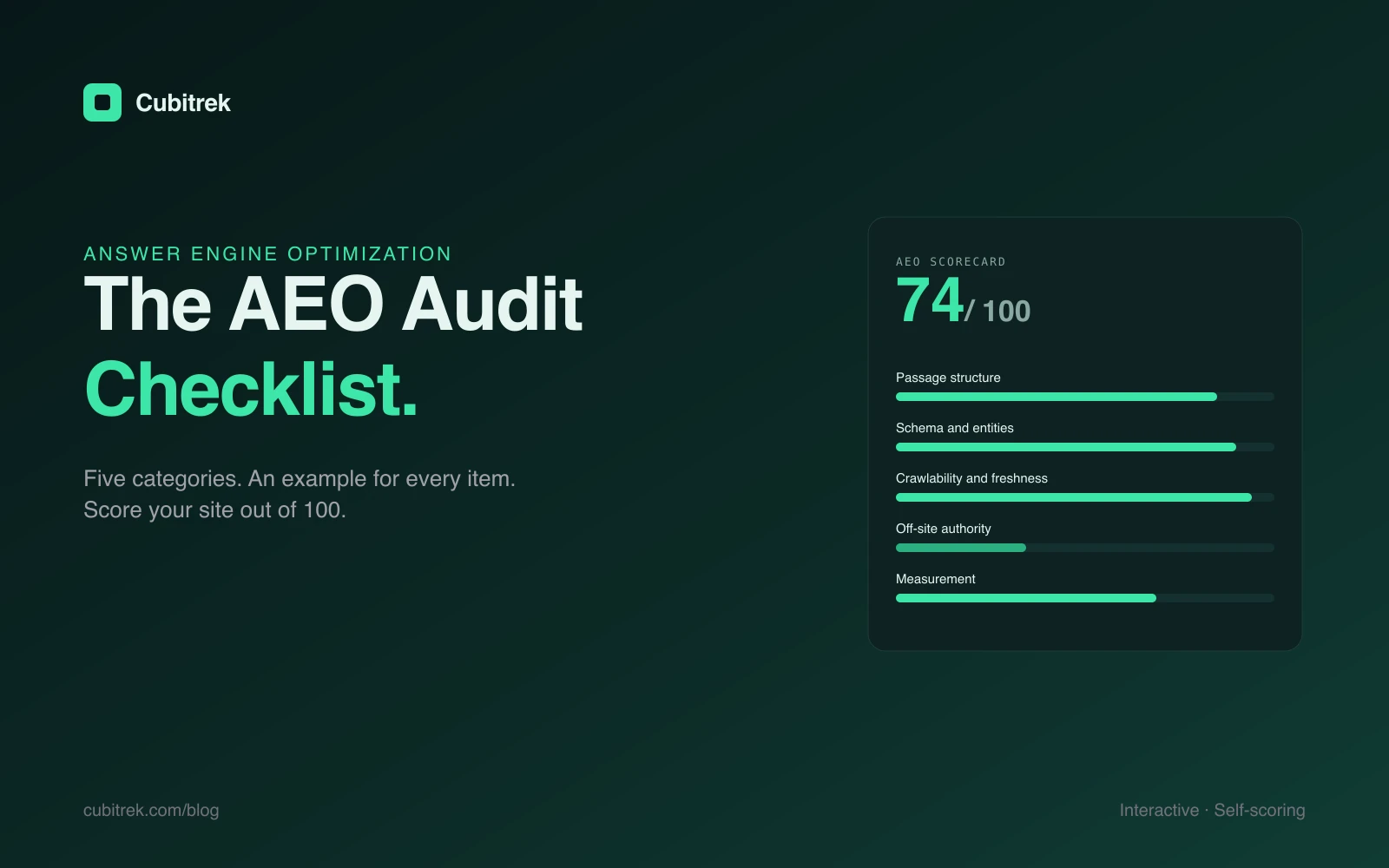
The AEO Audit Checklist
An interactive AEO audit with a weak-versus-strong example for every item, real audit scores, and a live self-scoring widget. Grade your site in five minutes.
Faizan Ali Khan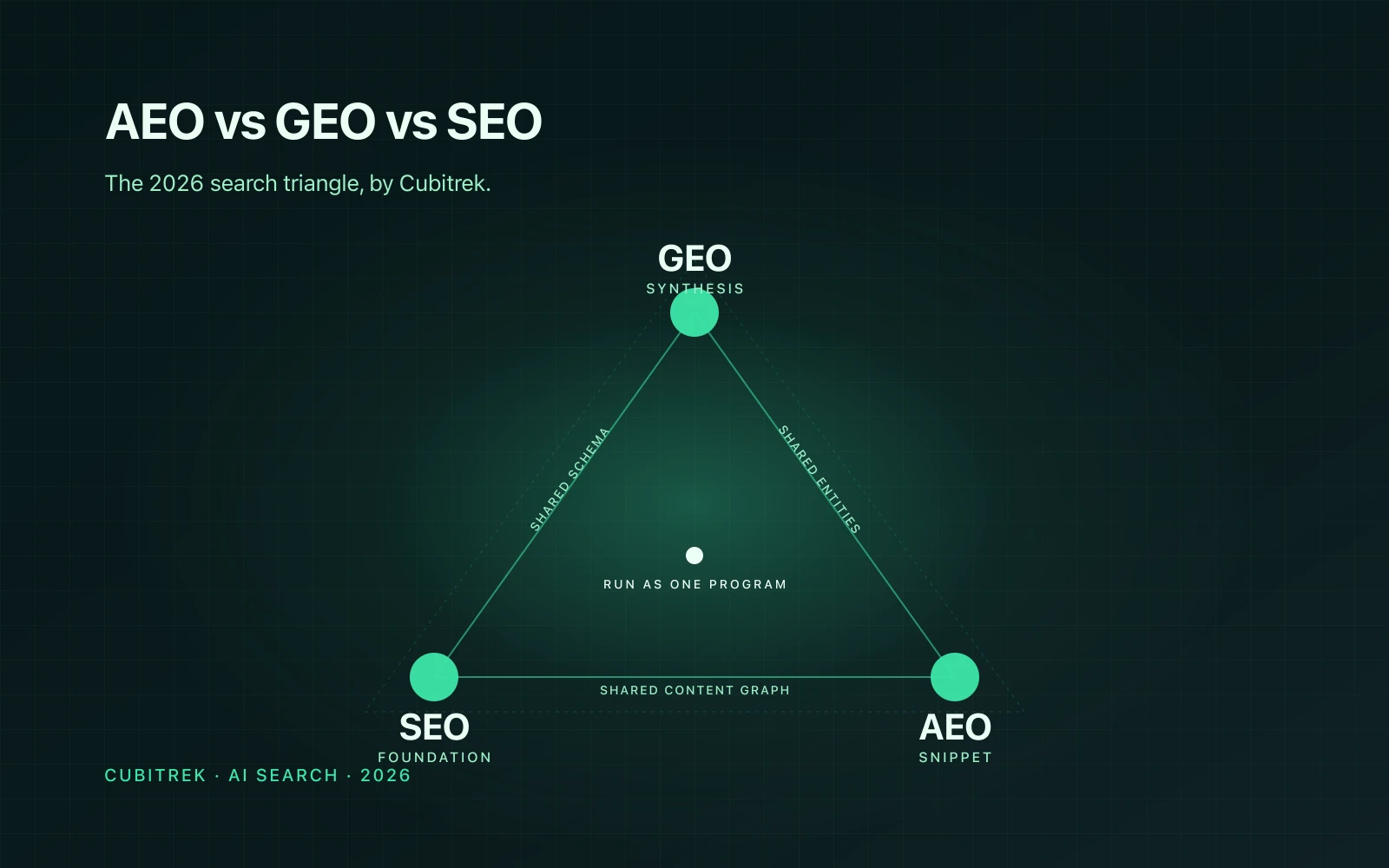
AEO vs GEO vs SEO: The Triangle
SEO is the foundation. AEO is the snippet game. GEO is the synthesis game. They are not competitors. Run them as one program and they compound.
Faizan Ali KhanReady when you are
Want Cubitrek to run AEO & GEO for you?
We install aeo & geo programs for growing companies across the US and Europe. Book a call and we'll come back with a one-page plan in 72 hours.