
What an AI Automation Agency Actually Does (and How to Judge One)
Half the results for this term are selling automation and the other half are selling a course on how to sell automation. Here is the real work, how it is priced, and the one question that separates a useful firm from a demo.

Search "AI automation agency" and the results split into two camps. One half is selling you automation. The other half is selling you a course on how to start an agency that sells automation. That tells you most of what you need to know about how young this category is.
Underneath the noise there is real work, and it is worth understanding before you buy it. This is what an AI automation agency actually does, how the engagements are priced, and the one question that separates a firm that will still be useful in month six from one that delivers a demo and disappears.
We are an agency in this category, so take the self-interest as read. To make that bias checkable, the evidence below is our own lead chain, including the month it broke.
What an AI automation agency is
An AI automation agency builds software that performs work inside your existing business systems, using language models for the parts that require judgment and ordinary code for everything else.
That last clause is the one that matters. A good automation is mostly not AI. It is API calls, scheduling, error handling and data mapping, with a model doing the specific step that needs reading, writing or deciding. When a proposal is all model and no plumbing, it will demo well and fail in production, because production is mostly plumbing.
The distinction from neighbouring categories:
| Category | What it builds | Where it ends |
|---|---|---|
| AI automation agency | Workflows that run without a person, inside your systems | You own a running process |
| AI consultancy | Strategy, roadmaps, opportunity assessments | You own a document |
| RPA vendor | Scripted clicks through user interfaces | Breaks when the interface changes |
| Software agency | An application your team uses | A person still does the work, faster |
| Reseller or implementation partner | Configuration of someone else's platform | You own a subscription |
None of these is wrong. They are different purchases, and the pricing should differ accordingly. Problems start when a firm is selling the fifth and describing the first.
The four kinds of work
Almost every engagement in this category is one of four things.
What gets built, roughly in order of how often it is asked for
- 01
Intake and routing
Something arrives, a form, an email, a call, a document, and the system reads it, classifies it, and puts it where it belongs with the right fields filled in. This is the most common first project and the easiest to verify.
- 02
Follow-up and outreach
The system acts on the intake: a call placed, a reply drafted, a sequence started, a booking made. Judgement is involved, so this is where governance and approval gates belong.
- 03
Internal knowledge
Staff ask questions in plain language and get answers grounded in your own documents, with citations. Useful, and the hardest of the four to measure honestly.
- 04
Reporting and reconciliation
Data pulled from several systems, compared, and turned into something a person reads. Unglamorous, and usually the highest return per hour of build time.
The part nobody quotes for
Here is our own lead chain, and the shape of what it produced over five weeks.
Where our enquiries came from
- Website contact form55%
- Directory referralClutch, The Manifest13%
- Demo or manually added10%
- Inbound phone call6%
- Bark marketplace6%
- A blog postsourced to the article URL6%
- Paid social lead formrecovered by hand3%
View as a table
| Channel | Share |
|---|---|
| Website contact form | 55% |
| Directory referralClutch, The Manifest | 13% |
| Demo or manually added | 10% |
| Inbound phone call | 6% |
| Bark marketplace | 6% |
| A blog postsourced to the article URL | 6% |
| Paid social lead formrecovered by hand | 3% |
Look at the bottom bar. Paid social produced the smallest share of the lot, and what little it produced is in the CRM only because a person noticed something was missing.
What happened: a lead submitted a paid social form one evening. The ad platform recorded it as delivered. Our CRM received nothing. The contact that eventually appeared was typed in by hand the following morning, carrying none of the qualifying answers the lead had given.
Nothing failed. The ad platform reported success. The CRM reported nothing at all, which looks exactly like a quiet day. Ads Manager showed zero leads for the campaign, which also looks exactly like a quiet day. The only thing in the entire chain that detected a problem was a human being wondering where the lead went.
A second one, caught the other way round. Before switching on a new search campaign we checked where its ads actually pointed. Every one of their final URLs returned 404. The real landing page existed at a different path, and nothing in the ad platform said so. The ads carried a spread of strength ratings, none of which has anything to do with whether the destination exists. Had we trusted the interface and enabled the campaign, every click would have been paid for and delivered to a "page not found".
One of those was a loss and one was a near miss, and both were found by a person rather than by any system. That is the real state of the art in most deployments, including the ones sold by firms that should know better, and it is why we now treat the monitoring as part of the deliverable rather than an operations afterthought.
The fix is not clever. It compares the two systems against each other on a schedule: every lead the ad platform holds, checked against the CRM by email and by phone, with anything unmatched raised as an alert. It runs on infrastructure separate from everything it watches, because a server that has died cannot report that it has died.
That principle is worth stealing whatever you buy and whoever builds it. A check that runs inside the thing it is checking is not a check.
Eight questions to ask
| Ask | What you are testing for | A weak answer |
|---|---|---|
| How will I find out this broke? | Whether monitoring is in the build or sold later | We monitor everything |
| Where does that alert run? | Whether the check dies with the thing it watches | On the same server |
| Show me a check going red on purpose | Whether the alert has ever actually fired | It has not needed to |
| Who owns the code and the credentials? | Whether you can leave | We host it all for you |
| What does this do when the model is wrong? | Whether there is a gate or just a hope | The model is very accurate |
| Which part is AI and which part is ordinary code? | Whether they understand their own build | It is all AI powered |
| What is the rollback? | Whether a bad run can be undone | We test thoroughly |
| What did you measure before, and what will you measure after? | Whether the result will be provable | You will see huge efficiency gains |
The third row is the one most firms fail. Ask to see an alert fire. A monitoring setup that has never gone red is not proven to work, it is only proven to be quiet, and those two states are indistinguishable until the day you need it.
How these engagements are priced
Three models are common, and the right one depends on how well defined the work is.
Fixed scope per automation. A defined workflow for a defined price. Works when you know exactly what you want. The risk is that discovery happens after the contract, and anything the scope missed becomes a change request.
Monthly retainer. A continuing budget for building and maintaining a set of automations. Works when the backlog is real and ongoing. The risk is paying for availability you do not use, so insist on seeing what shipped each month.
Build then hand over. A project price to build, then either you run it or you pay a smaller fee for monitoring and fixes. This is usually the honest structure for a first engagement, because it forces the question of who owns the thing at the end.
Whatever the model, the thing to check in the contract is ownership of the repository, the cloud accounts and the API credentials. If those sit with the agency, the price of leaving is a rebuild, and both sides should be clear about that before signing rather than after.
What a reasonable first 90 days looks like
One workflow in production inside the first month, chosen because it is easy to verify rather than because it is impressive. Monitoring on it from the day it goes live, including an alert that someone has watched fire. A measured before and after on a number that was agreed in advance. Then the second workflow.
If a proposal promises six automations in month one, the first month will produce six demos. Demos are not the same as a process you can stop supervising, and the gap between the two is exactly the work this article is about.
The short version
The category is real and the returns are real, particularly on the dull reconciliation work nobody wants to do by hand. What is not usually included, and what you should insist on, is the answer to one question: when this stops working, how will you find out?
Our own answer came from a lead we lost for half a day and a campaign we nearly paid to send into a dead page. Yours does not have to.
Key takeaways
- Ask how you will find out the automation broke, and where that alert runs. These two questions separate a build you can leave running from a demo.
- Check who owns the repository, the cloud accounts and the API credentials. If they sit with the agency, the price of leaving is a rebuild.
- Insist on a measured before and after on a number agreed in advance, or the result will not be provable either way.
- Expect one workflow in production in month one, chosen because it is easy to verify. A proposal promising six automations in month one will deliver six demos.
- Distinguish an automation agency from a consultancy, an RPA vendor and an implementation partner. They are different purchases and should be priced differently.
- The highest return per hour of build time usually sits in dull reporting and reconciliation work, not in the impressive conversational demos.
Questions people ask about this
Sourced from client conversations, Search Console, and AI-search citation monitoring.
- A firm that builds software performing work inside your existing business systems, using language models for the steps that need judgment and ordinary code for everything else. The output is a running process you own, as distinct from a consultancy's document or an implementation partner's configuration of someone else's platform.
- Four things cover almost every engagement. Intake and routing, where something arriving is read, classified and filed with the right fields. Follow-up and outreach, where the system acts on that intake. Internal knowledge, where staff query your own documents in plain language. Reporting and reconciliation, where data from several systems is compared and summarized. The last is the least glamorous and usually the highest return per hour of build time.
- Three structures are common: a fixed price per defined automation, a monthly retainer against an ongoing backlog, or a build fee followed by a smaller monitoring and maintenance fee. Build then hand over is usually the honest structure for a first engagement, because it forces the question of who owns the system at the end.
- Ask how you will find out it broke, where that alert runs, and to see a check go red on purpose. Then ask who owns the code and credentials, what happens when the model is wrong, which parts are AI and which are ordinary code, what the rollback is, and what will be measured before and after. The monitoring questions are the ones most firms fail.
- Because a system that counts only what it receives cannot tell the difference between no work arriving and work arriving then vanishing. Both look like a quiet day. Unless something compares two systems against each other, a broken integration can run for weeks with every dashboard green.
- No. RPA scripts clicks through user interfaces and breaks when the interface changes. An AI automation agency works against APIs and data, and uses a model for the steps that require reading or deciding rather than for driving a screen.
- One workflow in production inside the first month, chosen because it is easy to verify rather than because it is impressive. Monitoring on it from the day it goes live, including an alert somebody has watched fire. A measured before and after on a number agreed in advance. Then the second workflow.
- You should at minimum own the repository, the cloud accounts and the API credentials. Agencies differ on this and it is a legitimate commercial choice, but it determines the cost of leaving, so settle it before signing rather than after.
Keep reading
Related articles.
More on the same thread, picked by tag and category, not chronology.
How to Evaluate AI Agent Development Companies
Buyer's guide to evaluating AI agent development companies. Assessment criteria, red flags, questions to ask, and pricing benchmarks for 2026.
 Faizan Ali Khan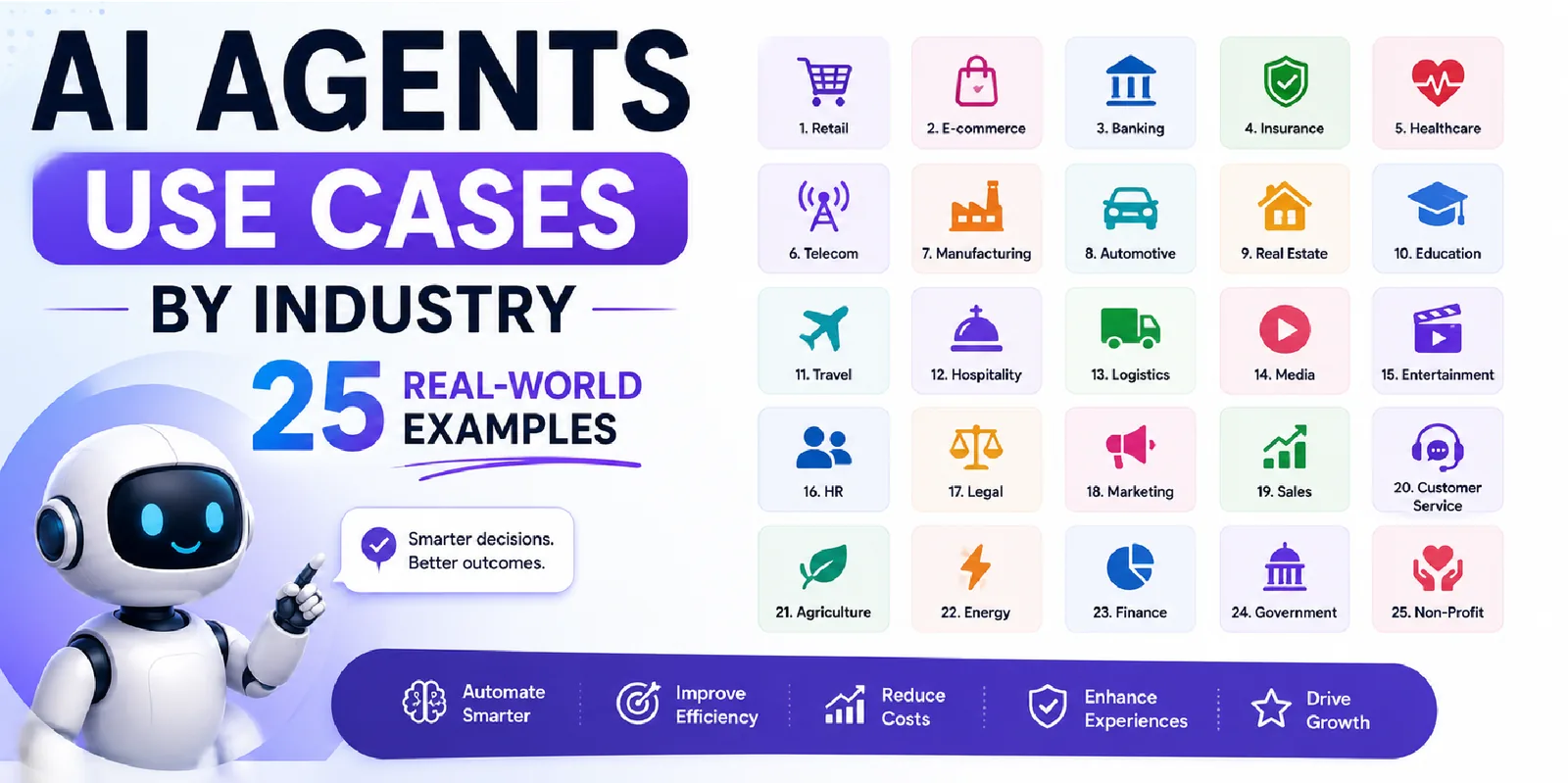
AI Agents Use Cases by Industry: 25 Real-World Examples
25 real-world AI agent use cases across healthcare, finance, retail, manufacturing, and more. See how industries deploy autonomous AI agents in 2026.
Faizan Ali Khan
What Are AI Agents? A Business Leader's Guide for 2026
AI agents are autonomous software systems that perceive, reason, and act to complete business tasks. Learn what they are, how they work, and why they matter in 2026.
Faizan Ali KhanReady when you are
Want Cubitrek to run AI Automation for you?
We install ai automation programs for growing companies across the US and Europe. Book a call and we'll come back with a one-page plan in 72 hours.