
The AI Agent Tech Stack: What You Need to Build Production Agents
The complete AI agent tech stack for production deployments. LLMs, frameworks, memory, tools, observability, and guardrails, everything you need in 2026.

The LLM is the brain. The tech stack is the body. A brain without eyes, hands, and memory is useless.
The gap between a Twitter demo and a production agent comes down to the stack around the model. The right stack lets your agent access data, take actions, remember context, handle errors, and run safely at scale.
This guide covers every layer of a production stack. Tool recommendations, selection criteria, and integration patterns are below. Use it as a reference whether you are on your first agent or scaling to enterprise.
Layer 1: Foundation Models (The Brain)
Your LLM choice drives reasoning quality, speed, cost, and capabilities. As of April 2026, the leading options are below.
| Model | Strengths | Weaknesses | Best For | Cost (Output) |
|---|---|---|---|---|
| Claude Opus 4.6 | Best reasoning, long context | Highest cost, slower | Complex analysis, strategy | $25/MTok |
| Claude Sonnet 4.6 | Strong reasoning, fast | Less depth than Opus | Production workhorse | $15/MTok |
| Claude Haiku 4.5 | Very fast, cheap | Less complex reasoning | Classification, routing | $5/MTok |
| GPT-4o | Multimodal, broad capabilities | Less precise reasoning | General purpose | $15/MTok |
| Gemini 2.5 Pro | 1M token context | Variable quality | Long document analysis | $10/MTok |
| Llama 3.3 70B | Self-hosted, no data sharing | Requires GPU infra | Privacy-sensitive workloads | Infra only |
Production tip: route by model. Use Haiku for classification and routing (70% of calls). Use Sonnet for standard tasks (25%). Use Opus for complex reasoning (5%). Costs drop 60 to 70% versus running everything through one model.
Layer 2: Agent Framework (The Skeleton)
For a broader introduction, read our AI agents business guide.
The agent framework gives structure to the perception-reasoning-action loop. Pick based on team engineering depth and use case complexity.
For most enterprise teams, OpenClaw is the fastest path to production. Visual builder, 13,700+ pre-built skills, infrastructure included. For engineering-heavy teams building novel architectures, LangGraph offers maximum flexibility. CrewAI fits multi-agent workflows that decompose into roles.
Layer 3: Tool and Integration Layer (The Hands)
Tools make an agent useful. The integration layer connects your agent to the systems it needs.
Model Context Protocol (MCP) is the emerging standard. Anthropic created it. Major platforms now support it. Define a tool once. Any MCP-compatible agent can use it. No more custom integrations per framework.
Where to plug in:
- Enterprise systems. Salesforce, SAP, Workday, ServiceNow. Use pre-built MCP connectors or platform-specific integrations.
- Internal APIs. Build custom MCP servers that expose your services.
- Web data. Wrap browser automation tools (Playwright, Puppeteer) as agent tools.
Critical tool categories for most enterprise agents:
- CRM and sales. Read and write customer data, create opportunities, update stages.
- Communication. Send emails, post to Slack and Teams, create calendar events.
- Documents. Read PDFs, generate reports, search knowledge bases.
- Data. Query databases, call analytics APIs, export data.
- Workflow. Trigger automation, create tickets, update PM tools.
Layer 4: Memory and Knowledge (The Brain's Storage)
Production agents need three kinds of memory.
Short-term memory. The current task context. Managed via the LLM's context window and structured prompts. Keep it lean. Only include info relevant to the current step. For long workflows, summarize earlier steps. Do not include full transcripts.
Long-term memory (RAG). The agent's knowledge base, built as a Retrieval-Augmented Generation pipeline. Components:
- A document processor (chunk and embed your docs).
- A vector database (Pinecone, Weaviate, Qdrant, or pgvector for Postgres users).
- An embedding model (Anthropic, OpenAI, or Cohere).
- A retrieval layer that queries the vector DB and formats results for the LLM.
Episodic memory. Records of past interactions, decisions, and outcomes. Stored as a structured database (Postgres) with semantic search. When the agent sees a similar situation, it pulls past experience.
Layer 5: Orchestration and Workflow (The Nervous System)
Orchestration manages the flow of work. Task decomposition, parallel execution, retries, state, and error handling.
For simple agents, the LLM handles orchestration through chain-of-thought. For complex multi-agent systems, use dedicated orchestration. OpenClaw's Lobster engine. LangGraph's graph-based workflows. Or custom orchestration with task queues like Celery, Temporal, or AWS Step Functions.
Key orchestration capabilities:
- State persistence across turns and restarts.
- Parallel tool execution for independent operations.
- Conditional branching based on agent decisions.
- Retry with backoff for transient failures.
- Timeout management for long-running tools.
- Deadlock detection for multi-agent interactions.
Layer 6: Observability (The Eyes)
The AI Agent Tech Stack · by the numbers
You cannot improve what you cannot measure. Production agents need observability across:
- Trace logging. Every LLM call, tool invocation, and decision point.
- Performance metrics. Latency, token usage, cost per task, success rates.
- Error tracking. Failures, exceptions, unexpected behavior.
- Quality evaluation. Output accuracy, task completion, user satisfaction.
Tools: LangSmith (best for LangChain), Arize Phoenix (model-agnostic), Helicone (LLM proxy with analytics), or custom Grafana/Datadog dashboards. At minimum, log every LLM request and response with metadata. Log every tool call with input and output.
Layer 7: Safety and Guardrails (The Immune System)
Production agents need multiple safety layers.
- Input validation. Reject malformed or malicious inputs.
- Output validation. Check agent outputs before actions execute.
- Scope constraints. Limit what the agent can access and modify.
- Budget controls. Per-task and daily spending limits.
- Rate limiting. Prevent runaway API calls.
- Human-in-the-loop. Approval workflows for high-stakes actions.
- Audit trails. Immutable logs for compliance.
Reference Architecture
| Layer | Recommended (Enterprise) | Recommended (Startup) | Budget Option |
|---|---|---|---|
| LLM | Claude (model routing) | Claude Sonnet | Haiku + Llama |
| Framework | OpenClaw | LangGraph or CrewAI | LangChain |
| Integration | MCP + custom connectors | MCP + Zapier | Direct API calls |
| Memory | Pinecone + PostgreSQL | pgvector | In-memory + JSON |
| Orchestration | Lobster / Temporal | LangGraph | Simple chains |
| Observability | LangSmith + Datadog | Helicone | Custom logging |
| Guardrails | Custom + Anthropic | Guardrails AI | Prompt-based |
How much does a production stack cost? Infrastructure runs $200 to $500 a month for a startup. That covers cloud hosting, vector DB, and LLM API. Enterprise infrastructure runs $5,000 to $20,000 a month. Dedicated infrastructure, premium tooling, multiple environments.
LLM API costs depend on volume. Budget $0.01 to $0.10 per agent task on average. Total first-year cost for a single production agent runs $15,000 to $50,000 for a startup. Enterprise runs $100,000 to $300,000.
Can I start simple and add layers later?
Yes, and you should. Start with an LLM, a framework, basic tools, and logging. Add RAG memory when the agent needs domain knowledge. Add observability tooling when you need to optimize. Add advanced guardrails when stakes go up.
The incremental approach avoids over-engineering. It also lets you learn what your agent actually needs.
On-premise or cloud?
Cloud (AWS, GCP, Azure) is the default. Scalability, managed services, and faster setup beat on-prem for most teams.
On-premise or self-hosted cloud fits when you have:
- Regulated industries with data residency requirements.
- Strict data governance policies.
- Highly sensitive data.
- Open-source LLMs you need to run locally.
Keep exploring
Key takeaways
- Layer 1: Foundation Models (The Brain)
- Layer 2: Agent Framework (The Skeleton)
- Layer 3: Tool and Integration Layer (The Hands)
- Layer 4: Memory and Knowledge (The Brain's Storage)
- Layer 5: Orchestration and Workflow (The Nervous System)
- Layer 6: Observability (The Eyes)
Keep reading
Related articles.
More on the same thread, picked by tag and category, not chronology.
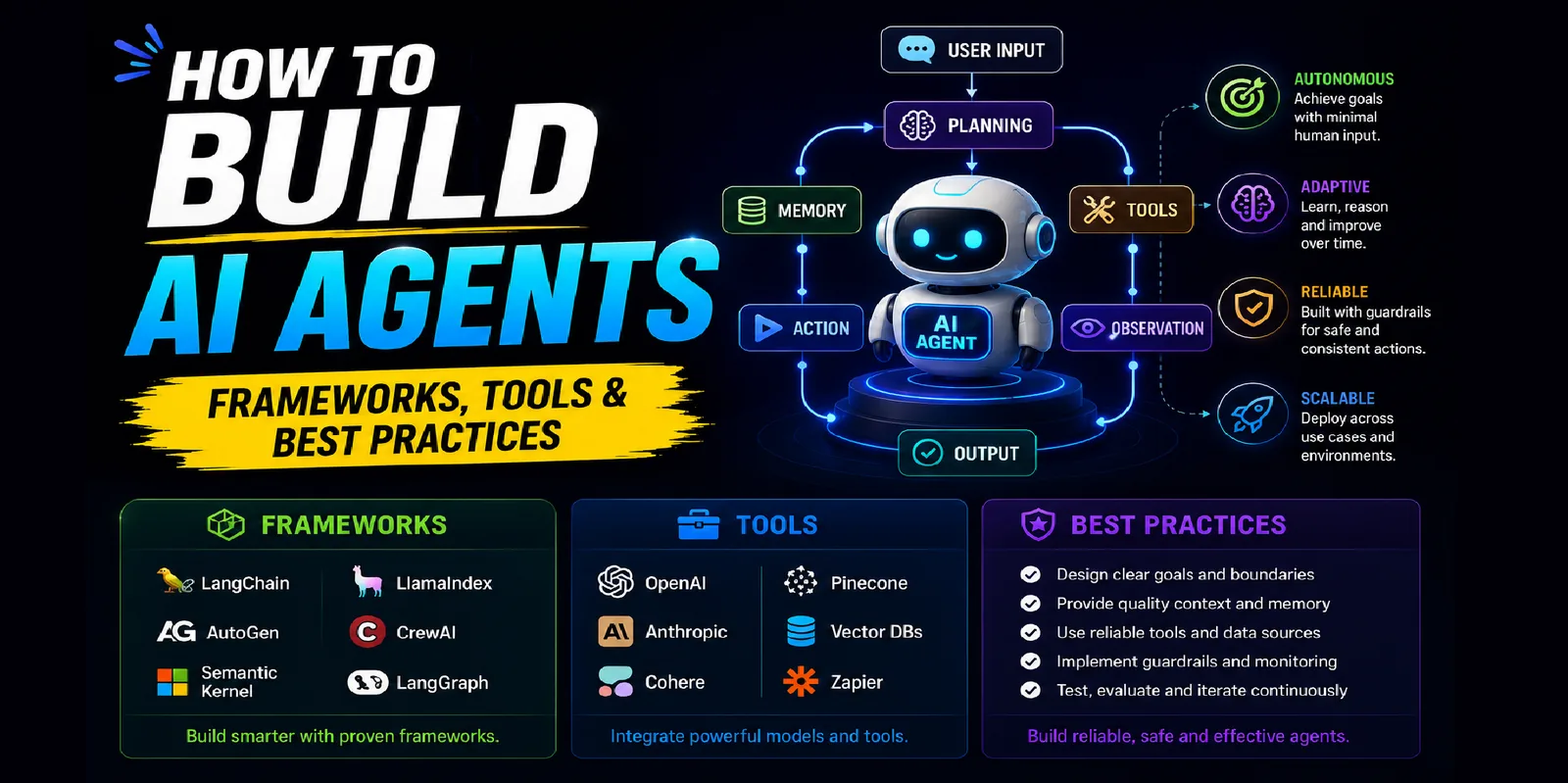
How to Build AI Agents: Frameworks, Tools & Best Practices
Step-by-step guide to building production AI agents. Compare frameworks, select tools, and follow best practices for reliable agent development in 2026.
Faizan Ali Khan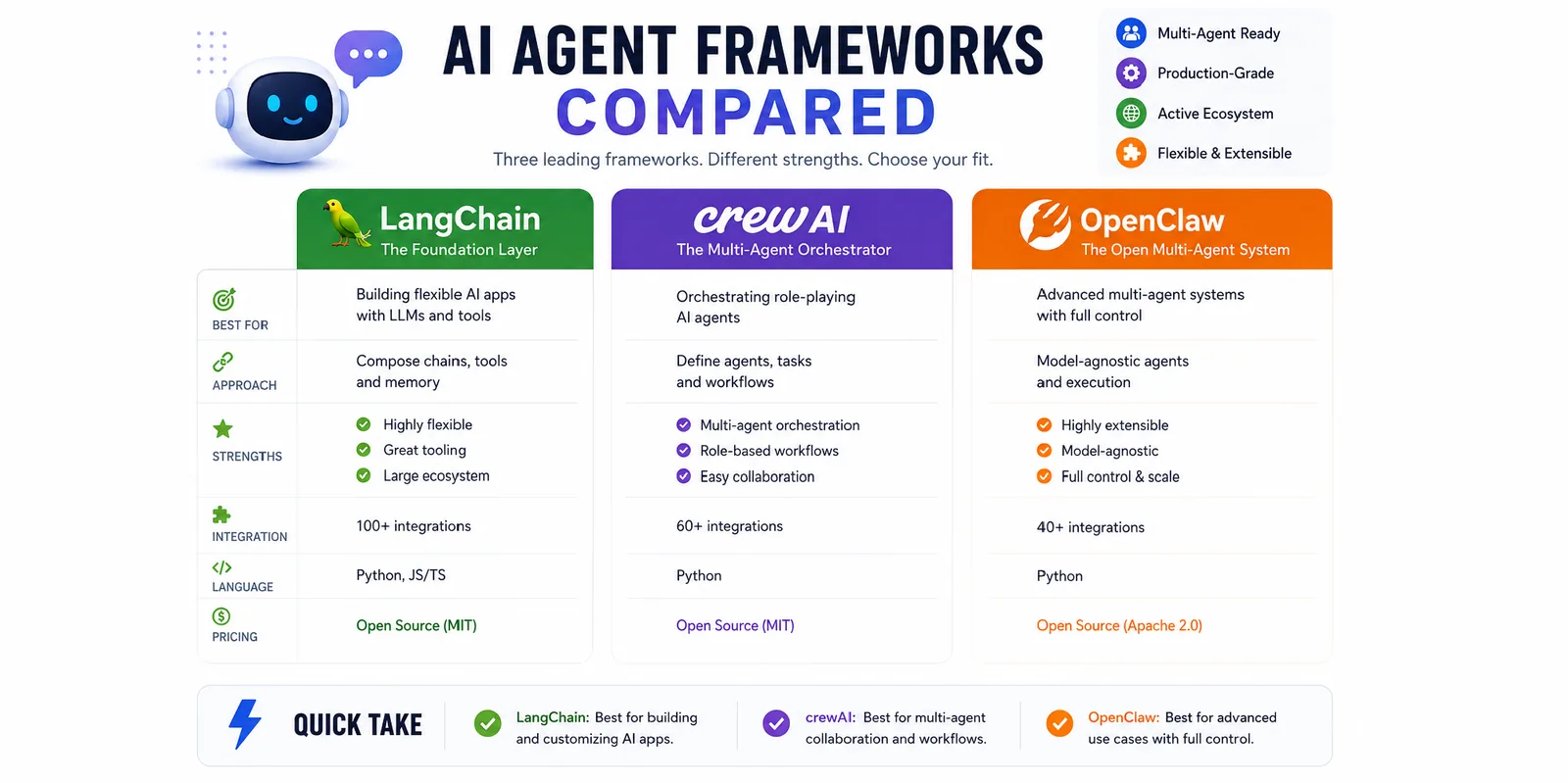
AI Agent Frameworks Compared: LangChain vs CrewAI vs OpenClaw
Detailed comparison of LangChain, CrewAI, and OpenClaw agent frameworks. Features, pricing, operating effort, and use case fit for enterprise AI agent development.
Faizan Ali Khan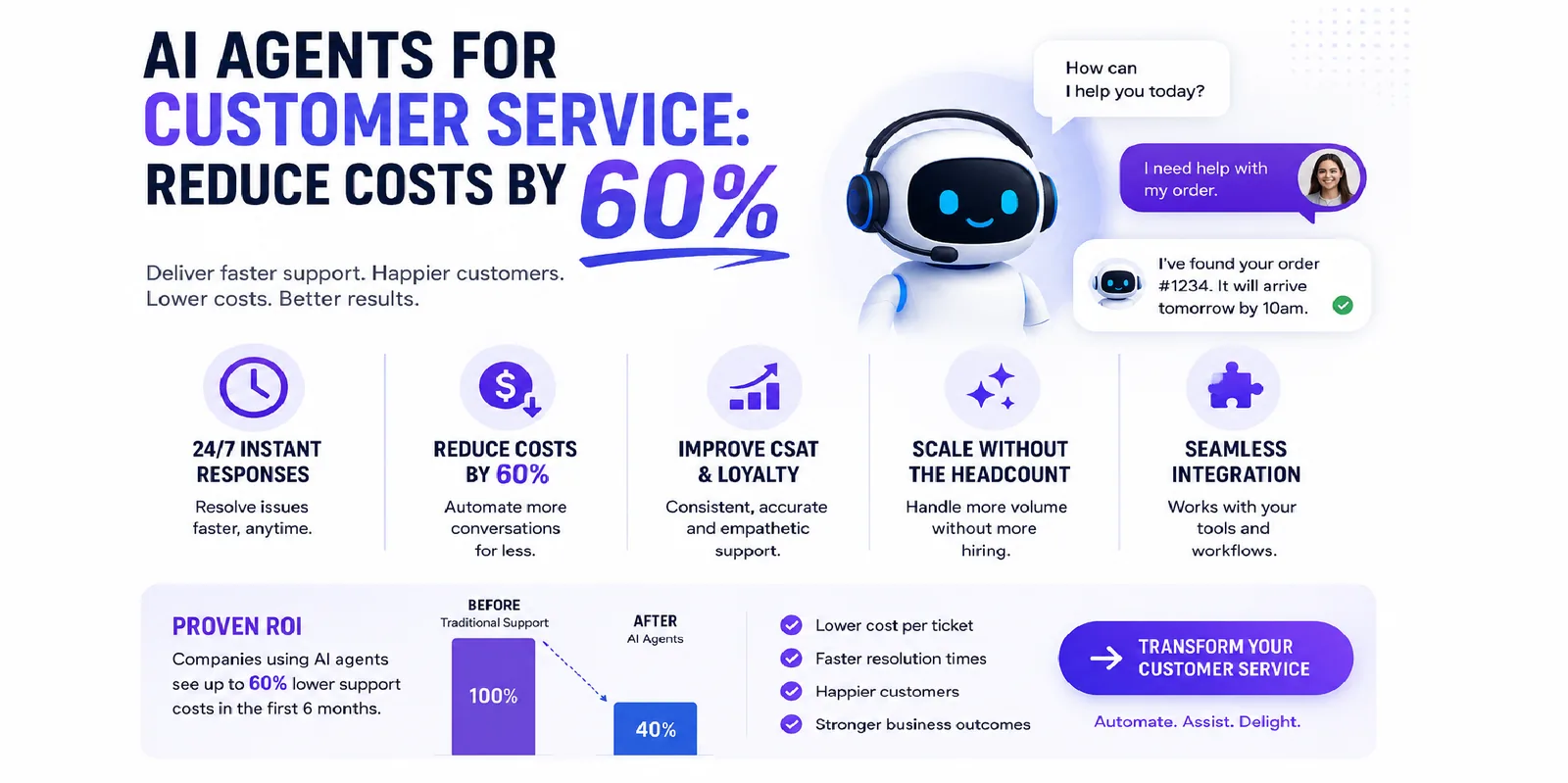
AI Agents for Customer Service: Reduce Costs by 60%
AI agents for customer service resolve 70%+ of tickets autonomously, cutting costs by 60%. Learn implementation strategies, real results, and best practices.
Faizan Ali KhanReady when you are
Want Cubitrek to run AI Agents for you?
We install ai agents programs for growing companies across the US and Europe. Book a call and we'll come back with a one-page plan in 72 hours.