

Answer Engine Optimization Tools: How to Choose One in 2026
Every AEO tool runs the same mechanic: a sampled prompt list against a few engines. Here is what they actually measure, the sampling problem nobody prices honestly, and the free cycle to run before you subscribe.

Answer engine optimization tools track whether AI engines mention your brand when someone asks a buying question. They run a list of prompts against ChatGPT, Perplexity, Gemini, Google AI Overviews, and Copilot on a schedule, record which brands and sources each answer names, and chart your share of those mentions over time.
That is the entire category. Everything else, the dashboards, the sentiment charts, the competitor tables, is presentation on top of that one mechanic. Once you know the mechanic, the buying decision gets much simpler, and so does the question of whether you need a tool at all this quarter.
What every AEO tool is actually doing
What an answer engine optimization tool measures
Three metrics matter, and they are not the same thing.
Mention rate. Out of the prompts you track, how many produce an answer that names your brand. This is the headline number on most dashboards.
Citation share. When the engine links its sources, how often one of those links is yours. A brand can be mentioned without being cited, and cited without being mentioned in the prose. These come apart more often than you would expect.
Sentiment and framing. How the engine describes you when it does mention you. Being named as "a budget option" in every answer is a different problem from not being named at all, and it needs a different fix.
The sampling problem nobody puts on the pricing page
Here is the thing that changes how you read every number these tools produce.
They do not measure your visibility. They measure a sample of it.
You can see this in how the category prices itself. Otterly.ai, whose plans are published openly, sells 15 prompts on its $29 Lite tier, 100 prompts on the $189 Standard tier, and 400 on the $489 Premium tier. You are not buying access to a measurement of AI search. You are buying a number of questions per cycle.
That has three consequences.
- Two tools will give you different numbers for the same brand in the same week. They ran different prompts. Neither is lying and neither is precisely right.
- Your prompt list is the measurement instrument. Pick 15 prompts where you already do well and your dashboard looks great while your pipeline stays empty. The prompt list deserves more care than the tool choice.
- Trend beats level. The absolute mention rate is close to meaningless across tools. The direction of that number, measured with a fixed prompt list over months, is the real signal.
Check engine coverage before you check price
The second thing the pricing page will not lead with: which engines are actually included.
Otterly's published plans cover ChatGPT, Google AI Overviews, Perplexity, and Microsoft Copilot on every tier, with Claude, Gemini, and Google AI Mode sold as paid add-ons rather than bundled. Peec AI's product page lists ChatGPT, Perplexity, and Gemini. Coverage differs meaningfully between vendors, and it changes as engines launch and rename surfaces.
So "tracks all major AI engines" is a claim to verify on the pricing page, not in the hero section. Two questions settle it:
- Which engines are in the plan I am about to buy, as opposed to the product overall?
- Is Google AI Mode included, and is it separate from AI Overviews in the reporting?
That last one matters more each month. AI Mode is where a growing share of commercial questions get answered without a click, and a tool that folds it into a general "Google" bucket cannot tell you what is happening there.
The categories, and who each one suits
How the AEO tool market splits
| Category | What you get | Suits |
|---|---|---|
| Entry trackers | A small prompt panel, a handful of engines, a simple share-of-voice chart | One brand, one market, proving the problem exists before you spend more |
| Mid-market platforms | Bigger panels, source attribution, competitor benchmarking, topic gap analysis | In-house teams running AEO as a standing program |
| Enterprise analytics | Large answer catalogues, agent and crawler analytics, SSO, security review | Multi-brand or regulated organizations that need procurement to sign off |
| Agency and multi-client | Client workspaces, white-label reporting, per-client prompt sets | Agencies reporting AI visibility to several clients each month |
| Crawler-side tools | How AI crawlers fetch and parse your pages, what they can extract | Teams whose problem is retrieval and rendering, not positioning |
Tools you will meet while shopping include Profound, Peec AI, Otterly.ai, Scrunch AI, Rankscale, and the AI visibility modules now bundled into Semrush and Ahrefs. If you are assembling the whole search stack rather than only the visibility layer, the 2026 AI SEO stack covers where classic SEO and AI writing tools fit around these. The category is young enough that feature lists shift quarterly, which is a good reason to buy monthly rather than annually in your first year.
What we see running these panels
Four patterns come up often enough across the programs we run to be worth planning around. These are proportions rather than counts, taken across engagements rather than any single one, and they are directional rather than benchmarks you should hold your own numbers against.
Engine spread is the largest single source of variance. For one brand, one question set, one week, the gap between the most and least generous engine is routinely wider than any month-to-month movement we later work hard to produce. A tool that reports one blended score hides that. Ask for the split before you report a number upward, because the blended figure will move on its own whenever an engine changes behavior.
The first prompt list a team writes is usually too kind. Teams naturally write prompts in their own vocabulary, using their category words and their framing. Rewrite the same list in the language a buyer actually uses and measured visibility typically drops, sometimes by half. That fall is not a regression. It is the first honest reading, and it is the one worth tracking from then on.
A minority of pages earn most of the citations. In the audits we run, citations concentrate heavily in a small share of pages, and it is consistently the pages that answer one question completely in a single self-contained passage. Long pages that cover six topics get retrieved and then passed over. This is why we treat passage structure as the first fix and measurement as the second.
Being cited and being visited are now different outcomes. This is the one that surprises teams most, and we can show it on our own property rather than a client's.
Do the free version first
Before any subscription, run one manual cycle. It takes an afternoon and it is the same mechanic the tools automate.
- 01
Write 20 buying questions
Not your brand name. The questions someone asks before they know you exist: best X for Y, X vs Z, how much does X cost, is X worth it. If your sales team answers a question weekly on calls, it belongs on this list.
- 02
Ask each engine in a clean session
ChatGPT, Perplexity, Gemini, and Google with AI Overviews on. Turn memory and personalization off, or use a logged-out window. Your own history will otherwise flatter you.
- 03
Record four columns
Prompt, engine, were you named, what was cited. Nothing else. A spreadsheet is fine and gives you a baseline you own rather than rent.
- 04
Read the citations, not the score
The sources the engines quote are your actual competitive set. Usually it is a mix of one or two publishers, a comparison site, and a Reddit thread. That list tells you where the next quarter of work goes.
- 05
Repeat monthly, same prompts
The value is entirely in the comparison. Change the prompts and you have thrown away the baseline.
If that run shows you are absent everywhere, you do not have a measurement problem. You have a visibility problem, and a tool will only tell you the same thing again next month with better charts. Fix the content and entity work first, and buy the tracker when you need to prove movement to someone else.
How to choose, in one page
Score any tool you are considering on these six, before the demo:
- Prompt capacity on the plan you will actually buy. Not the top tier in the comparison table.
- Engines included in that plan, with AI Mode named explicitly.
- Raw answer text, exportable, not just aggregate scores.
- Source attribution. Which domains shape the answers you lose. This is the field that turns a dashboard into a work list.
- Refresh frequency, and whether you can re-run a prompt on demand after shipping a fix.
- Contract length. Monthly, in a category this young.
Two things deliberately not on that list: the number of engines advertised on the homepage, and the size of the vendor's answer catalogue. Both are marketing surface area. Neither changes what you do on Monday.
Where this fits
A tracker tells you whether the work is landing. It does not do the work. The things that move the number are the same ones that have always moved organic visibility, adjusted for a reader that is now a model: clean self-contained passages, entity clarity in your schema, a crawlable and current site, and third-party sources that corroborate what you say about yourself.
It is also worth being clear about which discipline you are buying for, because vendors use the acronyms loosely. AEO, GEO, and SEO overlap on foundations and diverge on what counts as a win: an extracted answer, a citation inside synthesized prose, or a ranked link.
Run the AEO audit checklist first to find which of those is weakest on your site. Measure second. And if the honest answer is that nobody internally has time to run any of it, how to choose an AEO agency covers what to ask before you hand it to someone else.
Key takeaways
- Your prompt list is the measurement instrument. Choose it more carefully than you choose the vendor.
- Judge trend, not level. Absolute mention rates are not comparable across tools.
- Engine to engine spread is usually wider than any month to month gain, so never report a single blended score without the split underneath it.
- Demand raw answer text and source attribution. Scores alone cannot tell you why you lost a citation.
- Buy monthly in a category whose feature lists shift quarterly.
Questions people ask about this
Sourced from client conversations, Search Console, and AI-search citation monitoring.
- Answer engine optimization tools track whether AI engines mention and cite your brand. They run a fixed list of prompts against ChatGPT, Perplexity, Gemini, Google AI Overviews, and Copilot on a schedule, record which brands and sources each answer names, and report mention rate, citation share, and sentiment over time.
- Because each one measures a sample, not your total visibility. Plans are sold by prompt count, so two vendors running different prompt lists against different engine mixes will produce different mention rates in the same week. Neither is wrong. Compare the trend from a fixed prompt list rather than the absolute number between tools.
- Published entry plans start under $30 a month for a small prompt panel, mid-market plans run into the low hundreds, and enterprise analytics is quoted. Otterly.ai publishes $29, $189, and $489 tiers for 15, 100, and 400 prompts respectively, which shows the pattern: most of the price difference between tiers is sample size, not capability. Verify current pricing with the vendor.
- Yes, for one brand and a short prompt list. Write 20 buying questions, ask each in a clean logged-out session on ChatGPT, Perplexity, Gemini, and Google with AI Overviews, and record whether you were named and what was cited. Repeat monthly with the same prompts. Paid tools buy scale, scheduling, and an audit trail, not a different measurement.
- Check what your current subscription already includes, since both have shipped AI visibility features. A dedicated tool earns its place when you need larger prompt panels, per-client workspaces, or deeper source attribution than a bundled module provides.
- Mostly the label. Answer engine optimization and generative engine optimization describe overlapping work, and vendors pick whichever term their market uses. Compare the mechanics, prompt capacity, engine coverage, raw answer access, and source attribution, rather than the acronym on the homepage.
- Expect weeks, not days. Engines re-crawl and re-index on their own schedule, and some answer from a cached model view that lags your site. Ship the fix, then judge the effect over a month using the same prompt list you measured with before.
- The one whose category matches your problem. An entry tracker with a small prompt panel is the right answer for most companies in their first two quarters of AEO, and the wrong answer for an agency reporting to eight clients. Anyone who names a single best tool without asking about your prompt list, your engines, and your reporting audience is selling rather than advising.
Keep reading
Related articles.
More on the same thread, picked by tag and category, not chronology.
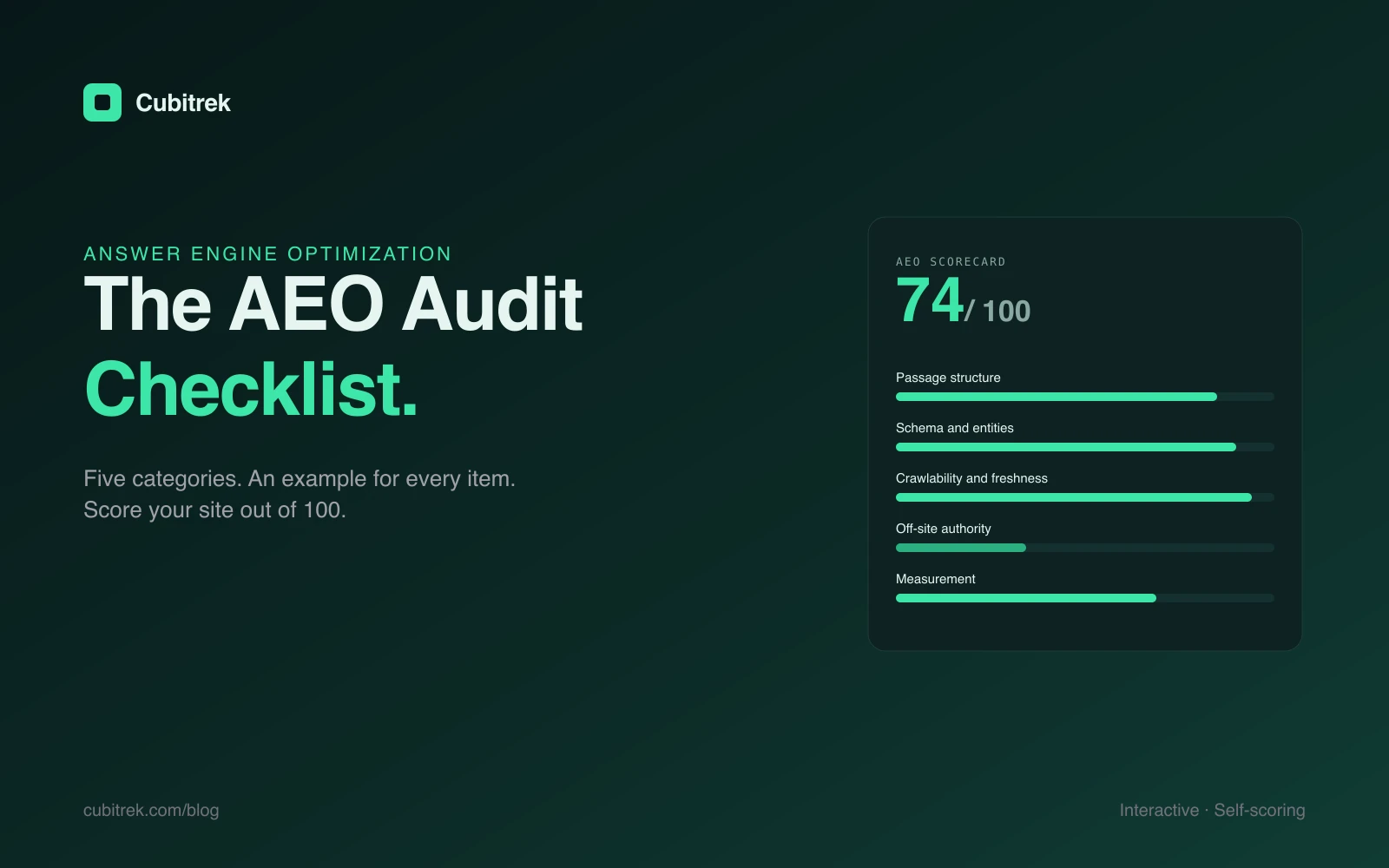
The AEO Audit Checklist
An interactive AEO audit with a weak-versus-strong example for every item, real audit scores, and a live self-scoring widget. Grade your site in five minutes.
Faizan Ali Khan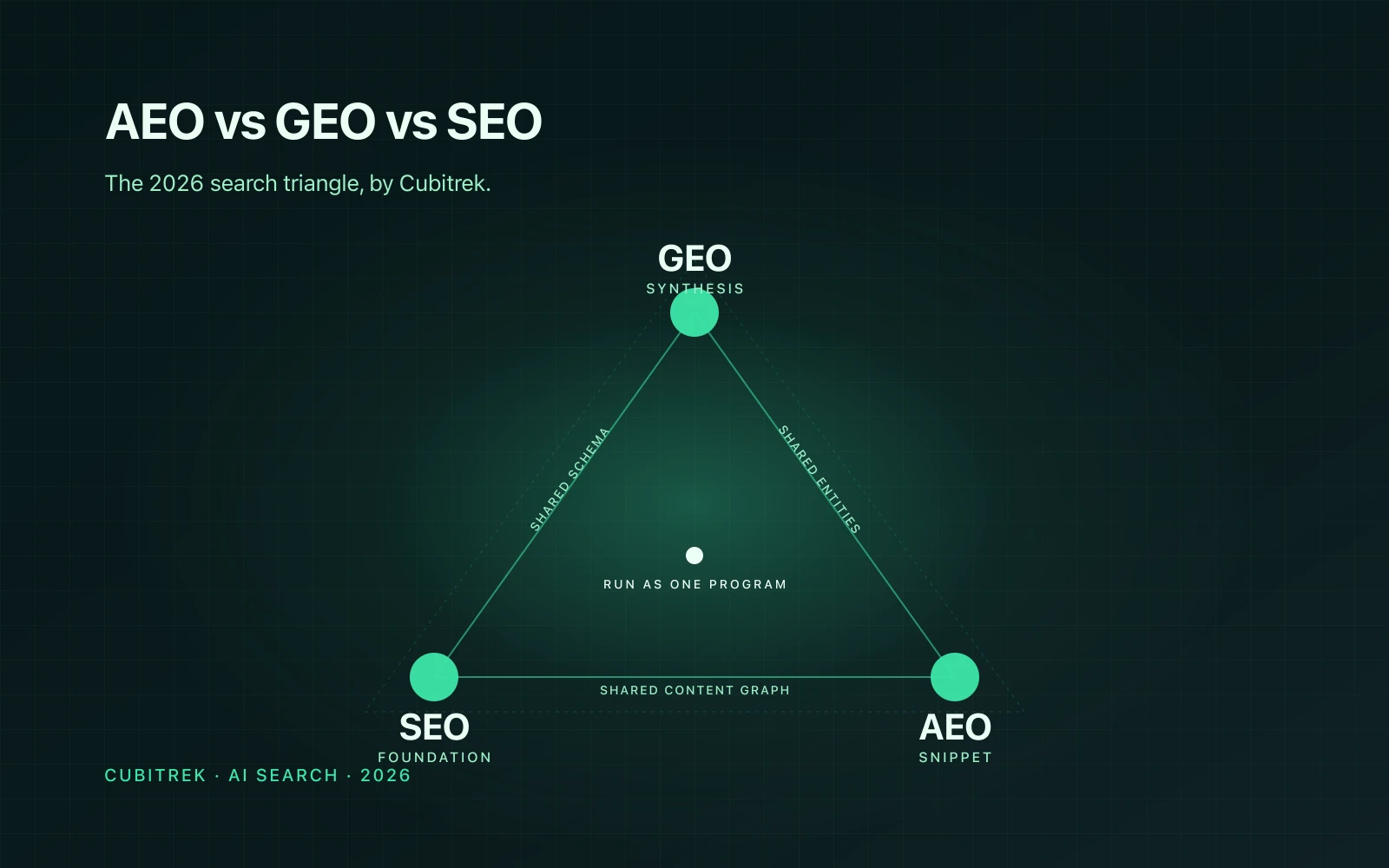
AEO vs GEO vs SEO: The Triangle
SEO is the foundation. AEO is the snippet game. GEO is the synthesis game. They are not competitors. Run them as one program and they compound.
Faizan Ali Khan
AEO 101: The Definitive Guide to Answer Engine Optimization in 2026
Answer engine optimization is how a brand gets cited inside ChatGPT, Perplexity, Claude, Gemini and Google AI Overviews. What AEO is, how it differs from SEO, and the playbook to run.
Faizan Ali KhanReady when you are
Want Cubitrek to run AEO & GEO for you?
We install aeo & geo programs for growing companies across the US and Europe. Book a call and we'll come back with a one-page plan in 72 hours.