Answer engine optimization: the 2026 AEO playbook
Answer engine optimization is how a brand gets cited inside ChatGPT, Perplexity, Claude, Gemini and Google AI Overviews. What AEO is, how it differs from SEO, and the playbook to run.

Answer engine optimization is how brands stay visible when search answers the question itself. Google shows AI Overviews and AI Mode, and many people ask ChatGPT, Perplexity, Claude or Gemini directly. Pew Research Center found Google users clicked a regular result in 8% of visits with an AI summary, against 15% without one.
If your brand is not inside that answer, you do not exist for that query.
Answer engine optimization (AEO) is the discipline that fixes this. AEO shapes your site so AI engines can find your facts, trust them, and quote them inside the answers they synthesize. This guide is the 2026 AEO playbook: what answer engine optimization is, why it matters now, the four things you have to do, and the fastest way to start running it for your brand this week.
How we measure AEO before we touch anything
What is Answer Engine Optimization (AEO)?
Answer Engine Optimization (AEO) is the work of getting AI engines to quote your facts when they answer a user's question.
Old SEO chased keyword rankings and clicks. AEO chases citations inside the AI's answer. The goal is simple. When an AI talks about your category, your brand is the source it pulls from.
How questions changed
Questions are getting longer: Google says the average AI Mode search is three times the length of a traditional query. People describe their situation in full sentences. "I have sensitive skin, I live in a humid climate. What under-50-dollar moisturizer will not feel greasy?"
You cannot win that with old keyword pages. Pair an API-First SEO approach with Action Schema so AI agents can read your content and call your services.
AEO, GEO, and SEO: the new triangle
You will hear all three a lot. They are not competing. They stack.
- SEO is the foundation. It gets you indexed and crawled.
- AEO is the snippet game. Be the direct, quoted answer to a short factual query.
- GEO is the synthesis game. Be the trusted source the AI weaves into longer answers for complex prompts.
Cubitrek runs them as one program. Most of the work is shared, schema, entity clarity, content structure, and citation tracking. Splitting them costs time and money. For the full breakdown of where each layer wins and what to ship first, see AEO vs GEO vs SEO: the 2026 search triangle.
Answer engine optimization vs SEO: the entity comparison
| Dimension | Classic SEO | Answer Engine Optimization |
|---|---|---|
| Primary unit | A keyword | A user prompt (full sentence) |
| Success signal | Rank position + click | Citation inside an AI-written answer |
| Page format that wins | Long-form, link-rich | Answer blocks + entity facts + Q&A |
| Schema priority | BlogPosting + breadcrumb | Organization + Article + Product or Service, matching the visible page |
| Authority signal | Backlinks | Cross-web brand mentions + reviews + reputation |
| Measurement | Search Console Performance report | Search Console Generative AI report, Bing's AI Performance report, a prompt panel for other engines |
| Click value | Diluted across ranks 1-10 | Fewer clicks, from visitors who already read a summary |
AEO does not replace SEO. It runs in parallel. Most of the underlying work overlaps (Schema, entity clarity, content structure) which is why a unified program ships faster than two separate retainers.
Why AEO matters for revenue
AI now decides who gets evaluated
When a user asks an AI about your industry, the model writes a fresh answer from sources it trusts. If you are not in that answer, you lose the customer before they ever visit your site.
If you are in it but the data is wrong, the AI ships your brand with stale facts or a hallucinated detail. Either way the buyer moves on.
The conversion paradox
AEO triggers zero-click answers. The AI replies, the user does not visit. That sounds bad. It is not.
The traffic that does click is heavily pre-vetted. Someone arriving from an AI answer has already been told you are a credible option, so the page has a different job to do than it does for a cold search click. We are not going to put a conversion multiple on that, because we have not measured one across enough engagements to stand behind it.
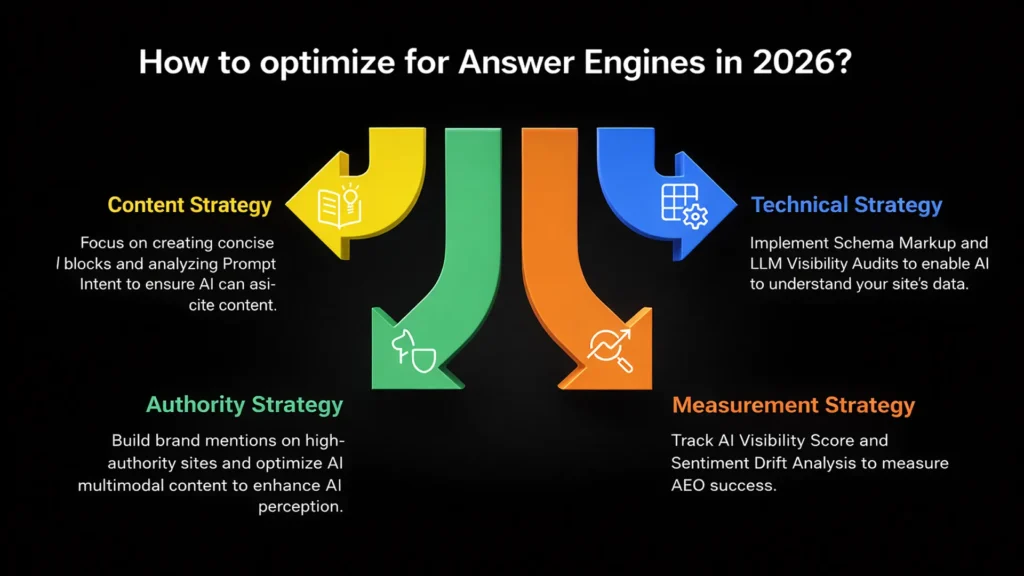
The four things AEO requires
I. Content built in answer blocks
Modern AI rewards content it can chunk, lift, and quote. Three habits do most of the work.
- The 50-word rule. Open every page or major section with a clean 40 to 60 word answer. It helps readers; Google says AI features need no special chunking.
- Prompt research. Stop chasing keyword volume alone. Track the actual prompts users type into ChatGPT and Gemini.
- Semantic triples. Write in subject-verb-object form. AI agents lift those facts straight into their knowledge graph.
II. Technical: speak machine
Great content fails if the page has no labels. Schema is the labeling work. Pair it with Unit Testing for SEO so things stay solid as engines change.
- Schema markup. The 2024 Web Almanac found JSON-LD on 41% of pages. Google does not require it for AI features, but it keeps pages eligible for rich results. Generate paste-ready blocks with our free Schema JSON-LD builder, then read up on nested JSON-LD for GraphRAG retrieval when you are ready for deeper graphs.
- An llms.txt file. Optional: Google Search ignores it, though some other services read it. We built a free generator if you want one.
- Crawler budget control. Let good agents through. Block training scrapers. See robots.txt 2026 for AI crawler budgets for our config.
- Weekly LLM visibility audits. Ask the top five AI engines about your brand and log every miss.
III. Authority: signals across the open web
AI does not stop at your site. It reads what the rest of the internet says about you. Track Sentiment Drift Analysis so you see how AI views of your brand shift.
- Plain-text mentions. Reddit threads, Wikipedia, trade journals. They count, links optional.
- Reviews and forums. AI fuses them into one verdict on your brand.
- Multimodal recognition. Google Lens treats images and video frames as entities. Optimize alt text, captions, and keyframes too.
IV. Measurement: new KPIs
Old metrics like "rank one" are fading. Track these instead:
- AI Visibility Score. How often is your brand cited for your top prompts?
- Sentiment drift. Is the AI's view of you improving or sliding?
- Information gain. How much new value does your content add the AI cannot find elsewhere?
Every tracker on the market measures the first of those by sampling a prompt list, which is why two of them will report different numbers for you in the same week. How to choose an AEO tool covers what to check before subscribing, and the free cycle to run first.
Case study: Keyper, from a fixed question panel to 90% coverage
Keyper is a Dubai proptech. Before any optimization we fixed a panel of 73 buyer questions across ChatGPT, Perplexity and Gemini and took a reading, so that any later number had something constant to be measured against. Then we wrote passage-first content and fixed the entity layer.
Keyper, June 2026 reading
What carries over is the sequence, not a timeline.
Five common answer engine optimization mistakes
Most teams shipping AEO for the first time make at least three of these. Each one quietly caps your citation rate at a fraction of what the same content could earn.
1. Writing for keywords, not prompts
Old SEO targets "best CRM for small business." AI users type "I run a 12-person services firm in Austin, my team hates Salesforce, what should we switch to?" If your H2s answer the keyword and not the prompt, AI engines do not lift you. Fix: build a question panel from sales calls, support tickets, Search Console queries and Bing's AI grounding queries, then write H2s that mirror them.
2. Treating Brand Hub as a meta description
A Brand Hub is not a one-paragraph "About" page. It is a structured, fact-dense single source of truth: legal name, founders, every product, every service, every coined concept, pricing structure, geographic coverage, official position statements. AI engines parse this once and trust it for months. Ship it as a real page (we run ours at /brand-hub) plus a machine-readable llms.txt at the root.
3. Shipping schema without entity reinforcement
JSON-LD alone is a baseline check. The compounding signal is entity reinforcement: your Organization schema points at your founders, who point at LinkedIn + Crunchbase + Wikipedia, who point back at your domain. AI engines follow the entity graph. A single isolated <script type="application/ld+json"> block does not produce citations; a knowledge graph does.
4. Optimizing only the homepage
The homepage is where buyers land after they trust you. AEO citations come from deep content pages answering specific prompts. Run the 50-word answer-block rule on your top 30 service + blog pages, not just the front door.
5. Measuring SEO metrics for an AEO program
If you grade an AEO program on Google rank position, you will conclude it is failing while citations climb in ChatGPT, Perplexity, and Gemini. Track AI Visibility Score per platform, sentiment drift, and citation freshness: the metrics the program moves.
Implementing AEO: the eight-step checklist
- Run an LLM visibility audit. Ask the top five AI engines about your brand. Log every miss and every wrong fact. The 2026 AEO audit checklist is the working version of this step, expanded to every layer below.
- Ship a Brand Hub. One canonical page plus an
llms.txtfile with your facts, founders, services, and citation guidance. - Rewrite your top 20 pages in answer blocks. Open with the 50-word rule. Use FAQs in question-and-answer form.
- Layer in schema. Organization, Service, Product, Article. Google no longer shows FAQ or HowTo rich results. Validate every page.
- Manage your ambient reputation. Reddit, niche forums, review sites. AI verifies brand truth using human-led data.
- Track citations weekly. Re-run the same question panel on the engines your buyers use and log what moved.
- Pair AEO with GEO. Most of the work is shared. Run them as one program.
- Get senior help if you need it. AEO and GEO are still new. The right partner compresses six months of trial into one sprint.
What is coming next: ambient search
By 2027 search becomes ambient. It will not live in a search bar. It will live in glasses, cars, kitchens, and code editors. These systems will book flights, buy software, and pick vendors based on the AI's verdict.
The brands that win in that world stop trying to rank. They start trying to inform.
Conclusion
Answer engine optimization is not a black box. It is a measurable discipline that puts you back in control of your brand's story inside AI engines. Get the technical foundations right, structure your content for chunking, build authority across the open web, and your brand becomes the answer when buyers ask the question.
Two ways to start this week:
- Self-serve: measure your AI Visibility Score on the Cubitrek AEO Platform. Free tier.
- Done-for-you: see the AEO + GEO consulting program. Senior operators ship the full system end-to-end, using the same platform.
Are you ready to be the answer?
Frequently asked questions
1) Is AEO replacing SEO?
No. Run them together. SEO gets you indexed. AEO gets you into the answer. Run only SEO and you fight for a shrinking pool of clickers. Run both and you cover classic search and AI answers.
2) What is the difference between AEO and GEO?
AEO is the snippet game. Be the direct, quoted answer to a short factual query. GEO is the synthesis game. Be the trusted source the AI weaves into longer answers. Most of the work is shared. Cubitrek runs them as one program for that reason.
3) How fast does AEO show results?
There is no reliable timeline; it depends on recrawl frequency and competition. Take a baseline on a fixed question panel, then re-run it on a schedule.
4) How do I find the queries real users ask AI engines?
Old keyword tools will not help. No engine publishes the prompts people type. Bing's AI Performance report shows the grounding queries behind Copilot citations; for other engines, build a fixed panel from sales calls, support tickets and Search Console queries.
5) Do I need an AI visibility tool?
Yes. If you cannot measure where you are cited, you cannot improve it. Start with the free reports: Search Console's Generative AI report (AI Overviews, AI Mode) and Bing's AI Performance report (Copilot). Other engines need a prompt panel.
6) What is the AI Visibility Score?
It is a 0 to 100 metric we built into the Cubitrek AEO Platform (live at aeo.cubitrek.com) that fuses three signals into one number. AI Answer mentions. AI Output mentions. Crawler page fetches. Across ChatGPT, Perplexity, Gemini, Claude, and Microsoft Copilot.
7) How much does answer engine optimization cost?
Self-serve via the Cubitrek AEO Platform starts free and scales with the number of tracked prompts and domains. Done-for-you AEO + GEO consulting through Cubitrek's AEO/GEO program is a monthly retainer in three tiers: Brand Hub, Scale and Enterprise. We quote after a short scoping call.
8) Can I run AEO in-house, or do I need an agency?
Both work. The platform half (citation tracking, Brand Hub structuring, content scoring) is now self-serve via aeo.cubitrek.com. The consulting half (writing the answer blocks, fixing schema, building authority across the open web) needs either an in-house operator with regular weekly time or an agency partner. Teams that already run their own SEO usually graduate to running their own AEO too, after a 30-day audit.
9) What is the difference between answer engine optimization and generative engine optimization?
AEO targets the snippet game: be the direct, quoted answer to a short factual query ("what is X", "best Y for Z"). GEO targets the synthesis game: be the trusted source the AI weaves into longer, multi-source answers to complex prompts ("compare X vs Y for our specific use case"). Most of the underlying work is shared: schema, entity clarity, content structure. Cubitrek runs them as one program for that reason.
10) Will AEO replace traditional SEO in 2026?
No. Google still serves billions of blue-link searches per day. AEO captures the rapidly growing share that now lives inside AI answers. Smart brands run both: classic SEO for high-intent transactional queries (where users want to click), and AEO for the broader research and consideration phase (where users want a synthesized answer). The two channels compound, not compete.
Key takeaways
- Fix a question panel and take a baseline before changing anything.
- Write plain answers and first-hand content; Google asks for non-commodity content, not recycled summaries.
- Keep schema matched to the visible page; Google no longer shows FAQ or HowTo rich results.
Questions people ask about this
Sourced from client conversations, Search Console, and AI-search citation monitoring.
- Answer Engine Optimization (AEO) is the process of optimizing your brand’s digital footprint so that AI-powered systems can easily discover, understand, and accurately represent your information as a direct answer to user queries.
Keep reading
Related articles.
More on the same thread, picked by tag and category, not chronology.
How to Choose an AEO Tool
Every AEO tool runs the same mechanic: a sampled prompt list against a few engines. Here is what they actually measure, the sampling problem nobody prices honestly, and the free cycle to run before you subscribe.
Faizan Ali Khan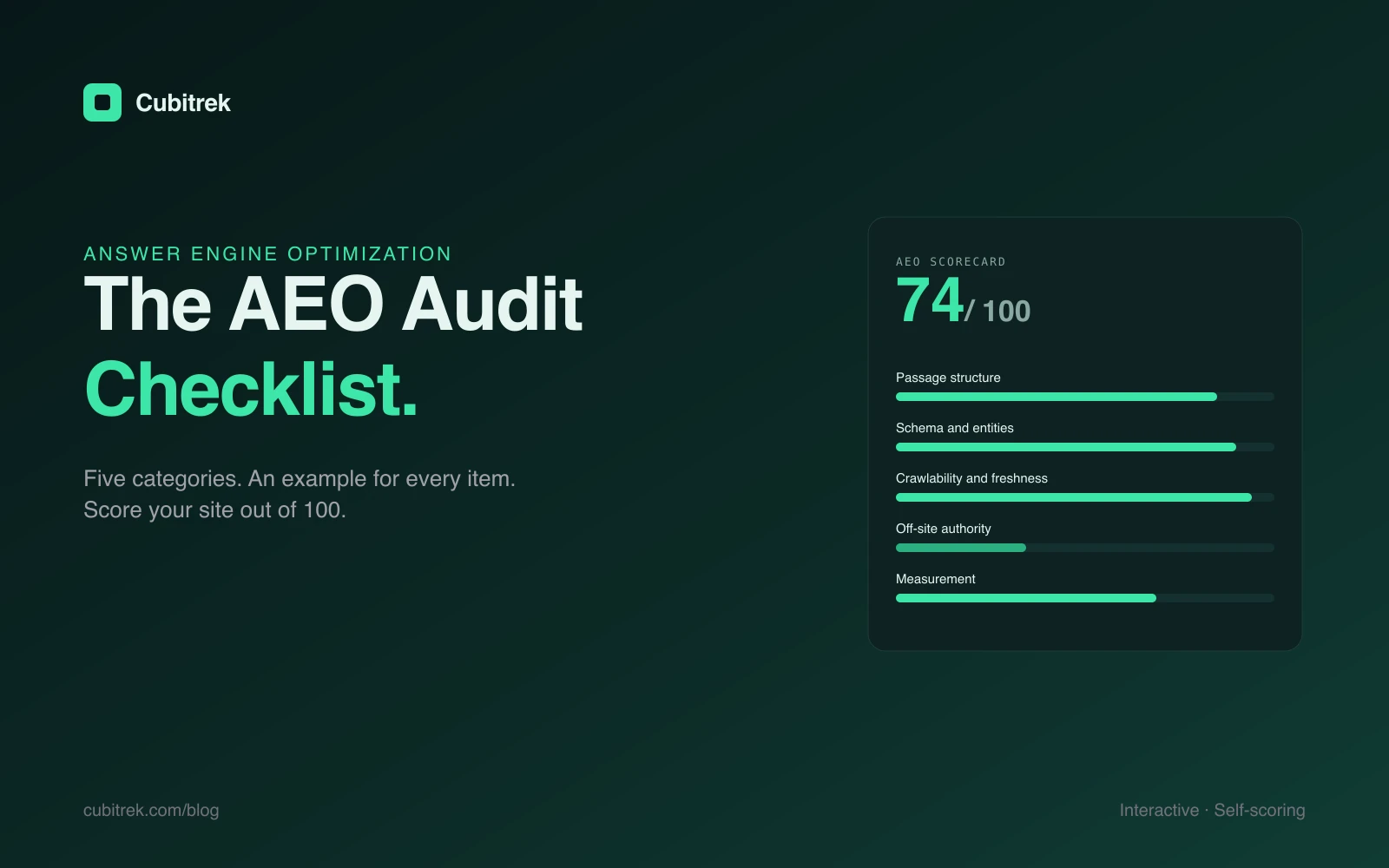
The AEO Audit Checklist
An interactive AEO audit with a weak-versus-strong example for every item, real audit scores, and a live self-scoring widget. Grade your site in five minutes.
Faizan Ali Khan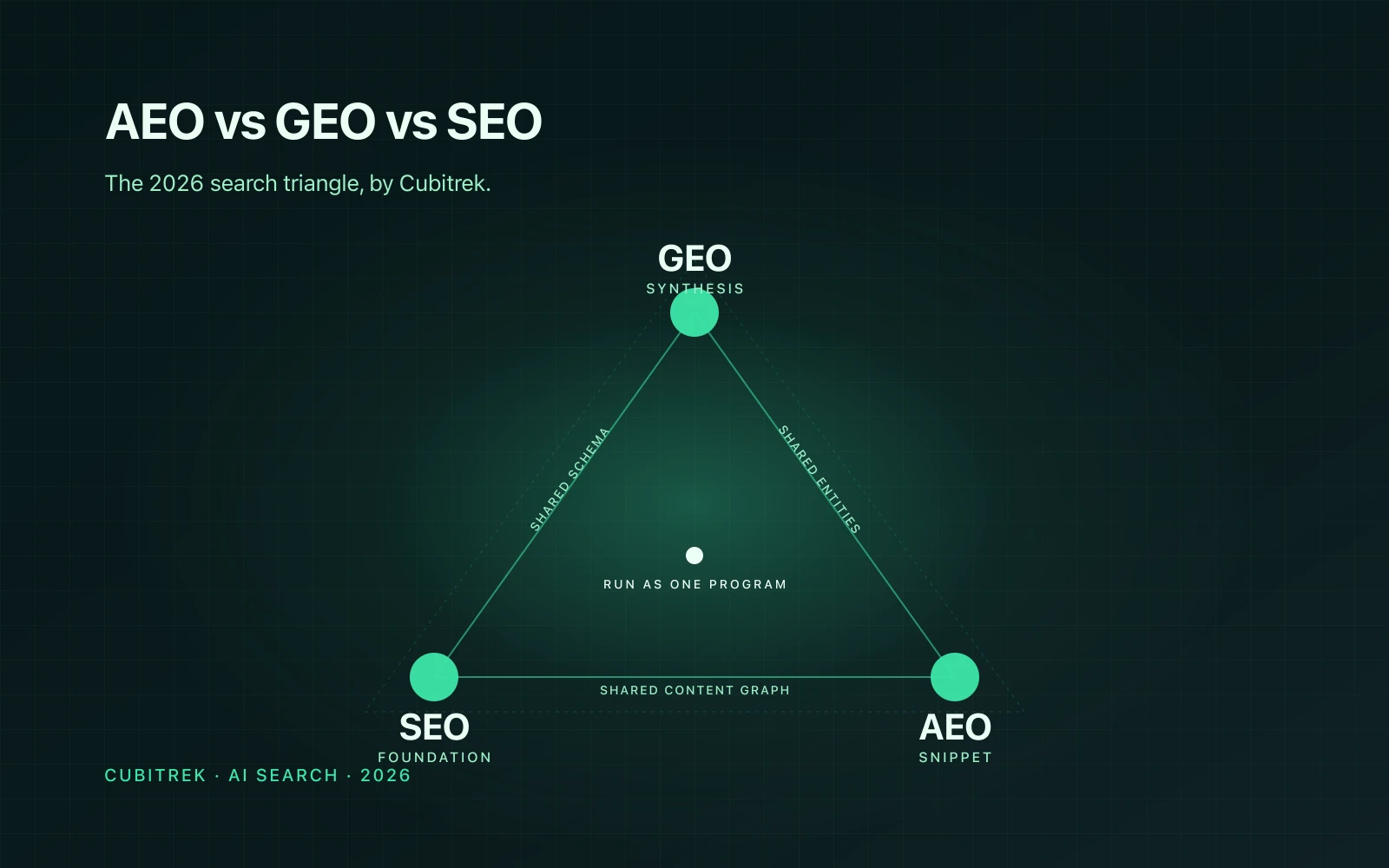
AEO vs GEO vs SEO: The Triangle
SEO is the foundation. AEO is the snippet game. GEO is the synthesis game. They are not competitors. Run them as one program and they compound.
Faizan Ali KhanReady when you are
Want Cubitrek to run AEO & GEO for you?
We install aeo & geo programs for growing companies across the US and Europe. Book a call and we'll come back with a one-page plan in 72 hours.