
Allied Bank: Half a Content Cohort into the Top 20 in 4 Weeks
One of Pakistan's largest banks ranked for its own name and little else. What happened when the first content cohort targeted the questions customers ask before they are ready to open an account.

Allied Bank is one of Pakistan's largest banks. Its website ranked well for its own name and very little else, which is the normal condition for an incumbent brand: the product pages carry the domain, and every question a customer asks before they are ready to open an account gets answered somewhere else.
We were engaged to fix the second half of that. This is what the first cohort did in its first four weeks.
First content cohort, first four weeks
The problem
A bank's search footprint is usually shaped like a barbell. Enormous brand volume at one end, product pages at the other, and almost nothing in the middle where the actual decision happens. Someone asking how to register for mobile banking, whether an investment is halal, or what a bank statement is used for is a customer in the making. Those questions were being answered by forums, aggregators and competitors.
The commercial problem is that this traffic is cheap to earn and expensive to buy. The strategic problem is that the answers being read were not the bank's.
What we did
Mapped the question space, not the keyword list. We built the plan around what a customer asks in sequence rather than around search volume alone, which is what produces a cluster that ranks together instead of ten posts competing with each other.
Wrote to a defined structure. Every post opens with a self-contained answer, uses the question as the heading, and carries one verifiable specific in the first paragraph. This is the same structure that makes a passage quotable by an answer engine, so the work serves classic search and AI search at once.
Handed execution to the client's team. We produced the plan, the briefs and the standard. Allied Bank's own team published, which is why the cohort shipped at roughly six posts a week without an agency bottleneck.
Watched for self-competition. Several target terms were already held by the bank's own product pages. Those were deliberately left alone rather than attacked with a blog post, because two of your own pages arguing for one query is how both lose.
What happened
Within four weeks of the first cohort going live, half the posts had reached the top 20 for their primary keyword and a third were in the top 10, two of them at position 2. The cohort's average position settled at 5.8.
The engagement numbers were more interesting than the ranking numbers. The deepest explainers, on SME banking and on halal investment, held readers for roughly twice the site average. That matters more than it sounds: a bank's blog usually bounces, and dwell time on a pre-purchase question is the closest available signal that the page did its job.
Bing moved too, with clicks up around a third month on month and impressions up around a quarter, though that channel remains mostly brand-driven and we would not claim the content produced all of it.
What we would do differently
Start the highest-volume terms sooner. The largest single opportunity in the plan, a product term with five-figure monthly volume, was scheduled late and is still held by a page ranking in the twenties. It should have been in the first cohort.
Get analytics access on day one. We had Search Console but not the client's analytics for most of the engagement, which meant reporting on rankings and engagement while the conversion half of the story stayed invisible. Ask for it before the first post ships, not after.
Plan for the pause. Publishing stopped at 18 of 75 planned posts. Cohorts lose momentum when they stop, because freshness and internal-link accumulation both compound. A slower but continuous cadence beats a fast burst followed by silence.
Where this goes next
The pattern holds beyond banking. Any incumbent with strong brand search and weak question coverage has the same barbell, and the same fix: find the questions your customers ask before they are ready to buy, answer them better than the aggregators, and make sure your own pages are not competing with each other while you do it.
Key takeaways
- Plan around the sequence of questions a customer asks, not the keyword volume list, or the posts compete with each other.
- Leave terms already held by your own product pages alone. Two of your pages arguing for one query is how both lose.
- Get analytics access before the first post ships. Reporting rankings without conversions tells half the story.
- A fast burst followed by silence loses to a slower continuous cadence, because freshness and internal links both compound.
Questions people ask about this
Sourced from client conversations, Search Console, and AI-search citation monitoring.
- On a domain with existing authority, the first cohort moved inside four weeks: half the posts reached the top 20 for their primary keyword and a third reached the top 10. A new domain would take considerably longer. The existing brand strength is doing real work in that timeline, which is why enterprise content programs and startup content programs should not be measured on the same curve.
- Usually not the ones its own product pages already hold. In this engagement several target terms were owned by the bank's existing product pages, and we deliberately left those alone. Two of your own pages competing for one query splits the signal and typically leaves both ranking worse than one would.
- The shape an incumbent's search footprint usually takes: enormous volume on brand terms at one end, product pages at the other, and almost nothing in the middle where the pre-purchase questions live. Those middle questions are cheap to earn and expensive to buy, which is why they are usually the largest available opportunity.
- Draw the boundary at pages you can identify as yours. Site-wide organic traffic rose sharply during this engagement and the site-wide average position improved by more than two places, but a bank that size runs brand campaigns, product launches and seasonal cycles simultaneously. We report the cohort, not the site.
Keep reading
Related articles.
More on the same thread, picked by tag and category, not chronology.
Keyper AEO and GEO
A Dubai proptech challenger could not outspend the portals on the results page, so we competed where the portals were not looking: inside the answers ChatGPT, Perplexity and Gemini generate.
Faizan Ali Khan
AEO 101: The Definitive Guide to Answer Engine Optimization in 2026
Answer engine optimization is how a brand gets cited inside ChatGPT, Perplexity, Claude, Gemini and Google AI Overviews. What AEO is, how it differs from SEO, and the playbook to run.
Faizan Ali Khan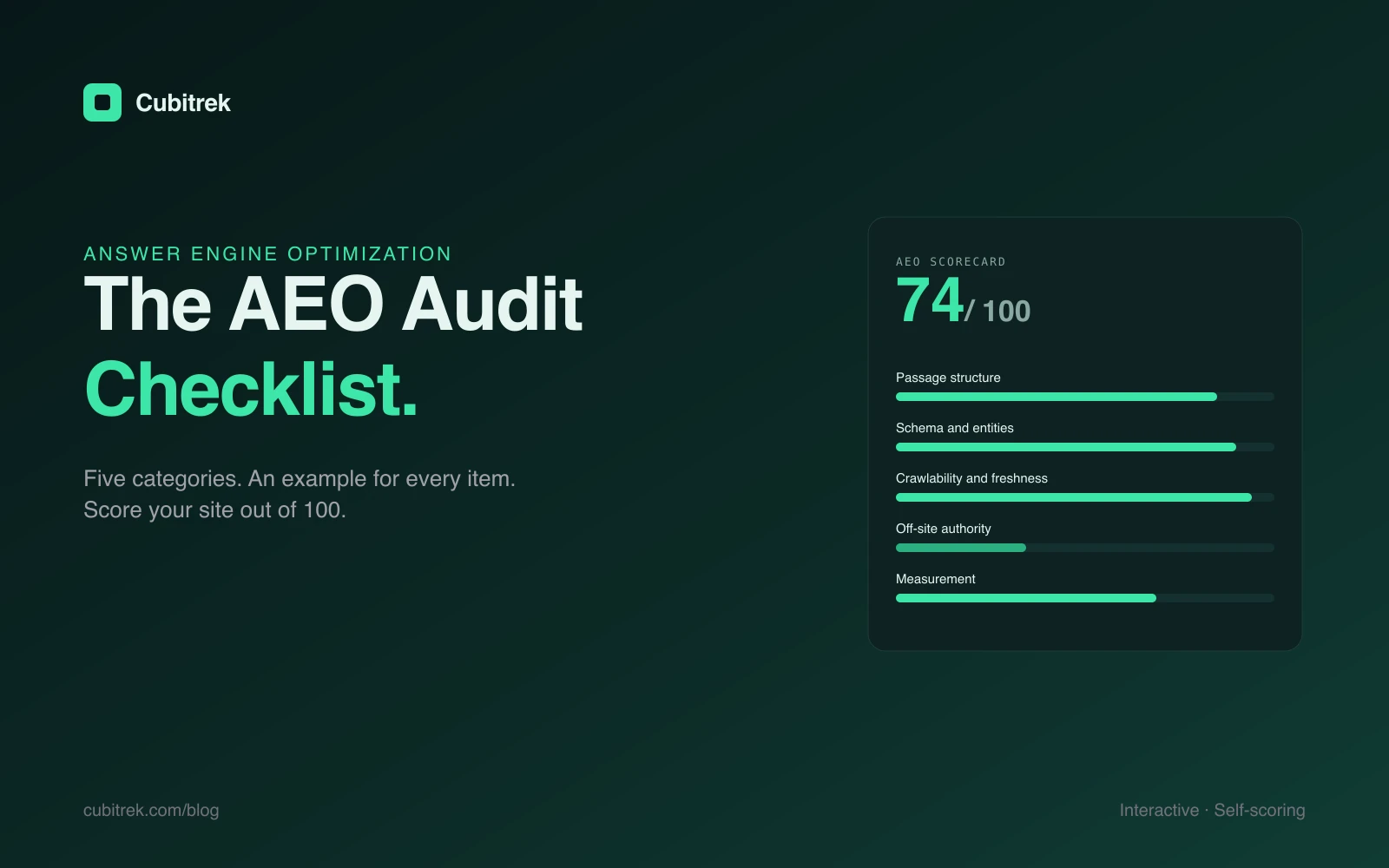
The AEO Audit Checklist
An interactive AEO audit with a weak-versus-strong example for every item, real audit scores, and a live self-scoring widget. Grade your site in five minutes.
Faizan Ali KhanReady when you are
Want Cubitrek to run SEO for you?
We install seo programs for growing companies across the US and Europe. Book a call and we'll come back with a one-page plan in 72 hours.