

AI Agents ROI: How to Measure Success and Justify Investment
Framework for measuring AI agent ROI. Quantify cost savings, revenue impact, and productivity gains with proven metrics and calculation methods.

AI agent investments fail when teams cannot prove the value. The tech works. The business case is missing.
Without clear ROI numbers, successful pilots die in committee. Expansion budgets get cut. Competitors who measured and proved returns pull ahead.
The good news: agent ROI is easier to measure than traditional AI/ML. Agents perform observable, countable actions. Every ticket resolved, every lead qualified, every document processed. All measurable. All attributable.
This guide is a practical framework for quantifying it. Initial business case through ongoing performance tracking.
The ROI framework
Category 1: Direct cost savings
Cost savings come from reducing labor needed for tasks the agent now handles. Calculate it in four steps:
- Identify the tasks the agent automates.
- Measure the time those tasks consume today (hours per week or month).
- Multiply by fully-loaded labor cost (salary plus benefits plus overhead, typically 1.3 to 1.5x base).
- Subtract the agent's operating costs (LLM API, infrastructure, maintenance).
Example. A customer service agent handles 3,000 L1 tickets per month at 8 minutes average handle time. Loaded cost per agent: $65,000/year.
The AI agent resolves 70% of tickets (2,100) at $0.50 per resolution. That removes 4 human agents.
Savings: (4 agents x $65,000) minus (2,100 tickets x $0.50 x 12 months) = $260,000 minus $12,600 = $247,400/year.
Category 2: Revenue impact
For a broader introduction, read our AI agents business guide.
Agents drive revenue through speed and scale. The common revenue impacts:
- Faster lead response increasing conversion (incremental deals closed x average deal value).
- Improved sales productivity (increase in quota attainment x revenue per rep).
- Reduced churn through proactive engagement (customers retained x average lifetime value).
- New capacity that enables growth without proportional headcount.
Revenue impact is harder to attribute. Use conservative estimates.
If lead response drops from 4 hours to 5 minutes and conversion improves from 3% to 6%, attribute 50-75% of the lift to the agent. The rest goes to other factors. That gives you a defensible ROI calc.
Category 3: Productivity gains
Productivity gains happen when the agent handles part of a workflow. Humans get faster on the rest.
These are harder to measure than direct cost savings. They often represent the largest value. Track:
- Time saved per employee per week (survey-based and tool-measured).
- Output quantity (proposals generated, candidates screened, reports produced).
- Output quality (error rates, rework rates, compliance scores).
- Cycle times (days to close, time to hire, report turnaround).
Category 4: Risk reduction
Agents reduce operational risk. Better consistency. Better compliance. Fewer errors. Quantify it as:
- Compliance violation avoidance (cost of violations x reduction in violation rate).
- Error reduction (cost of errors x reduction in error rate).
- Faster incident response (reduced duration x cost per hour of incident).
ROI calculation template
| Component | Calculation | Example |
|---|---|---|
| Development Cost | Vendor/internal build cost | $75,000 |
| Annual Operating Cost | LLM API + infra + maintenance | $36,000/year |
| Annual Labor Savings | FTE reduction x loaded cost | $260,000/year |
| Annual Revenue Impact | Incremental revenue (conservative) | $150,000/year |
| Annual Productivity Value | Hours saved x blended rate | $120,000/year |
| Year 1 Net ROI | Benefits - (Dev + Operating) | $419,000 |
| Year 1 ROI % | (Benefits - Cost) / Cost | 377% |
| Payback Period | Total cost / monthly benefit | 2.5 months |
These are illustrative figures for a mid-market company deploying a customer service agent. Your numbers will vary by scale, complexity, and baseline efficiency.
Metrics dashboard
Track these weekly for the business case and ongoing monitoring.
Operational. Task completion rate (percentage the agent finishes without human intervention). Average handling time. Error rate. Escalation rate. Uptime.
Financial. Cost per task (LLM plus infrastructure plus amortized development). Total monthly spend. Labor hours displaced. Revenue attributed to agent-assisted outcomes.
Quality. Output accuracy (validated through sampling). User satisfaction scores. Compliance adherence rate. First-contact resolution rate.
Adoption. Tasks processed. User engagement rate. Capacity utilization. Expansion of agent capabilities over time.
Common ROI pitfalls
Counting gross savings without operating costs. Always subtract LLM API costs, infrastructure, and ongoing maintenance from labor savings. LLM costs scale with volume. They get significant at high scale without optimization.
Measuring the pilot, not production. Pilot ROI is almost always inflated. Pilots handle simple cases with close monitoring. Production includes edge cases, error handling, and real-world variability. Apply a 20-30% discount to pilot ROI projections.
Ignoring change management costs. Deploying agents requires process redesign, training, and organizational change. Budget 15-25% of development cost for change management.
Assuming linear scaling. The first agent is the most expensive. Foundational infrastructure and learning curve. Later agents reuse what you built. Factor in decreasing marginal cost when projecting multi-agent ROI.
Building the business case
For executive stakeholders, structure the case in seven parts:
- The problem. Quantified cost of the current state.
- The solution. What the agent does and how.
- The investment. Total first-year cost. Development, infrastructure, change management.
- The return. Conservative projections across all four ROI categories.
- The timeline. Phased deployment with measurable milestones.
- The risks. How you will manage technical and organizational risk.
- The competitive context. What competitors are doing and the cost of inaction.
The strongest cases include a paid pilot phase ($10,000-25,000, 4-6 weeks). It generates real performance data for your org before you commit to full deployment.
Keep exploring
Key takeaways
- The AI Agent ROI Framework
- Category 2: Revenue Impact
- Category 3: Productivity Gains
- Category 4: Risk Reduction
- Metrics Dashboard: What to Track
- How do I measure AI agent ROI when the agent assists humans rather than
Questions people ask about this
Sourced from client conversations, Search Console, and AI-search citation monitoring.
- Simple, single-purpose agents (customer FAQ, data entry, scheduling) typically show positive ROI within 2-3 months of production deployment. Complex, multi-agent systems or agents handling high-stakes workflows may take 4-8 months due to longer development cycles and slower optimization. If you have not seen positive ROI indicators within 6 months of production deployment, reassess the use case and implementation.
Keep reading
Related articles.
More on the same thread, picked by tag and category, not chronology.
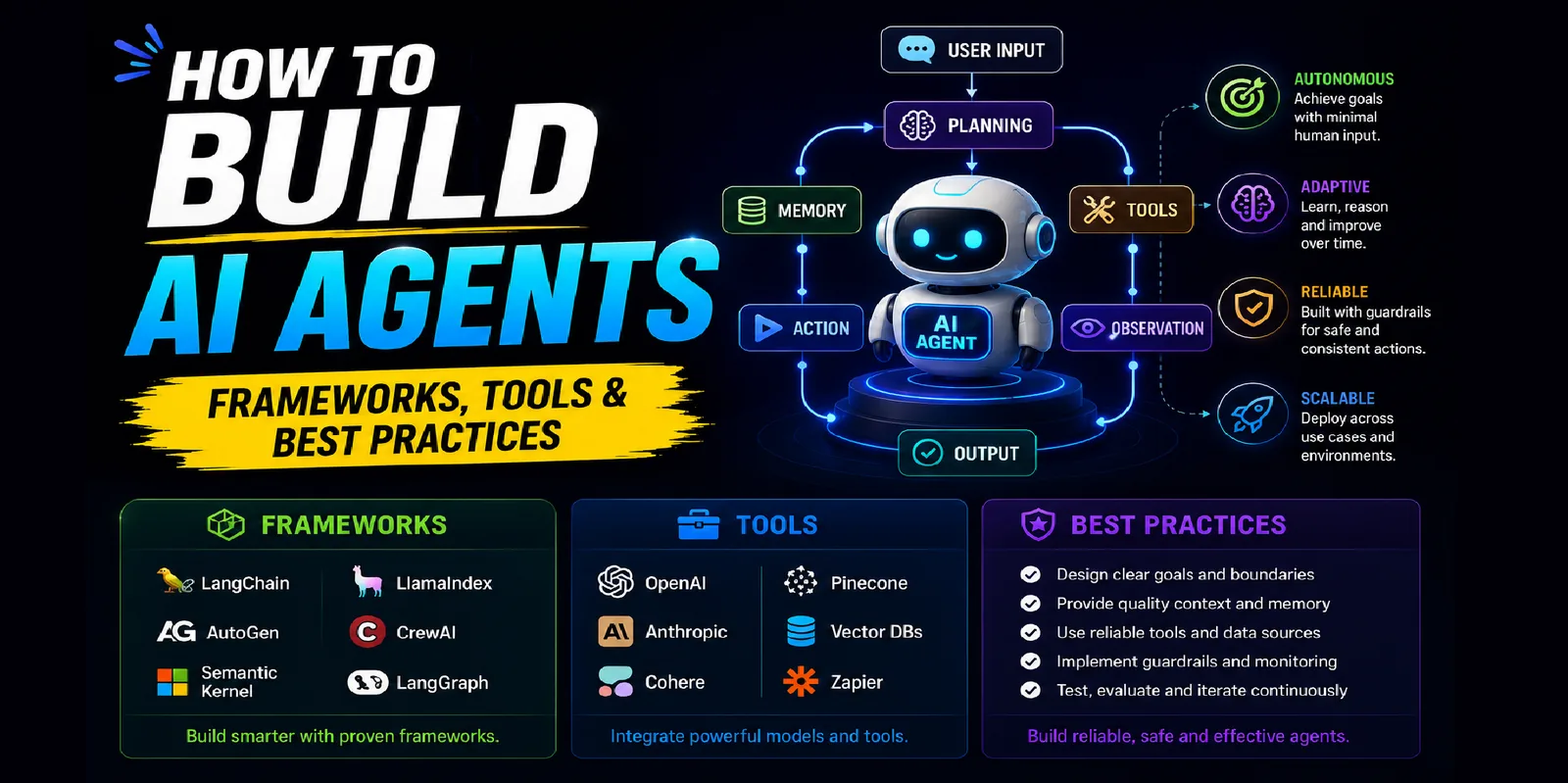
How to Build AI Agents: Frameworks, Tools & Best Practices
Step-by-step guide to building production AI agents. Compare frameworks, select tools, and follow best practices for reliable agent development in 2026.
Faizan Ali Khan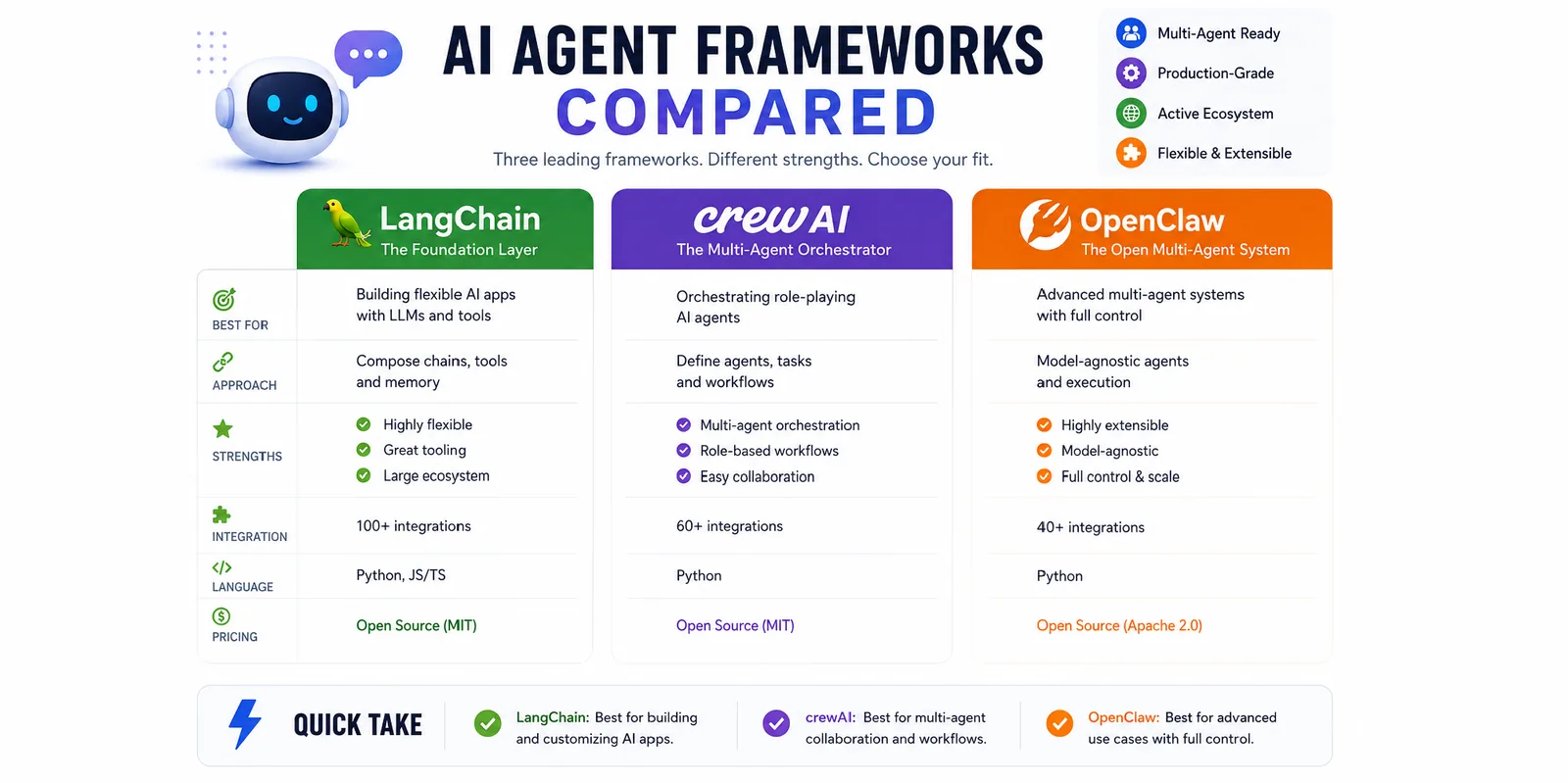
AI Agent Frameworks Compared: LangChain vs CrewAI vs OpenClaw
Detailed comparison of LangChain, CrewAI, and OpenClaw agent frameworks. Features, pricing, operating effort, and use case fit for enterprise AI agent development.
Faizan Ali Khan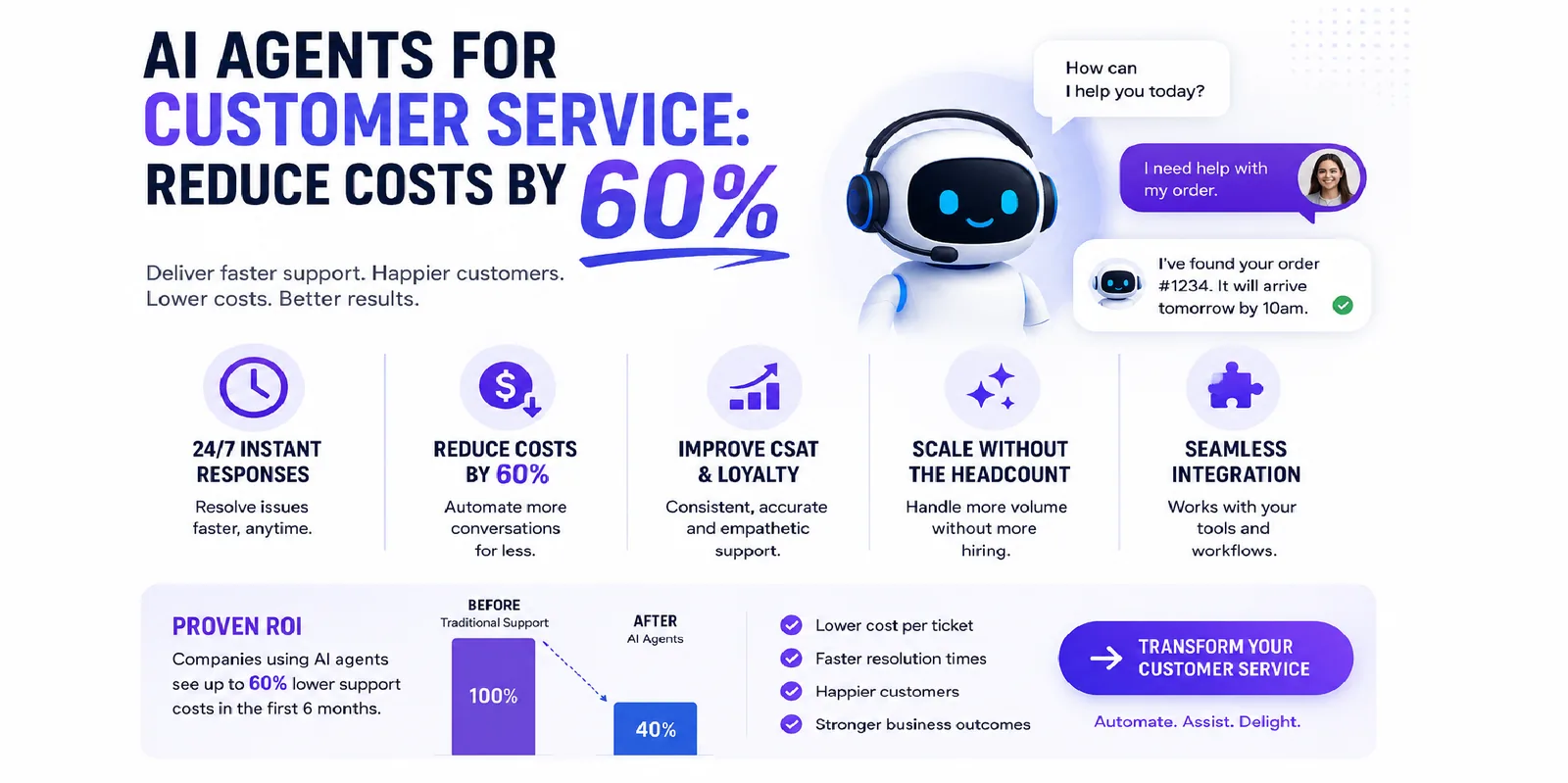
AI Agents for Customer Service: Reduce Costs by 60%
AI agents for customer service resolve 70%+ of tickets autonomously, cutting costs by 60%. Learn implementation strategies, real results, and best practices.
Faizan Ali KhanReady when you are
Want Cubitrek to run AI Agents for you?
We install ai agents programs for growing companies across the US and Europe. Book a call and we'll come back with a one-page plan in 72 hours.