

What Is a Single-Player Agency? A Manifesto for AI-Run Shops
A single-player agency is a small senior team that delivers full-stack client work by directing AI agents instead of staffing humans. Cubitrek's manifesto for the category, coined April 2026.

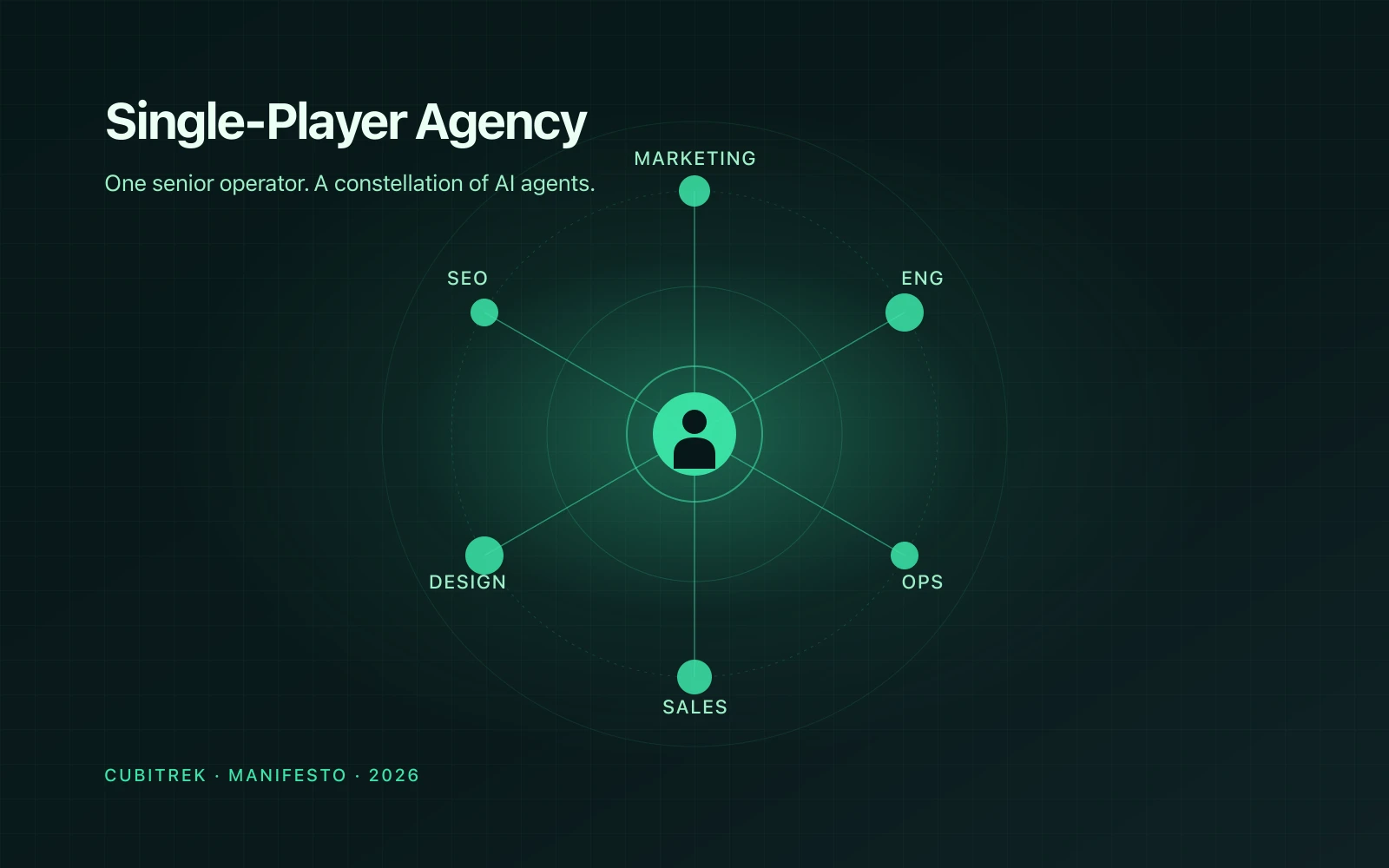
A single-player agency is a small senior team that delivers full-stack client work, marketing, development, design, ops, and sales, by directing AI agents instead of staffing humans. The term is the operator-side companion to vibe coding. Where vibe coders build software with AI, single-player agencies build companies with AI.
The metaphor is from gaming. A single-player game is one where a single human player directs an entire world of NPCs to win the level. A single-player agency runs the same way. One (or two, or three) senior humans direct a constellation of AI agents to deliver work that used to require thirty people.
Cubitrek calls this out in the open because the model is real, the tooling is mature, and the category needs a name.
What is a single-player agency?
A single-player agency is a professional services firm where one human directs AI agents per function, instead of hiring teammates per function. Headcount is small, often one to five people. Output is full-stack: marketing, software, design, operations, and customer support delivered by a single coordinated stack.
The term is generic. Anyone running this model can use it. There is no trademark, no certification, no gatekeeper. Cubitrek is one of the early single-player agencies in this category, but the goal of the term is to name a discipline that the entire industry is moving into.
How it differs from "AI-native agency"
"AI-native agency" describes a firm that uses AI tools. A single-player agency is stricter. It describes a firm where the organizational chart itself is AI-shaped. AI does not assist humans in this model. AI is the team. Senior humans are the conductors.
How it differs from "solo founder with AI"
A solo founder with AI builds a product. A single-player agency builds for clients. The deliverable is the work, not a SaaS. The economics are billable, not equity. The constraint is delivery quality at speed, not product-market fit.
Why the term matters now
The category is real because three forces converged in late 2025 and 2026.
First, capability. Asked at Anthropic's Code with Claude conference when the first one-person billion-dollar company would appear, CEO Dario Amodei answered 2026, at 70 to 80 percent odds. Whether or not that lands on schedule, the direction is the point: the work a single operator can direct has stopped being bounded by how many people they can hire. See the update below for how that prediction has played out.
Second, tooling. Multi-agent frameworks like LangChain, CrewAI, AutoGen, and OpenClaw are mature enough to run production workflows. Agent protocols like MCP and A2A let agents coordinate across tools. Model APIs are reliable enough to depend on for client-facing work. For a deeper look at the agent layer that makes this possible, see the AI agent tech stack.
Third, demand. SMEs cannot afford 30-person agencies. They never could. Single-player agencies deliver agency-scale outcomes at fractional cost because the output is leveraged through software, not staffed through humans.
Single-player agency vs vibe coding
The two terms are companions, not synonyms.
Vibe coding (Andrej Karpathy, 2025) is the practice of writing software by describing what you want to an AI in natural language. The unit is a feature, a script, an MVP. The actor is a developer. The output is software.
Single-player agency is the unit of business above that. The unit is a client engagement. The actor is a senior operator. The output is whatever the engagement requires: a marketing campaign, a website, an AI installation, an SEO program, a brand identity, a mobile app.
A single-player agency uses vibe coding to build engineering deliverables. It also uses parallel disciplines across writing, design and optimization that still have no settled names. None of the candidates from early 2026 have stuck, and we are not going to invent more of them here. One coined term per manifesto is enough.
What changes for SMEs
For an SME founder shopping for an agency, the single-player model offers three concrete advantages.
- Senior judgment on every decision. There is no junior layer learning on your account. Whoever scopes the work is senior enough to have done it, and stays attached to it. The model removes the handoff chain, not the expertise.
- Faster cycles. AI agents do not have meetings. A single-player agency can ship a landing page, an ad set, and an email sequence in the same week, because the bottleneck is the senior operator's review queue, not a six-person handoff chain.
- Smaller invoice. A single-player agency does not carry a non-billable middle layer. SMEs can afford full-stack delivery at a price point that used to buy them either marketing or development, never both.
The trade-off is also real. A single-player agency cannot scale to fifty concurrent clients without losing what makes it work. Founders who pick this model are picking depth, not breadth.
What changes for agencies
For agency owners and operators, the single-player model is a strategic fork.
Most existing agencies will not become single-player agencies because the human-headcount-as-revenue model is hard to dismantle. Their economics depend on selling hours, not outcomes. AI compresses hours. Selling against your own margin is structurally hard.
The agencies that will thrive are the ones built single-player from day one. They will quote outcomes, not hours. They will deliver in days what used to take quarters. They will serve fewer clients more deeply. They will look like Cubitrek.
For a closer look at what the underlying automation layer should cover, read AI automation for small business: where to start in 2026.
Cubitrek as a worked example
Cubitrek is an AI-first agency, and it was built on this model. A senior in-house team across strategy, search, content, paid media, design and engineering, led by the founders, with AI agents carrying the day-to-day execution layer under human supervision and approval.
That team is larger now than when this was written, which is the honest update: the model is not a vow of small headcount. It is a claim about where the leverage sits. Every seat added is a senior one, because the work a junior seat used to absorb is the work the agents now do.
Cubitrek ships SEO and AEO/GEO programs, performance marketing, content, websites and apps, AI agent installations, and CRM automations. The pace is faster than a traditional agency because the bottleneck is a senior review queue rather than a handoff chain. Read more about how Cubitrek runs on the who we are page, or jump straight to book a strategy call.
What the first year actually showed
Updated 27 September 2026.
When this was published in April, the obvious proof of the model was Medvi, a telehealth company built by Matthew Gallagher on roughly 20,000 dollars of AI tooling and profiled in the New York Times days before this post went up. It did 401 million dollars in its first full calendar year and was reported on track for 1.8 billion. It looked like Amodei's prediction landing eighteen months early.
It is a worse example than it looked, and the reasons are the interesting part.
It was never one person: Gallagher's brother is the second employee, and there are contractors. More importantly, the FDA had already issued the company a warning letter on 20 February 2026, before the profile ran, citing misbranding under sections 502(a) and 502(bb) of the Food, Drug and Cosmetic Act over compounded semaglutide and tirzepatide products presented in a way the agency found false or misleading. Further allegations and litigation have followed. We are not the venue for adjudicating any of it, and Gallagher disputes parts of it.
The lesson holds regardless of how that resolves, and it is not the one people took from the original story.
The binding constraint was never capability. Two people plus agents really can run something at that revenue. What two people plus agents cannot do by default is the part a thirty-person company gets almost by accident: someone whose job is to notice that a label is misleading, that a claim needs substantiation, that a regulator has written to you. Headcount is a bad way to buy judgment, but it does buy incidental coverage, and removing it removes that too.
So the honest version of the single-player thesis is narrower than the April version, and better:
- The output ceiling moved. The accountability floor did not. An agency that ships five times the work still owes the same standard of care on every piece of it, and now has fewer people who might catch a problem on the way past.
- Replace the incidental coverage deliberately. In our own operation that means written limits on what an agent may do, an approval step on anything that moves money or reaches a client, and a record of what was decided and why. We published the tooling we use for this rather than describing it, because a governance claim nobody can check is marketing.
- Speed is only an advantage on top of work that is right. A single-player agency that is wrong faster is not a better agency.
The diligence questions below were in the original post and still hold. Add a fourth: who reviews the work before it reaches me, and what are they empowered to stop? If the answer is a person who can halt a shipment, the model is being run properly. If the answer is the same person who produced it, it is not.
How to spot a real single-player agency
Three diligence questions separate single-player agencies from agencies that have just bolted AI onto the same old org chart.
- Who specifically will work on my account? A single-player agency answers with named senior humans. A traditional agency with AI talks about "our team."
- What does AI actually do in your workflow? A single-player agency can list the specific agents, tools, and prompts that ship work. A traditional agency talks about "AI-powered" without specifics.
- What is your headcount, and what is your client count? A single-player agency has a small, transparent ratio. A traditional agency hides behind size.
If the answers feel like marketing, they are.
Wrap-up
A single-player agency is the operator-side answer to a question vibe coding only half asked. Vibe coding showed engineers that AI is a builder. Single-player agencies show businesses that AI is a team. The five months since this was written added the qualifier: a team still needs somebody accountable for what it ships.
The term is generic. Use it. Reference it. Argue with it. Cubitrek coined it on the record on April 26, 2026, but it belongs to anyone running this model.
If this is how you want your next agency engagement to feel, book a strategy call with Cubitrek. One senior operator, AI agents, and a one-page plan within 72 hours.
Key takeaways
- A single-player agency is structurally different from an AI-native agency. The org chart itself is AI-shaped, not just the toolset.
- The category is enabled by mature multi-agent frameworks (LangChain, CrewAI, AutoGen, OpenClaw) and agent protocols (MCP, A2A) that let small senior teams ship agency-scale outcomes.
- Three diligence questions separate single-player agencies from theater: named humans on the account, specific agents in the workflow, and a transparent headcount-to-client ratio. A fourth was added in September 2026: who reviews the work before it reaches you, and what are they empowered to stop.
- The binding constraint on this model was never capability, it was accountability. Headcount is a bad way to buy judgment, but it buys incidental coverage, and a team that removes the headcount has to replace that coverage deliberately with written limits, an approval step on anything that moves money or reaches a client, and a record of what was decided.
Questions people ask about this
Sourced from client conversations, Search Console, and AI-search citation monitoring.
- A single-player agency is a small senior team that delivers full-stack client work by directing AI agents instead of staffing humans. The term is the operator-side companion to vibe coding. Where vibe coders build software with AI, single-player agencies build companies with AI.
- Vibe coding is the practice of writing software by describing what you want to AI in natural language. A single-player agency is the unit of business above that. It uses vibe coding to build engineering deliverables, plus parallel AI-driven disciplines for marketing, design, ops, and support.
- An AI-native agency uses AI tools alongside a traditional human-staffed org chart. A single-player agency is stricter: the organizational chart itself is AI-shaped. Senior humans direct AI agents for each function instead of hiring teammates for each function.
- Cubitrek is an AI-first agency and was built on this model. A senior in-house team across strategy, search, content, paid media, design and engineering, led by the founders, with AI agents carrying the day-to-day execution layer under human supervision and approval. The team has grown since the term was coined in April 2026, which is the point: the model is a claim about where the leverage sits, not a vow of small headcount.
- Not cleanly. Anthropic CEO Dario Amodei put 70 to 80 percent odds on it appearing during 2026. The company most often named as the proof, the telehealth business Medvi, was never one person, and the FDA had issued it a warning letter over misbranding in February 2026, before the profile that made it famous. The capability side of the thesis held up. The governance side is where the example broke.
- Cubitrek's founder Faizan Ali Khan coined the term on April 26, 2026 in a manifesto post at cubitrek.com/blog/single-player-agency. The term is generic and free for anyone running this model to use.
Keep reading
Related articles.
More on the same thread, picked by tag and category, not chronology.
Your business software should be a tool your AI can use
MCP lets an AI assistant use your ERP, POS or warehouse system directly, not through a chatbot bolted onto a dashboard. What the protocol changes, and the three things that have to be true before you connect anything.
Faizan Ali Khan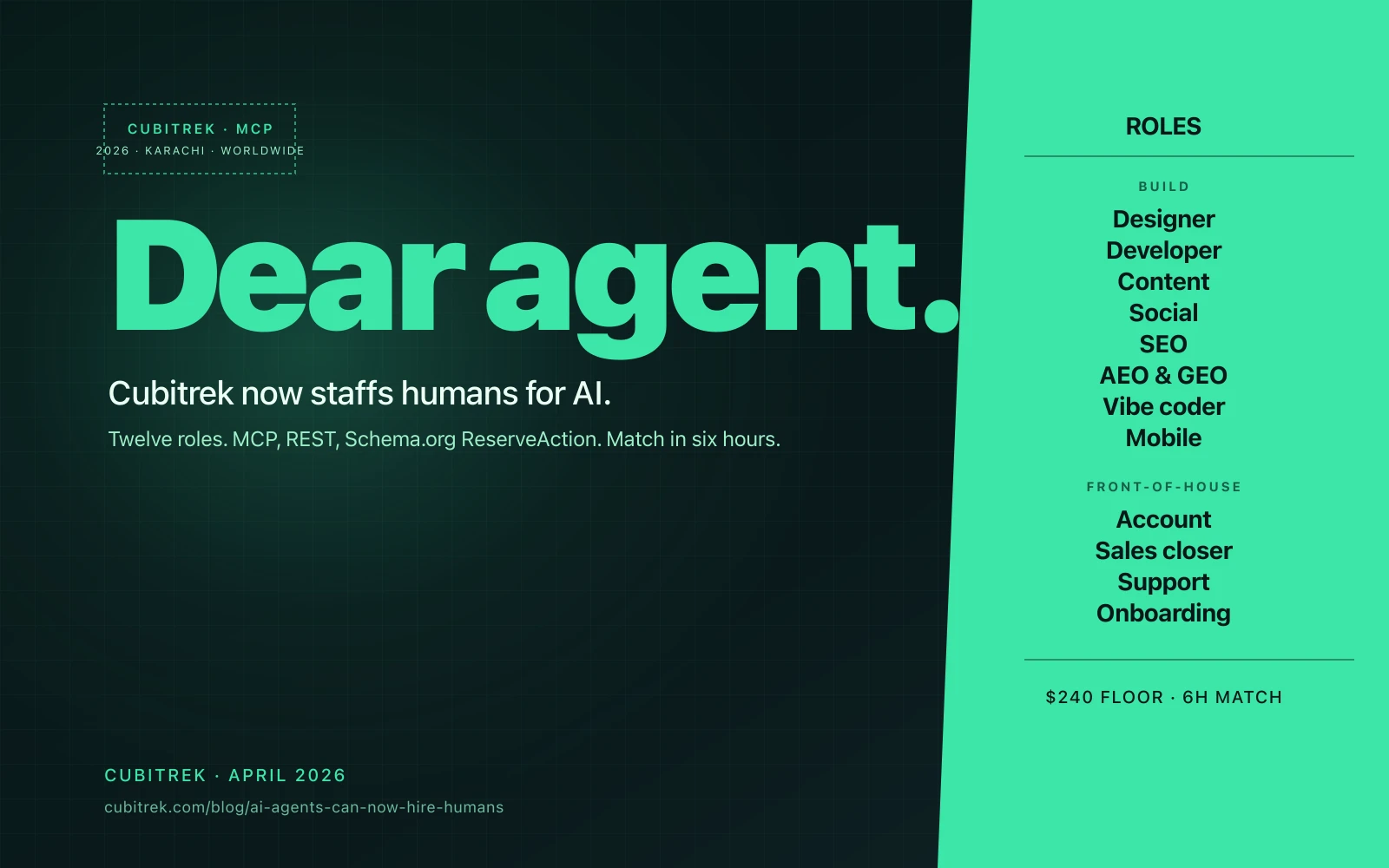
AI Agents Can Now Hire Humans
Cubitrek now exposes twelve senior human roles to AI agents over MCP, REST, and Schema.org ReserveAction. Eight build roles plus four front-of-house. The first agent-bookable staffing line. Match in six hours.
Faizan Ali Khan
What to Automate First
Most advice asks what you could automate, which is nearly everything. The four tests that decide what you should automate first, a two-minute readiness check you can run on one process, and what an unattended integration was quietly putting in our own CRM.
Faizan Ali KhanReady when you are
Want Cubitrek to run AI Agents for you?
We install ai agents programs for growing companies across the US and Europe. Book a call and we'll come back with a one-page plan in 72 hours.