

Hire an AI Engineer in 2026: Salaries, Skills, and the Build vs Buy Decision
Hire an AI engineer in 2026 and you face a market that did not exist three years ago. The role splits into 5 sub-specializations, and what you pay depends more on the title you advertise than on the seniority label. This guide tells you what to look for, how to read the public salary data, and when to skip a full-time hire entirely.

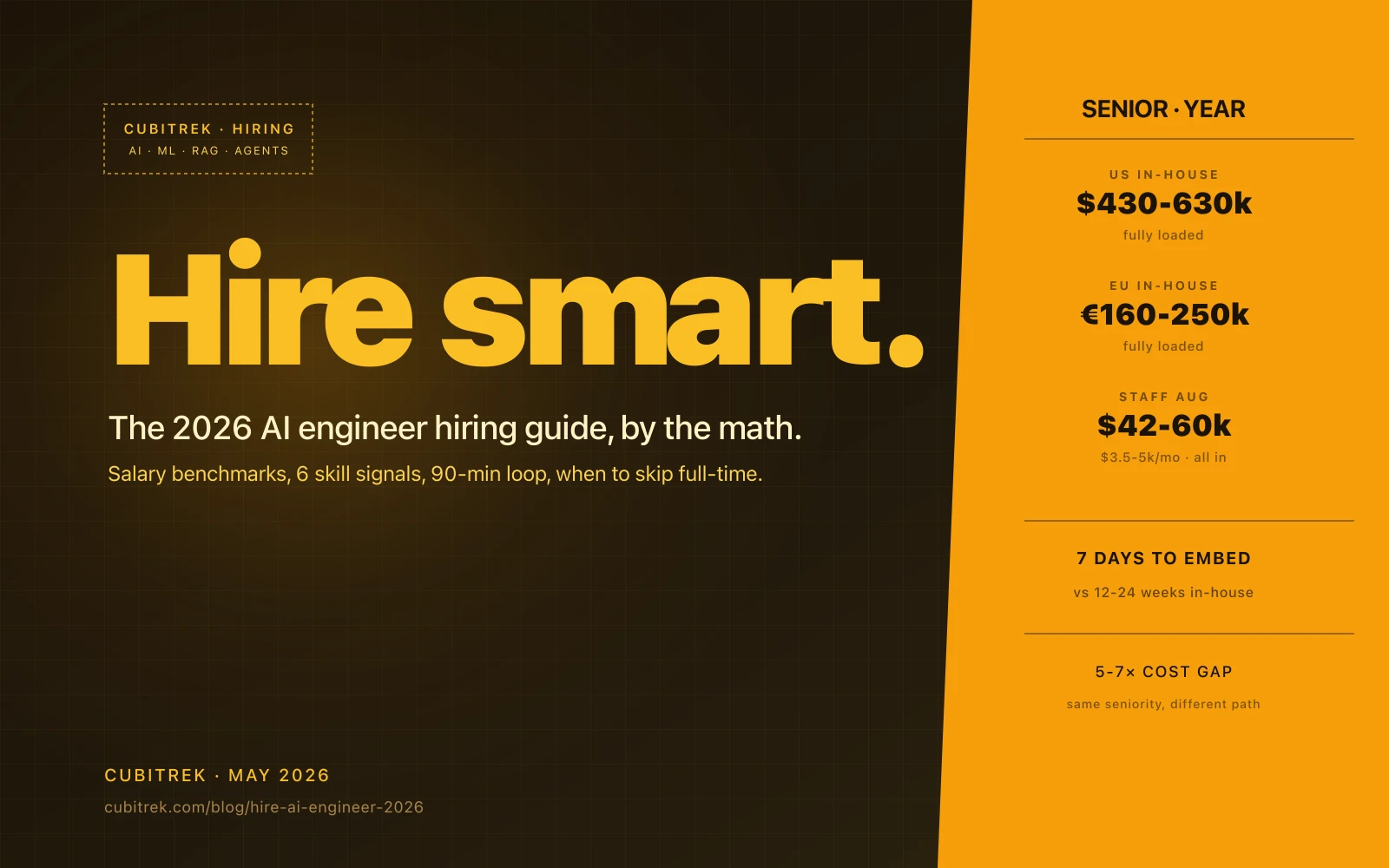
Hire an AI engineer in 2026 and you face a market that did not exist three years ago. The role splits into at least five sub-specialisations (LLM engineering, RAG, agent frameworks, prompt engineering, MLOps), each commanding different salary bands. Compensation varies widely by title and market, and the title on the job description moves the number more than the seniority label does. Remote and fractional alternatives bill monthly per engineer rather than as a salary, with vetting standards that match or beat in-house hiring. This guide tells you what to look for, how to interview, what to pay, and when to skip a full-time hire entirely.
What an AI engineer actually does in 2026
The category split that matters when you write the job spec:
| Sub-specialisation | What they actually ship | Hire when you need |
|---|---|---|
| LLM engineer | Production integrations of GPT, Claude, Gemini, open-source LLMs into product features | Copilot features, AI search, content generation in your app |
| RAG engineer | Retrieval-augmented generation pipelines (chunking, embeddings, vector DB, hybrid search, re-ranking) | AI features grounded on your proprietary data |
| Agent framework engineer | LangChain, CrewAI, AutoGen, OpenClaw, MCP-native agents in production | Autonomous workflows for sales, support, research, ops |
| Prompt engineer | Prompt design, eval harnesses, fine-tuning, RLHF, model distillation | Quality and consistency layer across an existing AI surface |
| MLOps engineer | Model serving, GPU infra, eval pipelines, observability, drift detection | Production reliability at scale (10M+ inferences/month) |
Most teams need a hybrid (typically LLM plus RAG, or LLM plus agent framework). Pure single-specialisation engineers are rare and expensive.
The 2026 AI engineer salary benchmark
Figures below are Levels.fyi self-reported total compensation for the United States, read on 8 October 2026. They are a distribution across everyone who reported that title, not a seniority band, so read them as percentiles rather than as a grade ladder.
Full-time, US-based
| Title | 25th percentile | Median | 75th percentile | 90th percentile |
|---|---|---|---|---|
| AI Engineer | $108k | $156k | $216k | $300k |
| Machine Learning Engineer | $204k | $283k | $384k | $504k |
Two things worth noticing before you budget from this. The two titles are a long way apart, so which one your job description uses moves the number more than the seniority label does. And the Levels.fyi sample skews toward large technology employers, so a non-tech company hiring in a smaller market should expect to sit below these figures rather than on them.
On fully loaded cost: salary is not the bill. Benefits, employer taxes, equipment, software and any recruiter fee sit on top, and the multiple varies enough by country, state and benefits package that quoting one number here would be guesswork. Ask your finance team for the loaded multiple they already use for an engineering hire and apply it to the band above.
Full-time, EU-based
EU compensation varies widely by country and we do not have a sourced benchmark we are willing to publish. Levels.fyi carries per-country data that you can filter to the market you are hiring in, which is more useful than a single European average would be.
Remote contractor / fractional
Staff augmentation bills a monthly rate per engineer instead of a salary, so there is no recruiter fee, benefits load or equipment cost on your side. Cubitrek runs this model; talk to us for current rates. The vetting is comparable to an in-house loop when it is run by an operator who understands the role.
Hourly contractor
Marketplace rates for AI specialists run well above generalist engineering rates, and each marketplace publishes its own current ranges, which move faster than an article can track. Check the live rate on the platform you intend to use rather than a figure quoted elsewhere.
Hourly contracting peaks for short bursts. Above roughly a day a week, a monthly retainer or staff augmentation usually beats hourly on both rate and continuity.
What to look for when you hire an AI engineer
Six signals that separate operators who ship from candidates who interview well:
1. Shipped at least one production AI feature in the last 12 months
Not a demo. Not a notebook. A feature users hit, with traffic, with monitoring, with at least one production incident they personally triaged. The 2024-2025 AI gold rush produced a lot of resumes with "AI" sprinkled on top; the production-experience filter sorts the wheat instantly.
Ask in the interview: "Walk me through the AI feature you shipped most recently. What was the eval methodology? What broke in production?" If they cannot describe the eval methodology or the incident, they have not shipped.
2. Working knowledge of at least two LLM providers' production APIs
Why two: every production AI feature in 2026 needs a fallback provider when one provider's API has an outage or a model version regresses. Engineers who only know OpenAI are a liability when GPT has a bad week. Senior candidates name OpenAI, Anthropic, and at least one of (Google, Meta, DeepSeek, Mistral) with concrete experience on each.
3. Eval discipline
The single fastest filter. Ask: "How do you decide whether a prompt change actually improved your AI feature?" A junior says "I tested it manually." A senior says "I have a labeled test set of 200-500 examples, I run the change against the set, I score against ground truth with a metric like LLM-as-judge plus exact-match, I gate the deploy on the score."
If you do not have a labeled test set yet, your AI engineer's first job is to build one. If they do not lead with that, they are not the right hire.
4. RAG-specific experience (if you are building anything grounded on your data)
Vector DB selection (Pinecone, Weaviate, Qdrant, pgvector), chunking strategy, embedding model selection, hybrid search (BM25 plus dense vectors plus optional ColBERT late-interaction), re-ranking strategy. See our hybrid search optimization post for the 2026 production patterns they should know.
5. Agent framework experience (if you are building agents)
LangChain or LangGraph, CrewAI, AutoGen, OpenClaw, Model Context Protocol (MCP). At least two of these in production. The framework choice itself is a tell: candidates who advocate for one framework dogmatically usually have not shipped multiple workloads. Senior candidates pick per workload.
6. Cost awareness
LLM API spend is a real budget line in 2026. Senior candidates volunteer numbers ("our per-query cost is around $0.012 because we use GPT-4o-mini for retrieval and Claude 4 for synthesis"). Junior candidates do not know what their feature costs to run.
How to interview an AI engineer (the 90-minute loop)
The interview loop that separates production-ready candidates from confident bluffers:
Minutes 0-15: Past work walkthrough. Have them screen-share one production AI feature they shipped. Ask: dataset size, eval methodology, biggest production failure, current per-query cost. Listen for specifics.
Minutes 15-45: System design. Give them this brief: "Design an RAG-based customer support agent that handles 10,000 tickets per month, grounds on a 5,000-document knowledge base, and falls back to a human at the right times." Whiteboard. Look for: chunking strategy, vector DB choice, hybrid retrieval, eval set, fallback heuristic, cost projection.
Minutes 45-75: Code task. A 30-minute coding task in their language of choice. Suggested task: "Given this list of 500 customer support tickets, write a script that classifies each into 5 categories using a cheap LLM, evaluates the result against the labeled examples I provided (50 of them), and outputs a confusion matrix." This tests prompting, eval, and basic data handling in one task.
Minutes 75-90: Their questions. Senior candidates ask about: your eval infrastructure, your model-version-pinning strategy, your cost budgets, your on-call rotation. Junior candidates ask about benefits and salary.
See our deep-dive list of AI engineer interview questions for the specific questions to ask at each phase.
When to hire full-time vs fractional vs staff aug
Three honest decision rules.
Hire full-time when
- You will give the engineer 30+ hours per week of meaningful work for 12+ months.
- The AI work is core IP that needs deep institutional knowledge of your domain, customers, and codebase.
- You can carry a fully loaded senior salary with no certainty the work justifies it in the first six months.
- You have a clear career path (manager, staff, principal) that lets you retain the hire.
Hire fractional / part-time when
- You need senior judgment for 5-15 hours per week (architecture, code review, strategic decisions) but not full-time implementation.
- Specific to AI/ML strategy: a fractional CTO-of-AI buys principal-level judgment for a few hours a week at a fraction of an in-house salary, which suits a team that needs direction more than throughput.
- The role is in the discovery phase and you want to learn what to hire full-time for in 6 months.
Staff augmentation when
- You need full-time execution (30-40 hours per week) but cannot afford or justify the all-in in-house cost.
- The work is well-defined enough that a pre-vetted senior engineer can be productive in week 1 with the right onboarding.
- You want EU or US timezone coverage without the legal overhead of opening international entities.
- Speed matters more than building institutional knowledge from scratch (you need the work shipped, not a tenure marker).
Our default recommendation for series-A and B companies: start with staff augmentation for the first 6-12 months, learn what you actually need from the work, then hire full-time for the specific role you can write the spec for with confidence. The opposite path (hire full-time first, hope you guessed right) is the most expensive mistake we see.
The hidden costs of hiring AI engineers nobody tells you about
Six budget lines first-time hirers underestimate:
- Recruiter fees. Contingency search is commonly quoted as a percentage of first-year salary, and on a senior AI salary that percentage is a large absolute number. Get the fee in writing before you brief anyone.
- Equipment, software, AI tool subscriptions. A high-end laptop, the assistant and editor subscriptions this role expects, and a development LLM budget. Price your own stack rather than a generic figure; the subscriptions alone have moved a lot in two years.
- Onboarding time. A senior AI engineer typically reaches full productivity at month 3, not month 1. That is 2 months of partial output you pay full salary for.
- Eval infrastructure they will demand. Your first AI engineer's first 4-6 weeks will go to building the eval harness you do not have yet. That is necessary work; budget for it.
- LLM API spend. Senior engineers consume meaningfully more tokens than juniors because they iterate faster. Meter a month of real development usage before you set the budget line, because it varies by an order of magnitude with how the team works.
- Retention risk. AI engineers are among the most poachable roles in 2026 software. Retention without competitive equity or differentiated work is a real budget line, and a replacement costs you the recruiter fee and the ramp again.
Staff augmentation flattens five of those six (we cover equipment, tools, onboarding, eval infrastructure setup, and retention; you only pay the per-engineer monthly rate). LLM API spend is the only line that stays the same.
Want this run for you?
Cubitrek's staff augmentation program ships pre-vetted senior AI, ML, RAG, and agent-framework engineers in 7 days. EU and US timezones, no recruiter margin, replace anytime, contracts signed in days. Talk to a delivery lead via contact for a 30-minute scoping call. We will tell you what role to hire (and whether to hire at all) before you sign anything.
Key takeaways
- Eval discipline is the fastest filter. Candidates who cannot describe their labeled test set methodology have not shipped to production.
- The 90-minute interview loop: past-work walkthrough, system design, code task, candidate questions. Real production stories beat resume claims.
- Hidden costs add 40-60 percent on top of salary: recruiter fees, equipment, onboarding, eval infrastructure, LLM API spend for dev time, attrition risk.
- Staff augmentation flattens 5 of those 6 hidden costs (only LLM dev API spend stays the same).
Questions people ask about this
Sourced from client conversations, Search Console, and AI-search citation monitoring.
- Per Levels.fyi self-reported US data read on 8 October 2026, AI Engineer total compensation runs $156k at the median and $300k at the 90th percentile, while Machine Learning Engineer runs $283k and $504k at the same points. Those are distributions across the title rather than seniority bands, and the sample skews to large technology employers, so a smaller market should expect to sit below them. Add your own loaded multiple on top for benefits, taxes and equipment. Staff augmentation bills a monthly rate instead, with no recruiter fee or benefits load.
- Six signals: shipped production AI feature in the last 12 months, working knowledge of at least two LLM providers' APIs, eval discipline with a labeled test set, RAG experience if you build anything grounded on your data, agent framework experience (LangChain, CrewAI, AutoGen, OpenClaw, MCP), cost awareness on production LLM spend.
- Fractional or staff augmentation for the first 6-12 months, almost always. The role is too new and too varied for most teams to write a confident full-time spec on day one. Hire full-time later for the specific work pattern you have learned you need.
- Three channels. Direct sourcing (LinkedIn Recruiter, Wellfound, Hired) for full-time at 15-25 percent recruiter fee. Marketplaces (Toptal, Upwork, Deel) for hourly contracting, at rates each platform publishes and updates. Boutique staff-augmentation firms (Cubitrek, Andela, Crossover) for senior monthly engagements.
- ML engineer ships the model (training, fine-tuning, model serving). AI engineer ships the product feature built on top of the model (prompt engineering, RAG pipelines, agent workflows, LLM API integration). Most modern AI engineers do not train models from scratch; they integrate frontier-model APIs with retrieval, tools, and evals.
- 7 days median through staff augmentation. 12-24 weeks for full-time in-house hiring through traditional recruiting. The 5-10x speed difference is the second-biggest asymmetry after the cost gap.
- Full-time: severance, legal cost, recruiter fees on the replacement, 3-6 months of lost productivity. The cost of a bad senior AI hire is the severance, the legal cost, the recruiter fee on the replacement and several months of lost output, which together run to a large fraction of the first-year salary. Staff augmentation: replace in 5 business days at no extra cost.
Keep reading
Related articles.
More on the same thread, picked by tag and category, not chronology.
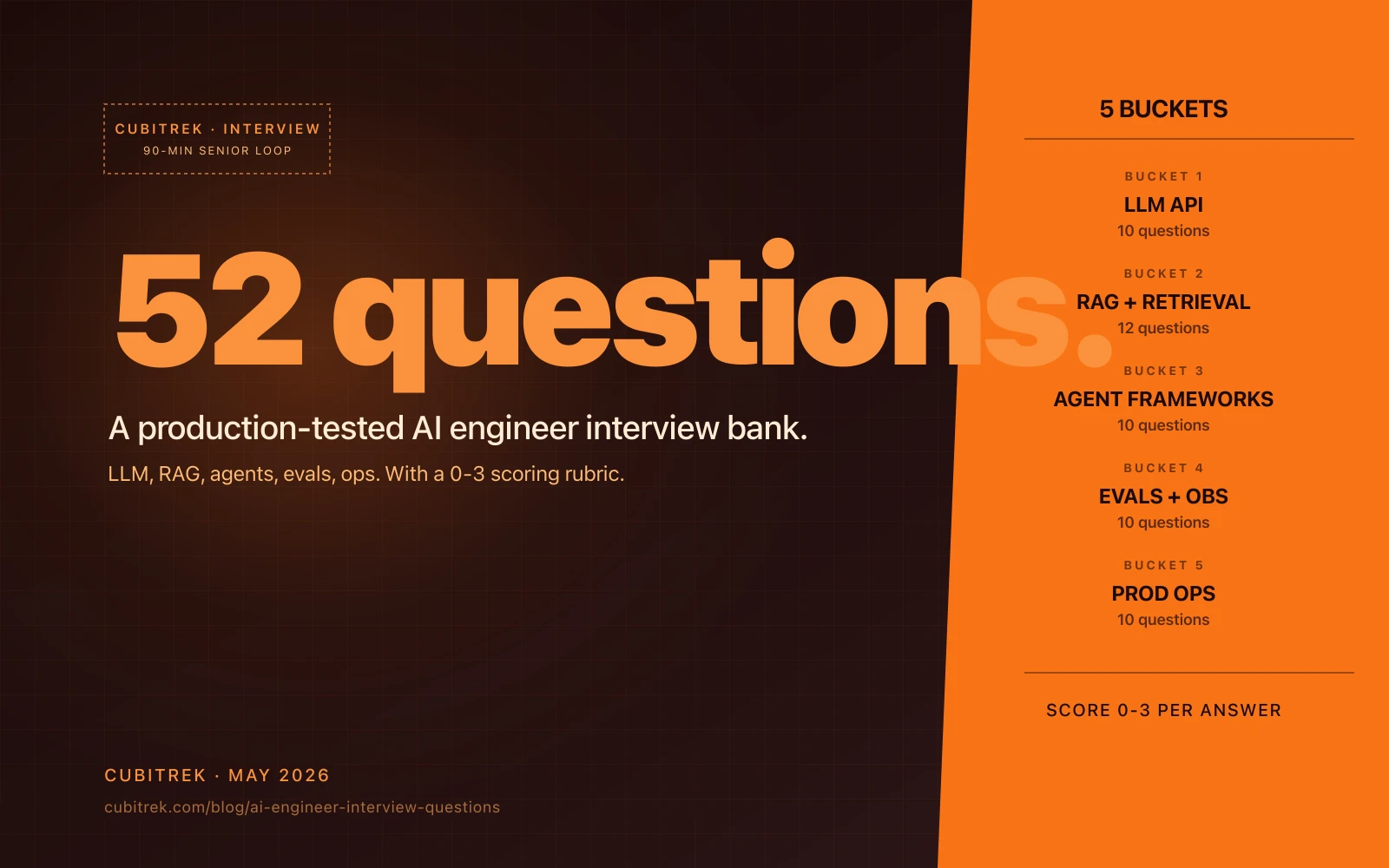
52 AI Engineer Interview Questions
52 real AI engineer interview questions across LLM API integration, RAG and retrieval, agent frameworks, evaluation and observability, and production operations. With scoring rubric and what good answers look like. Used at Cubitrek to pre-vet every staff-augmentation candidate.
Faizan Ali Khan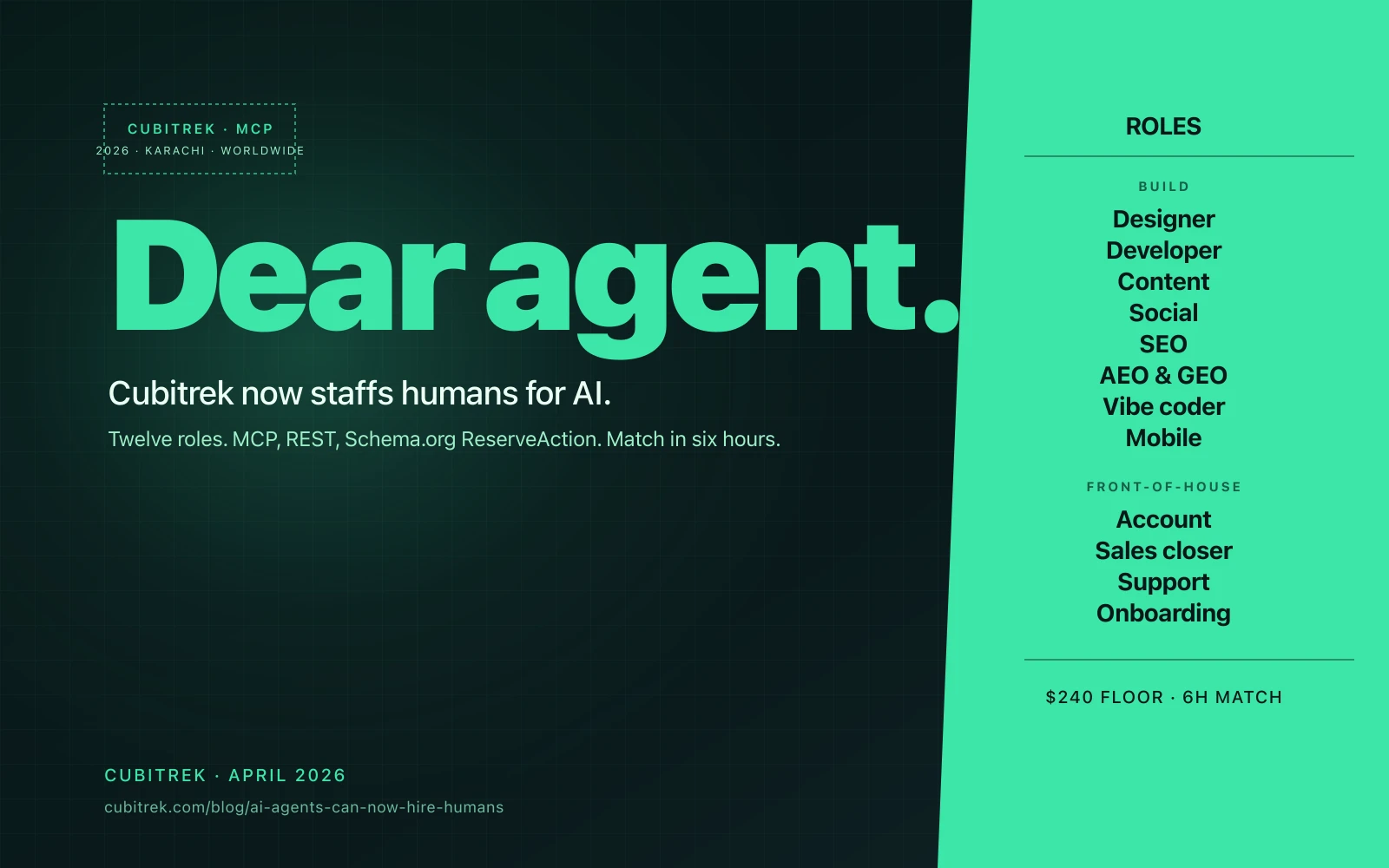
AI Agents Can Now Hire Humans
Cubitrek now exposes twelve senior human roles to AI agents over MCP, REST, and Schema.org ReserveAction. Eight build roles plus four front-of-house. The first agent-bookable staffing line. Match in six hours.
Faizan Ali Khan
Norway’s IT Skills Gap: Why More Tech Leaders Are Turning to Flexible Talent Models
Norway’s digital economy is growing fast, but many companies are struggling with one thing they cannot easily buy: experienced IT professionals.
Faizan Ali KhanReady when you are
Want Cubitrek to run Staff Augmentation for you?
We install staff augmentation programs for growing companies across the US and Europe. Book a call and we'll come back with a one-page plan in 72 hours.