
Future-Proof Healthcare Startups: Breakthrough Business Ideas for 2026
Breakthrough healthcare startup ideas for 2026, from ambient clinical AI to agentic workflows and FDA-cleared diagnostics, with the market data behind them.


Healthcare is moving fast in 2026. AI diagnostics, ambient clinical AI, and agentic workflows are reshaping how care gets delivered.
Founders who build for this shift can win real market share. The demand is for accessible, patient-centered care that scales.
AI agents now do more than answer questions. They complete defined tasks inside governed clinical workflows. That is where the new breakthrough startups are forming.
Healthcare AI in 2026
Future proof healthcare startups
A future-proof healthcare startup is built to adapt as the market shifts. It pairs current technology with a profitable, scalable model.
Tech integration
How do you start a healthcare startup in 2026? Begin with the core stack. That means electronic health records (EHRs), telehealth, wearables, and AI on top of all three.
The goal is simple. Raise the quality of care, cut waste, and lower cost per patient. AI now sits inside these systems, not beside them.
Regulatory compliance and scalability
Regulatory compliance is how a startup meets the laws and standards that govern its work. These cover patient data privacy, product approval, and ethical practice.
Key regulations for healthcare startups
- HIPAA (Health Insurance Portability and Accountability Act)
Protects the privacy and security of patient data in the United States. Providers, insurers, and digital health companies must enforce strong access controls.
- GDPR (General Data Protection Regulation)
Protects the privacy of people in the European Union. It requires explicit consent, secure storage, and the right to access or delete medical data.
- FDA (Food and Drug Administration)
Regulates medical devices, drugs, and digital health tools. Startups building wearables or AI diagnostics need FDA clearance for safety and efficacy.
Note that AI-specific oversight is tightening in 2026. Bake governance, audit logs, and human review into any clinical AI from day one.
Personalized healthcare in 2026
Personalized healthcare now means more than precision medicine. It uses AI and connected devices to fit each patient's unique needs.
Pairing AI with the Internet of Things (IoT) reshapes patient care. Continuous data plus models means earlier signals and better outcomes.
Wearables
Implantable devices such as brain-computer interfaces (BCIs) are the next wave of wearable health tech.
From chronic pain to paralysis, this technology holds promise for problems that affect millions of lives.
Telemedicine
Telemedicine delivers remote clinical care through real-time, two-way audio and video between patient and provider.
It usually covers non-emergency issues that do not require an in-person visit. Hybrid models now blend virtual and in-person care for wider access.
Genomics
Genomics studies all of an organism's DNA. Genomics and gene editing are among the most exciting areas in healthcare.
These tools can treat life-threatening conditions at a molecular level. In 2026, research keeps advancing on cancer and cardiovascular disease.
The healthcare data dilemma
The data dilemma is the tension between data access and patient privacy. Startups need data to build AI diagnostics, personalized medicine, and research.
Health data is a prime target for attackers. When records leak, the damage runs from identity theft to harms we cannot yet predict.
The financial risk alone should force action. Startups must also meet strict privacy laws (HIPAA, GDPR) and cybersecurity rules.
Key challenges in the healthcare data dilemma
- Startups need large datasets to train AI models and build predictive analytics.
- Interoperability (sharing patient data across platforms) improves treatment.
- Startups need strong encryption and real-time monitoring to prevent breaches.
- AI needs big datasets, so ownership is a hard question. Patient, provider, or startup?
- Some startups sell anonymized data for research, which raises consent concerns.
How a healthcare startup solves the data dilemma
- Use secure, tamper-proof health records for better transparency and control.
- Train AI models locally on devices instead of sharing raw data (federated learning).
- Give patients real control over their data, including the right to opt out.
Solving the healthcare tech skills crisis
AI-driven, precision-targeted diagnosis and drug discovery need skilled people to build them. Talent, not technology, is often the bottleneck.
Surveys on digital adoption in healthcare point to the same gap. The biggest obstacle to new technology is a shortage of specific skills.
In 2026, providers are closing this gap two ways. They invest in training and partner with the tech industry to move faster.
This is also where an agency helps. Cubitrek builds AI agents and AI automation so a lean team ships without heavy hiring.
Breakthrough business ideas for 2026
Startups are building on AI, ambient clinical tools, telehealth, and genomics. Here are concrete ideas that can define healthcare startups in 2026.
AI-powered diagnostics
AI platforms analyze medical scans, flag disease, and support clinician decisions. FDA-cleared imaging tools can cut radiologist read times by around 30 percent.
The value shows up most in imaging, where results are easier to validate. AI triage also helps clinicians process complex cases faster.
Examples:
- Aidoc and Qure.ai: FDA-cleared radiology triage for stroke, lung, and cardiac findings.
- Ada Health: an AI symptom checker for patient-facing intake.
Ambient clinical AI (AI scribes)
Ambient AI listens to the visit and writes the structured note in the EHR. Early adopters report saving roughly 90 minutes per physician per day.
This matters because clinicians spend close to two hours on EHR work per hour of care. AI scribes cut charting time by about 40 percent.
The market is real, not hype. Ambient scribes generated around $600M in revenue in 2025, more than double the year before.
Examples:
- Abridge and Nabla: ambient AI scribes generating clinical notes in real time.
- Advanced setups add pre-visit chart summaries and in-visit guideline prompts.
Agentic workflow platforms
Agentic AI does not just recommend. It executes defined tasks inside tightly governed workflows, with human review at the edges.
The clearest wins are in operations, not diagnosis. Prior authorization, scheduling, intake, and revenue-cycle work are all strong targets.
Prior authorization alone eats about 13 hours of staff time per practice each week. Agents handle much of that intake and follow-up automatically.
Examples:
- Hippocratic AI: patient-facing voice agents operating at large scale.
- Cohere Health and Adonis: AI for prior authorization and revenue-cycle work.
Telemedicine and hybrid care platforms
Demand for virtual and remote care keeps growing. Hybrid models mix in-person and digital visits to widen access.
Examples:
- Teladoc Health: real-time doctor consultations at scale.
- AI-assisted triage that routes patients to the right level of care.
Blockchain for transparent patient records
Blockchain can make records tamper-proof and reduce fraud. It supports patient identity checks without a third-party middleman.
Examples:
- Medicalchain: blockchain-based patient records.
- BurstIQ: securing medical data with AI and blockchain.
Wearable and remote patient monitoring (RPM)
Wearables track heart rate, glucose, and sleep in real time. AI-driven monitoring lets doctors assess patients without a hospital visit.
Examples:
- Apple Watch and Dexcom G7: continuous heart and glucose tracking.
- FDA-cleared RPM for heart failure, hypertension, and atrial fibrillation.
Personalized medicine and genomics startups
Advances in genomics allow treatments tailored to a patient's DNA. AI can predict drug response and suggest matched therapies.
Examples:
- Tempus: AI-driven genomic analysis for cancer treatment.
- 23andMe: DNA testing for personalized health insights.
Common queries about healthcare startups in 2026
What is the biggest healthcare AI opportunity in 2026?
Ambient clinical AI and agentic operations lead. Scribes cut documentation time. Agents clear prior authorization and intake backlogs.
Do healthcare AI startups need FDA clearance?
Only for regulated uses. Diagnostic and device claims need FDA clearance. Documentation and back-office tools usually do not, but privacy law still applies.
How big is the AI healthcare market in 2026?
Estimates put it near $50 billion in 2026, growing at roughly 39 percent per year. The AI scribe segment is among the fastest growing.
How do small healthcare startups adopt AI without a big team?
Start with one painful, repeatable workflow. Partner with an agency like Cubitrek to build, govern, and monitor it before scaling.
Conclusion
AI diagnostics, ambient clinical AI, agentic workflows, and genomics will shape healthcare startups in 2026.
Founders who invest in scalable systems, strong data security, and clear regulatory compliance can win. The market rewards teams that ship governed, patient-centered products.
Want to build a healthcare startup on AI agents and automation? Book a call with Cubitrek and map your first workflow.
Key takeaways
- AI, telemedicine, genomics, and blockchain will drive the future of healthcare startups in 2025, creating a new era of patient-centered innovation.
- Future Proof Health Care Startups
- Telemedicine
Keep reading
Related articles.
More on the same thread, picked by tag and category, not chronology.

php2shell: patch, then plan
Two critical PHP vulnerabilities, CVSS 9.2, unauthenticated remote code execution, and no safe server configuration. What to do this week, why your version number cannot tell you if you are exposed, and why patching to PHP 8.2 buys you ten weeks.
Faizan Ali Khan
The AI Code Review Bottleneck
Anthropic went from 2,500 merges a day to over 30,000 in four months and replaced git to cope. You cannot buy what they built, and they say so. What transfers is the diagnosis, and what it looks like at ordinary scale.
Faizan Ali Khan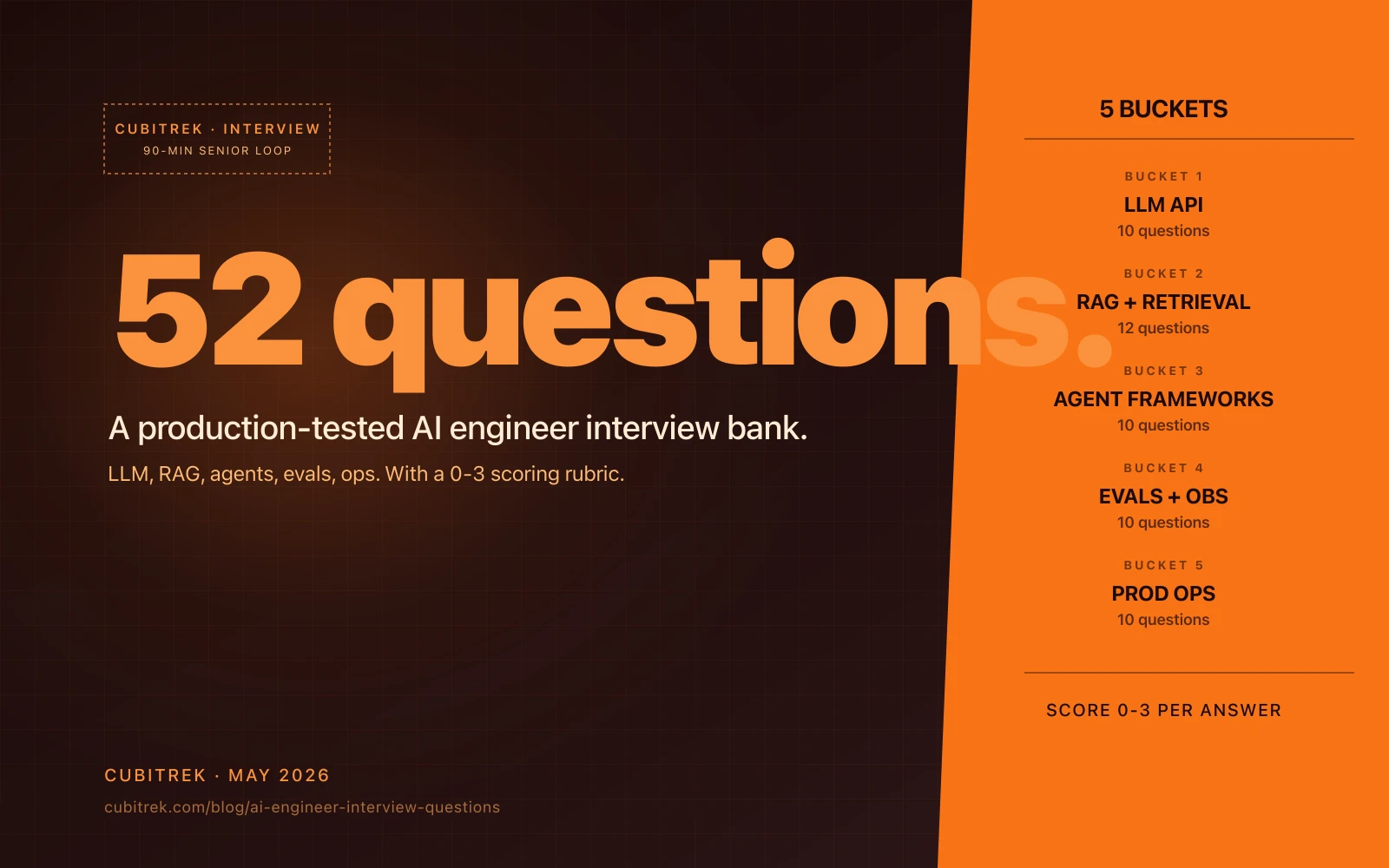
52 AI Engineer Interview Questions
52 real AI engineer interview questions across LLM API integration, RAG and retrieval, agent frameworks, evaluation and observability, and production operations. With scoring rubric and what good answers look like. Used at Cubitrek to pre-vet every staff-augmentation candidate.
Faizan Ali KhanReady when you are
Want Cubitrek to run MVP Services for you?
We install mvp services programs for growing companies across the US and Europe. Book a call and we'll come back with a one-page plan in 72 hours.