

AI Moved the Bottleneck From Writing Code to Reviewing It
Anthropic went from 2,500 merges a day to over 30,000 in four months and replaced git to cope. You cannot buy what they built, and they say so. What transfers is the diagnosis, and what it looks like at ordinary scale.

When a team adopts AI coding agents, the constraint moves. Writing code stops being the slow part, and reviewing and merging it becomes the slow part. The work does not disappear; it relocates, and it lands on the people who were already the scarcest.
Anthropic hit that wall harder and earlier than anyone, because they adopted harder and earlier than anyone. In October 2026 they published what they did about it, and the numbers are worth reading even though the solution is one you cannot buy.
The number that makes the point
From Anthropic's own engineering post:
"In May 2026, Anthropic averaged around 2,500 code changes merged per day; as of September, we merged over 30,000 per day."
Twelve times the merge volume in four months, because Claude writes the code now. Their main branch history runs close to 100 GB, a compressed working copy is over 25 GB, and they perform roughly 25 million CI checkouts a day.
Their answer was to replace git. They built an internal version control system called Scion, moved their monorepo off git in five months, and a team of seven people did it.
You cannot copy the solution, and they say so
This is the part most of the coverage skips. Scion is not a product, and Anthropic has been direct about why:
"Scion is by no means a suitable replacement for git for general use."
"it's difficult to offer Scion in a form that would be broadly useful to other organizations"
The design, they say, "really only make sense for truly enormous monorepos." If you are reading this and your repository is not approaching 100 GB of history, Scion is not a decision in front of you. There is nothing to evaluate and nothing to migrate to.
What transfers is the diagnosis, not the tool.
Source: Anthropic, Redesigning source control at Anthropic, read 16 October 2026.
The same shift, measured outside Anthropic
If this were only happening at Anthropic's scale it would be a curiosity. It is not.
DORA, Google's software delivery research program, published its read in March 2026 and gave the effect a name:
"The verification tax: Time saved writing is often re-spent auditing."
The same post describes where the cost lands:
"Velocity gains for an individual author frequently translate into a significantly increased cognitive load for the reviewer."
And the finding that should shape how you plan for this:
"higher AI adoption is associated with an increase in both software delivery throughput and software delivery instability."
Both at once. More shipped, and more broken. That combination is the thing to design around, because optimizing only for throughput makes the second half worse.
Source: DORA, Balancing AI tensions, published 10 March 2026, read 16 October 2026.
What this looks like below Anthropic's scale
We run AI coding agents against our own repositories every working day. We are a small team, nowhere near 30,000 merges, and the same pressure shows up anyway in a smaller and more ordinary form. Here is what actually broke for us, and what we changed.
Concurrent agents trample a shared checkout
Two agent sessions working in the same checkout will overwrite each other's work, and the loser gets no error. The fix is boring and complete: one git worktree per concurrent session, so every session gets an isolated working copy against the same repository.
The cost nobody mentions is disk. Worktrees accumulate quietly, and a handful of them with installed dependencies will fill a laptop. Remove the worktree when the work merges, and never delete the branch as part of that cleanup.
Cleanup chained to a merge can undo the merge
Deleting a branch immediately after merging it can close the pull request as unmerged, depending on timing. We now confirm the merge commit exists on the main branch before any cleanup runs. It is a two-second check that prevents an hour of confusion.
The build catches what review cannot
During a bulk rename across our own site, a find-and-replace that was correct for URLs also matched the import paths that load each article's body, because those paths contain the same string. The build failed immediately with a module-not-found error and the problem was fixed in minutes.
The reason that is worth telling: the failure mode next to it is silent. An article whose body fails to load still renders its title, its metadata and its FAQ, with no article in the middle and no warning anywhere. One of those is caught by a machine in seconds. The other is caught by a human noticing, eventually.
As agents produce more changes per day, the share of problems that a person will notice goes down. The share a build can prove goes up only if someone builds the check.
A check that cannot go red is not a check
We run a daily job that compares what we have published against what is actually indexed. It is wired to fail the workflow and open a tracking issue when pages are missing, and we have watched it do exactly that.
That sounds obvious until you audit your own alerts. A check that has never failed is indistinguishable from a check that cannot fail. Before trusting one, make it go red on purpose.
Some failures produce no error at all
Our worst category is the silent one. A lead submitted through an ad form that never reaches the CRM generates no error anywhere: the ad platform reports it delivered, the CRM shows nothing, and the only signal is a person noticing days later. We ended up writing a watcher that compares the two systems directly and reports the mismatch, because nothing in either system would ever raise it.
Agent-generated work has the same shape. Success and silence look identical, so the only reliable signal is a check that compares what should have happened against what did.
What to do about it
In the order that pays
- 01
Make review capacity visible before you add generation capacity
FirstCount what is waiting for review and how long it waits, before adopting another tool that produces more of it. If that number is already uncomfortable, more generation makes the problem worse, not better.
- 02
Automate the deterministic half of review
Weeks 1-2Formatting, lint, types, tests, dependency and build checks should all fail before a human opens the change. Every one of those a person catches is capacity spent on something a machine proves faster.
- 03
Cap change size
OngoingA large change costs more than proportionally more attention to review. Agents happily produce large changes because nothing stops them. Limiting size is the single highest-leverage policy available, and it is free.
- 04
Point humans at what machines cannot check
OngoingArchitecture, business rules, permissions, data handling, failure modes. A reviewer reading an agent's formatting is capacity thrown away.
- 05
Add a check for each silent failure you discover
As they appearAnything that can fail without producing an error needs something comparing two systems and reporting a mismatch. Then prove the check can fail.
What we do not know
Honest limits, because this is a shift in progress rather than a settled practice.
We do not know where the review bottleneck starts to bite as a function of team size, and neither source gives a threshold. Anthropic's numbers are from a company operating far outside normal conditions, and DORA's are correlations across a survey population rather than a rule about your team.
We also do not know whether the tooling category now forming around AI code review will absorb this problem or simply move it again. Every previous wave of delivery tooling made some work disappear and created new work somewhere else, and there is no reason to expect this one to be different.
What is well supported is the direction: generation capacity has grown faster than verification capacity, and the gap is where the delays and the instability live.
Where this touches us
We build and run AI systems for other companies, which means we hit this on our own work before we recommend anything about it. If you are adopting AI coding tools and your delivery process is starting to strain, the useful conversation is usually about review capacity and automated gates rather than about which assistant to buy.
That is the work our AI engineering and automation practice does, and it starts with what is waiting in your queue rather than with a tool recommendation.
Sources
Read on 16 October 2026. Both are primary documents from the organizations that produced the research.
- Anthropic, Redesigning source control at Anthropic
- DORA, Balancing AI tensions, 10 March 2026
- Git documentation, git-worktree
Key takeaways
- Measure what is waiting for review before adopting a tool that produces more of it. More generation against a full queue makes the problem worse.
- Cap change size. A large change costs more than proportionally more attention to review, and nothing stops an agent producing one.
- Give each concurrent agent session its own git worktree, because two sessions in one checkout overwrite each other and the loser gets no error.
- Confirm a merge landed before any cleanup runs, since deleting a branch straight after a merge can close the pull request as unmerged.
- A check that has never failed is indistinguishable from a check that cannot fail. Make it go red on purpose before trusting it.
Questions people ask about this
Sourced from client conversations, Search Console, and AI-search citation monitoring.
- When a team adopts AI coding agents, writing code stops being the slow part and reviewing and merging it becomes the slow part. The work does not disappear, it relocates onto reviewers, who were usually the scarcest people already. DORA describes the same effect as a verification tax: "Time saved writing is often re-spent auditing."
- Scion is the internal version control system Anthropic built to replace git after merge volume rose from around 2,500 a day in May 2026 to over 30,000 a day by September. A team of seven built it and migrated the monorepo in five months. You cannot use it: it is not a product, and Anthropic states that "Scion is by no means a suitable replacement for git for general use" and that its concepts "really only make sense for truly enormous monorepos".
- DORA's March 2026 analysis found that "higher AI adoption is associated with an increase in both software delivery throughput and software delivery instability". Both move together, so optimizing only for throughput tends to make the instability worse. That is a correlation across a survey population rather than a rule about any particular team.
- Give each concurrent session its own git worktree, so every session gets an isolated working copy of the same repository. Two agent sessions in one checkout will overwrite each other's work and the one that loses gets no error. Watch the disk cost: worktrees with installed dependencies accumulate quickly, so remove the worktree when the work merges, and never delete the branch as part of that cleanup.
- The parts a machine cannot prove: architecture, business rules, permissions, data handling and failure modes. Formatting, lint, types, tests and build checks should all fail before a person opens the change. Every one of those caught by a reviewer is scarce capacity spent on something a machine settles faster and more reliably.
- Because success and silence look identical. A build error is caught by a machine in seconds, but a change that renders an incomplete result with no warning is only caught by a person noticing. As agents produce more changes per day, the share of problems a person will happen to notice falls, so the only reliable signal is a check that compares what should have happened against what did.
Keep reading
Related articles.
More on the same thread, picked by tag and category, not chronology.

Hire an AI Engineer in 2026
Hire an AI engineer in 2026 and you face a market that did not exist three years ago. The role splits into 5 sub-specializations, and what you pay depends more on the title you advertise than on the seniority label. This guide tells you what to look for, how to read the public salary data, and when to skip a full-time hire entirely.
Faizan Ali Khan
The AI Agent Tech Stack: What You Need to Build Production Agents
The complete AI agent tech stack for production deployments. LLMs, frameworks, memory, tools, observability, and guardrails, everything you need in 2026.
Faizan Ali Khan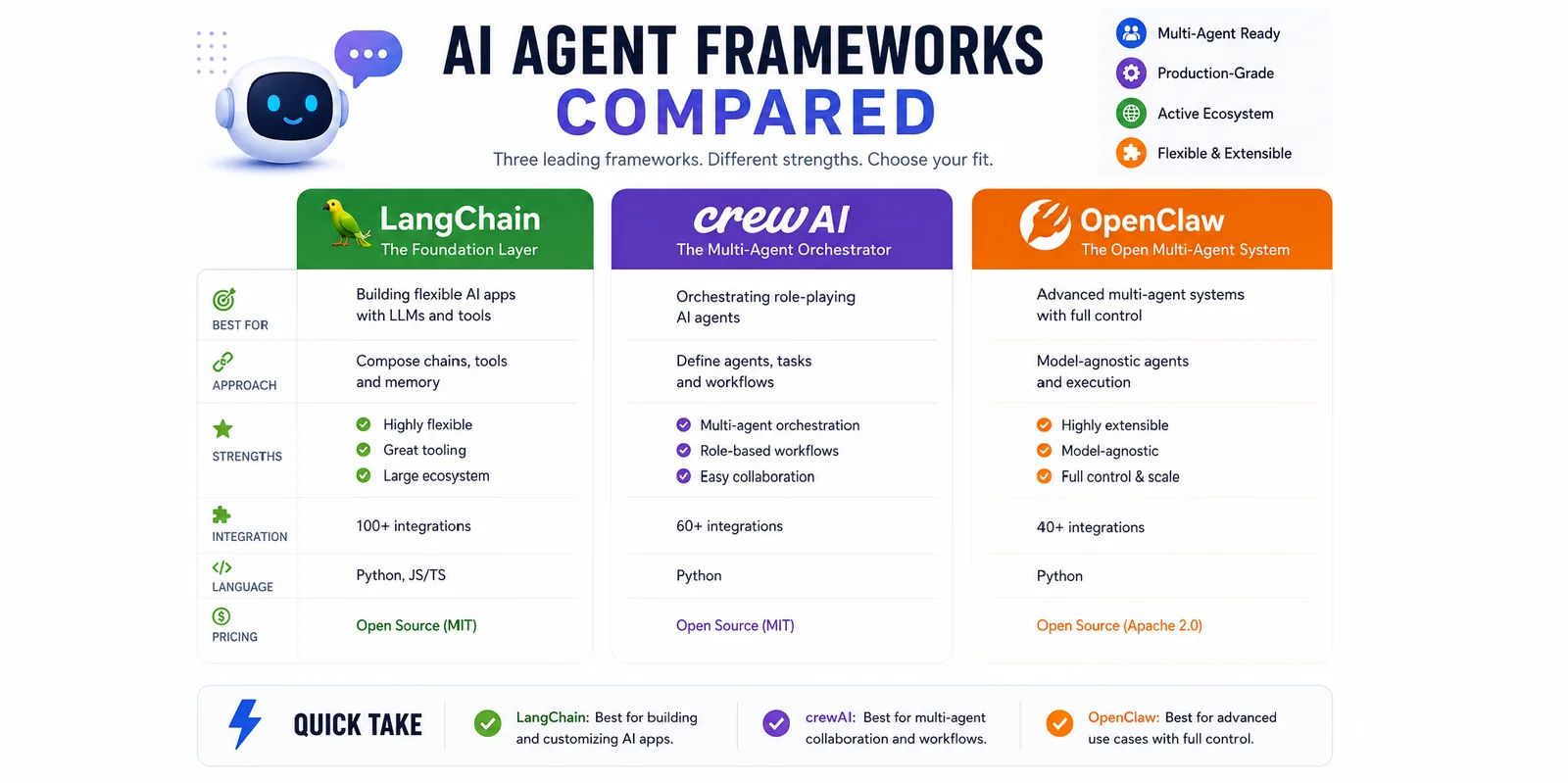
AI Agent Frameworks Compared: LangChain vs CrewAI vs OpenClaw
Detailed comparison of LangChain, CrewAI, and OpenClaw agent frameworks. Features, pricing, operating effort, and use case fit for enterprise AI agent development.
Faizan Ali KhanReady when you are
Want Cubitrek to run AI Solutions for you?
We install ai solutions programs for growing companies across the US and Europe. Book a call and we'll come back with a one-page plan in 72 hours.