Businesses in ChatGPT: What It Changes for Your Business
OpenAI launched Businesses in ChatGPT on 10 November 2026: claim your profile, correct your facts, see your mentions, and if you are US ecommerce, publish a Business Agent. What it actually does, what OpenAI says it does not do, and why the insights matter more than the agent.

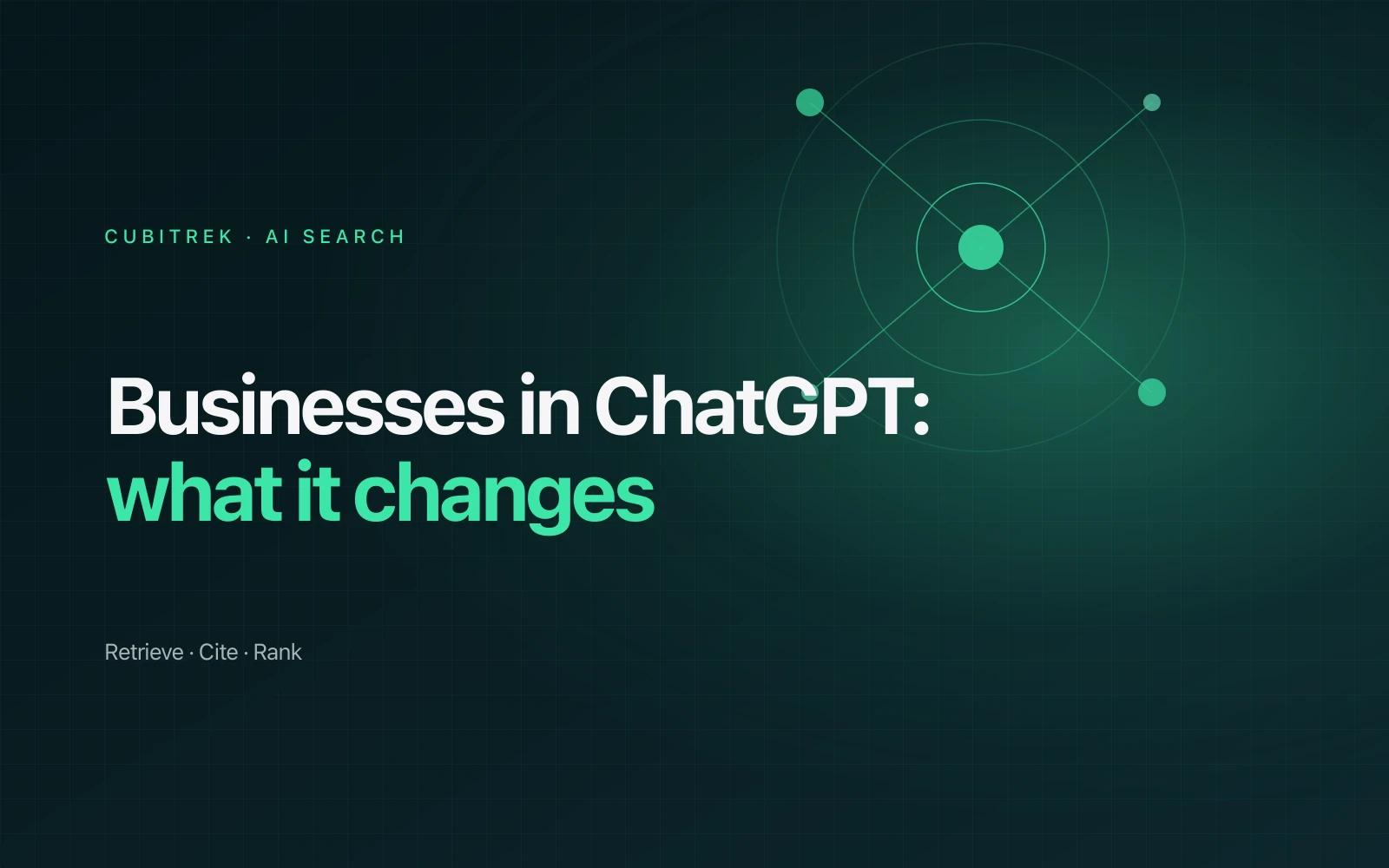
On 10 November 2026 OpenAI launched Businesses in ChatGPT in beta. It lets a company claim its profile inside ChatGPT, keep its product and policy information current, see how often it is mentioned, and, if eligible, publish a Business Agent that answers customer questions in a labelled side conversation. Business Hub is the control panel. Business Agents are limited at launch to eligible ecommerce and online service businesses in the United States.
OpenAI puts the audience at 1.2 billion people using ChatGPT each week. That is the reason this matters. It is also the reason the launch is being read more optimistically than OpenAI's own documentation supports.
What Businesses in ChatGPT actually includes
Three distinct things ship under one name, and conflating them is the first mistake.
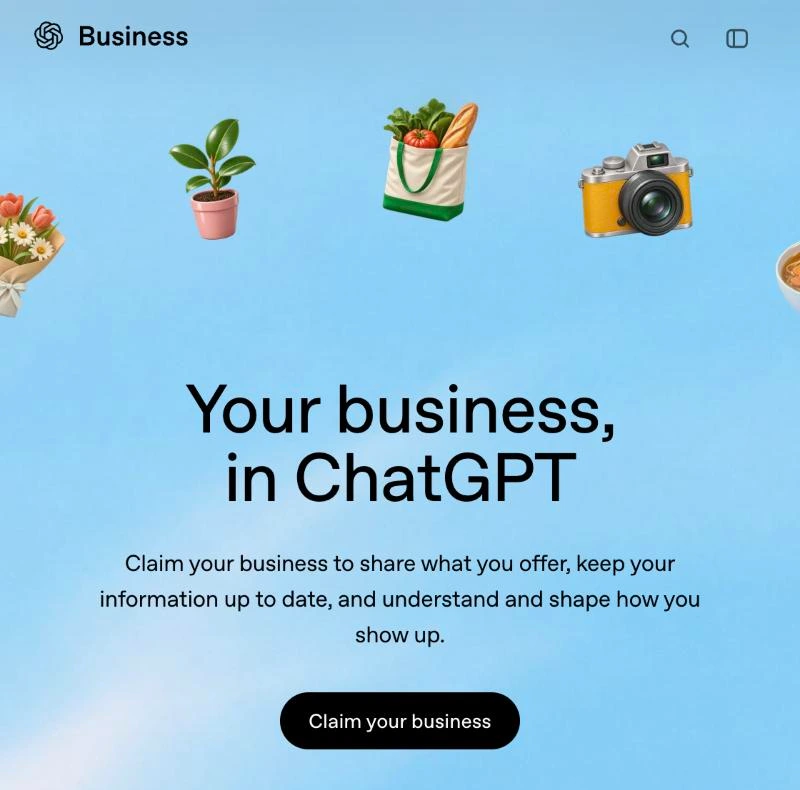
Business Hub is where you claim and verify the business, then update key details. Retailers can upload product feeds carrying pricing and availability. A claimed profile gets a blue check. Claiming is initially available to eligible businesses with a website.
Insights report the number of mentions and website clicks a business receives in ChatGPT, plus discovery topics, which OpenAI defines as common themes across conversations where your website is cited. These are aggregated and appear only once there are enough conversations to meet a threshold. OpenAI states it does not share users' conversations or Business Agent chats with businesses.
Business Agents are the agentic layer. When your business appears in a model response, a user can open your profile and start a separate conversation with your agent, which answers from your product and policy information under guidelines you set. OpenAI is explicit that this conversation is clearly labelled, separate from the user's original chat, and distinct from ChatGPT's own independent answers. Businesses can sponsor their agent and use it as the destination for ChatGPT Ads, with sponsored placements labelled.
Businesses in ChatGPT at launch
Who can claim, and who cannot yet
Eligibility is the part most coverage has glossed. OpenAI's own FAQ sets it out: eligibility depends on factors including industry, location, and verification and integrity checks. You must own the business or be authorised to represent it.
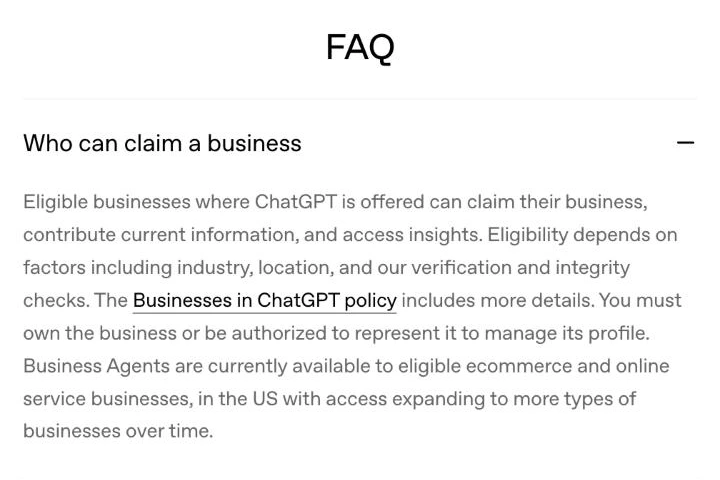
So there are two different gates, and they are frequently reported as one:
- Claiming is open to any eligible business located where ChatGPT is available, with a website.
- Business Agents are available only to eligible ecommerce and online service businesses in the United States.
A business outside the United States can therefore be claimable but agent-ineligible. Access is rolling out, and reports from launch day indicate some claims outside the US were placed in a queue rather than completed immediately, though coverage disagrees on how general that is. If you are outside the US, treat agent access as unscheduled: OpenAI has committed to expanding markets and categories but has published no timeline.
The line almost everyone is skipping
Buried in the product FAQ is the sentence that should frame every decision you make about this:
ChatGPT continues to make independent recommendations and comparisons. Claiming does not guarantee higher placement or sales.
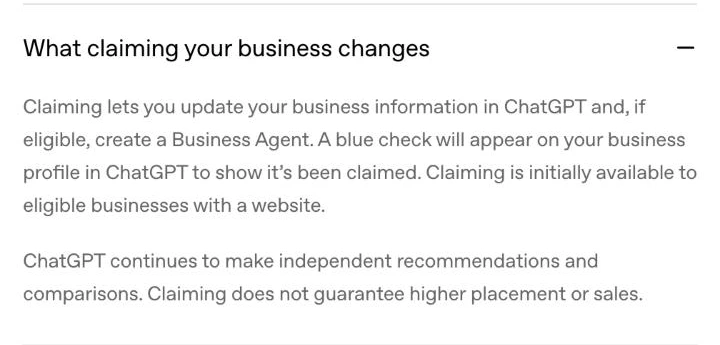
Read that against how the launch is being sold elsewhere and the gap is obvious. Claiming is a data correction and measurement layer, not a ranking lever. It lets you fix what ChatGPT says about you, and it lets you see what is happening. It does not buy you a better position in an answer.
Whether you get recommended in the first place is still decided by the retrieval and citation behaviour that governs every AI engine: whether your content answers the question cleanly, whether your entity is unambiguous, whether your claims are corroborated off your own domain. That is the same work as generative engine optimisation and answer engine optimisation. Nothing in this launch replaces it. If anything, a claimed profile raises the cost of having thin or contradictory content, because now the gap between what you publish and what you assert in your profile is legible to the platform.
The real unlock is measurement, not ranking
Here is the part worth your attention, and it is not the agent.
Until now, measuring AI visibility meant building your own instrumentation: pick a question set, run it against each engine on a schedule, parse the answers, count mentions and citations. We do this for clients, and it is genuinely useful, but it is a sampled proxy. You are inferring platform behaviour from outside the platform.
Business Hub reports mentions and website clicks from inside. That is a first-party number where previously there was only an estimate. Discovery topics go further: themes across the conversations where your site is cited, which is close to query data for a surface that has never had any.
This matters more than it sounds, because of how concentrated AI citations currently are. In our AEO and GEO work with Keyper, the brand reached mentions in 90% of a 73-prompt tracked question set, with 271 citation events in a single month across 69 distinct URLs. Of those citations, 86% came from ChatGPT.
We flagged that concentration as a risk at the time, because resting visibility on one provider's retrieval behaviour is a single point of failure. The same concentration is what makes native ChatGPT reporting disproportionately valuable: if the majority of your AI citations come from one engine, first-party numbers from that engine are not one data source among many. They are most of your picture.
That is the honest case for claiming today, even with no agent and no ranking benefit. You get measurement you could not otherwise buy, and you get to correct your own facts.
How this compares to Google Business Profile
The closest mental model is not a search ranking product. It is Google Business Profile: a free, claimed, verified record that controls the facts a platform repeats about you, carries a trust badge, and reports aggregated interaction data, without buying position in organic results.
Claimed profiles: the Google precedent and the ChatGPT version
| Google Business Profile | Businesses in ChatGPT | |
|---|---|---|
| Cost to claim | Free | Not stated on OpenAI's launch pages |
| Verification + trust badge | Yes | Yes, blue check on claimed profiles |
| Controls the facts shown | Yes | Yes, plus product feeds for retailers |
| Aggregated performance data | Yes | Yes, mentions, clicks, discovery topics |
| Guarantees better placement | No | No, stated explicitly by OpenAI |
| Two-way customer conversation | Messaging | Business Agent, US eligible categories |
| Paid amplification | Google Ads | Sponsored agent as ChatGPT Ads destination |
The precedent is instructive in one more way. Businesses that treated Google Business Profile as a box to tick got a tidy record and little else. Businesses that treated it as a distribution surface, kept it current, and fed it real inventory and real answers, took share from competitors who did not. The same split is about to happen here, with a smaller field and a much earlier start.
What the competitors are doing
ChatGPT is not the only engine building a merchant-facing layer, and the direction is consistent across all of them: structured product data in, agentic answers out.
Google reaches AI surfaces through Merchant Center and the Shopping Graph, with structured data on your own site feeding what it can assert. Google also has the deepest claimed-profile infrastructure of anyone through Business Profile, which is precisely the pattern OpenAI is now reproducing.
Perplexity runs a merchant programme that lets stores get products into its shopping results, using Google Shopping feed format. Reporting on its current terms, fees and eligibility is inconsistent across secondary sources, so check Perplexity's own documentation rather than a summary, including ours.
Shopify is the quiet winner here. OpenAI states that eligible products from Shopify merchants are already integrated into ChatGPT through Shopify Catalog, and that Shopify merchants can connect from Business Hub or the Shopify admin to streamline verification. If you are on Shopify, the on-ramp is materially shorter than everyone else's.
We have deliberately not published a feature-by-feature fee comparison across these platforms. The figures circulating this week come from vendor analyses that contradict each other on basic points including audience size and transaction fees, and we are not willing to put numbers in front of you that we cannot trace to a primary source.
What to do this week
A sensible first pass
- 01
Check eligibility and claim
30 minutesGo to Business Hub and search for your business. Claiming is open to eligible businesses with a website where ChatGPT is available. Note that continuing means accepting the Businesses in ChatGPT Terms, so read them first if procurement will care.
- 02
Correct your facts before anything else
1 to 2 hoursThe profile is only as good as what you put in it. Check that your description, categories, policies and, for retailers, product feed pricing and availability match what is live on your site. A claimed profile that contradicts your own site is worse than no profile.
- 03
Set a visibility baseline now
Half a dayRecord mentions, clicks and discovery topics as soon as insights populate. Without a baseline taken before you change anything, you cannot attribute later movement to any of the work you do.
- 04
Only then consider an agent
OngoingIf you are US-based and in an eligible category, scope what the agent is allowed to say. It answers from your product and policy information under guidelines you control, which means your policies become customer-facing copy. Most teams need to rewrite them before they are fit for that.
The contrarian read
The strategic value of this launch is inverted from how it is being marketed.
The agent is the headline and the least important part for most businesses right now, because most businesses cannot have one. The insights are the footnote and the most important part, because they convert AI visibility from something you estimate into something you measure, on the engine that in our own client data produced 86% of citations.
There is also a second-order effect worth naming. Once a platform offers a claimed profile, ads against it, and an agent you can sponsor, the commercial logic points one way. Sponsored placements are labelled and separate today. The organic surface is still independent today. Plan for a world where the free surface gets more competitive, and make sure the thing that earns you a mention, which is genuinely citable content and a clean entity graph, is strong enough to survive that.
The businesses that will do well here are the ones already doing the unglamorous work: unambiguous entity signals, answers structured so a model can lift them cleanly, claims corroborated somewhere other than their own marketing site. Claiming your profile makes that work visible. It does not substitute for it.
If you want to know where you currently stand before you claim anything, that is the measurement problem we solve, and we do it as a fixed-scope engagement rather than a retainer. For ecommerce teams where the product feed is the real asset, the feed and storefront work is usually the higher-leverage half.
Key takeaways
- Separate the two gates before you plan anything. Claiming and Business Agents have different eligibility, and a business outside the US can be claimable but agent-ineligible.
- A claimed profile that contradicts your live site is worse than no profile, because the mismatch becomes legible to the platform. Correct your facts before you add anything.
- Take a visibility baseline the moment insights populate. Without a pre-change reading you cannot attribute any later movement to any of your work.
- In our own client data from the Keyper engagement, 86% of AI citations came from ChatGPT across 271 citation events in one month. That concentration is why first-party reporting from this one engine is worth more than it looks.
- Business Agents answer from your product and policy information, which turns internal policy copy into customer-facing copy. Most teams need to rewrite it before it is fit for that.
- Pricing is not stated on OpenAI's launch pages, and the product is in beta with no published expansion timeline. Claim, correct and measure now; do not rebuild your content operation around an agent you cannot access.
Questions people ask about this
Sourced from client conversations, Search Console, and AI-search citation monitoring.
- Businesses in ChatGPT is a beta product OpenAI launched on 10 November 2026. It has three parts: Business Hub, where an eligible company claims and verifies its business and updates key details including product feeds with pricing and availability; aggregated insights showing how often the business is mentioned and how many website clicks it receives, plus discovery topics covering the themes of conversations where the site is cited; and Business Agents, which let eligible businesses publish an agent that answers customer questions from their own product and policy information.
- OpenAI says any eligible business located where ChatGPT is available can claim its business through Business Hub, and that claiming is initially available to eligible businesses with a website. Eligibility depends on factors including industry, location, and OpenAI's verification and integrity checks. You must own the business or be authorised to represent it. Existing OpenAI Enterprise customers and advertisers can claim through their OpenAI representative, and Shopify merchants can connect their store from Business Hub or the Shopify admin to streamline verification.
- No. OpenAI states directly that ChatGPT continues to make independent recommendations and comparisons, and that claiming does not guarantee higher placement or sales. Claiming lets you correct the information ChatGPT holds about you, adds a blue check to your profile, and unlocks insights and, where eligible, a Business Agent. Whether ChatGPT recommends you in the first place is still governed by retrieval and citation behaviour, which is the domain of generative engine optimisation and answer engine optimisation.
- Not at launch. OpenAI says Business Agents are available to eligible ecommerce and online service businesses in the United States, with access expanding to more types of businesses over time. Claiming a business is separate and is open more broadly, to eligible businesses with a website anywhere ChatGPT is available. OpenAI has said it plans to expand Businesses in ChatGPT and Business Agents to more markets and categories but has not published a timeline.
- No. OpenAI states that it does not share users' conversations or Business Agent chats with businesses. Insights are aggregated and are only available once there are enough conversations or interactions to meet certain thresholds. A Business Agent conversation is clearly labelled, kept separate from the customer's original ChatGPT conversation, and distinct from ChatGPT's own independent answers.
- OpenAI's launch announcement and product page do not state a price for claiming a business, for Business Hub or for Business Agents. Some third-party coverage reported both as free during the beta. Businesses can separately choose to sponsor their Business Agent and use it as a destination for ChatGPT Ads, which is a paid placement and is labelled as sponsored.
Keep reading
Related articles.
More on the same thread, picked by tag and category, not chronology.
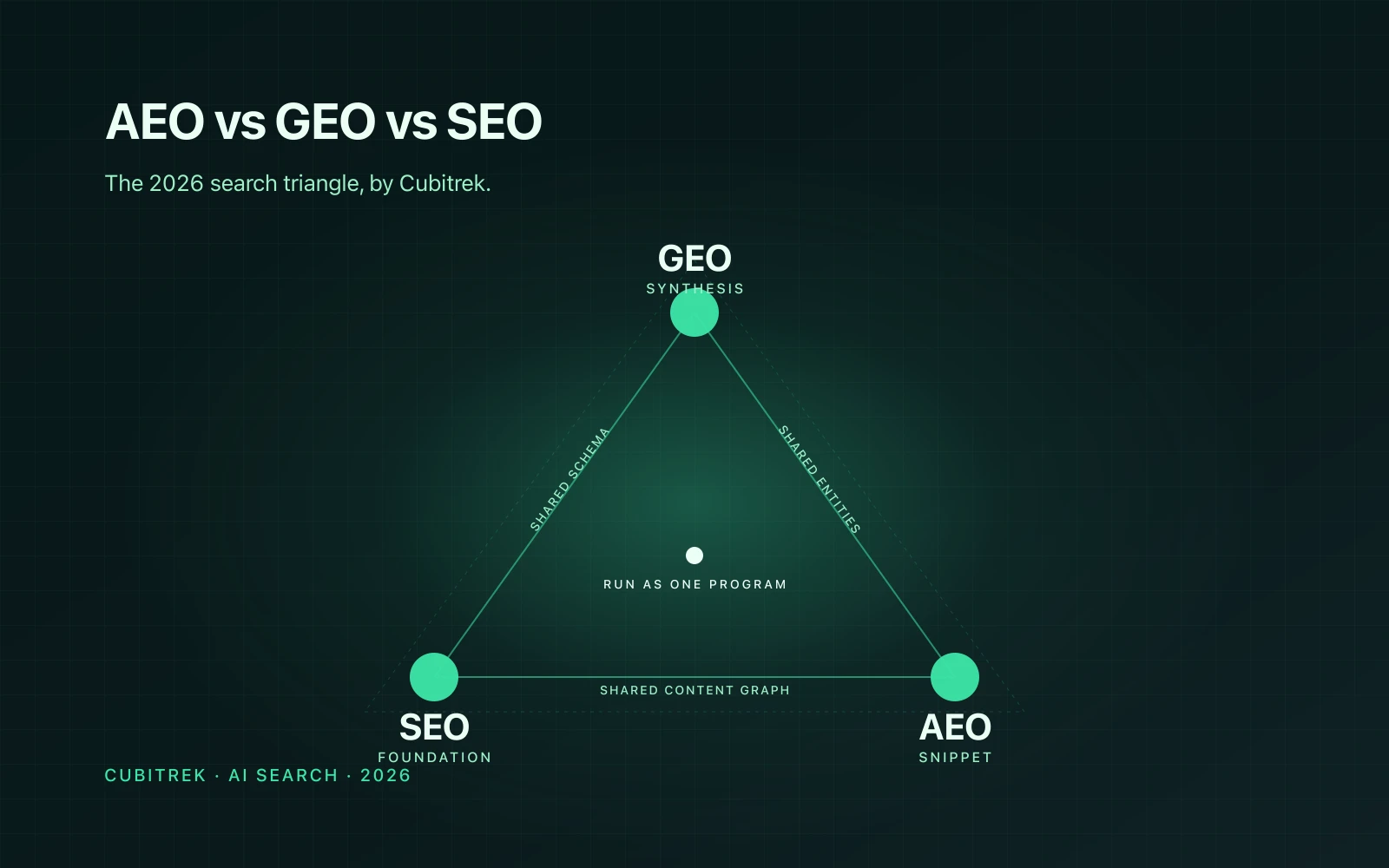
AEO vs GEO vs SEO: The Triangle
SEO is the foundation. AEO is the snippet game. GEO is the synthesis game. They are not competitors. Run them as one program and they compound.
Faizan Ali Khan
AI SEO Services: The Real Work
An agency owner's account of what sits under the AI SEO label: the four kinds of work in a real engagement, which three are verifiable and which one is not, and the cases where you should not buy it at all.
Faizan Ali Khan
Keyper AEO and GEO
A Dubai proptech challenger could not outspend the portals on the results page, so we competed where the portals were not looking: inside the answers ChatGPT, Perplexity and Gemini generate.
Faizan Ali KhanReady when you are
Want Cubitrek to run AEO & GEO for you?
We install aeo & geo programs for growing companies across the US and Europe. Book a call and we'll come back with a one-page plan in 72 hours.