

Why 2026 Is Critical for Mobile App Security
Why 2026 is the tipping point for mobile app security: agentic AI attacks, the updated OWASP MASVS, and the EU Cyber Resilience Act deadlines.

Did you know? According to Statista, total revenue of the mobile app market is expected to grow annually at the rate of 7.48%, projected to reach $781.70 billion by 2029.
With this growth, mobile app security is at high stake in 2026. The technology has evolved, and so have the cyber threats. AI-driven attacks, agentic malware and deepfake fraud now put mobile app security at a tipping point.
Businesses and governments must act to protect apps, users and their reputations.
Below you will learn why mobile app security is critical in 2026, the most significant threats, the standards that now apply, and what to do next.
TLDR: In 2026, most monitored apps face attacks, agentic AI lets low-skilled attackers move in hours, and OWASP MASTG v2.0 plus the EU Cyber Resilience Act reset the bar. Build secure-by-design, adopt MASVS L1 or L2, and audit every third-party dependency.
The Current State of Mobile App Security
The current state of mobile app security is explained below in detail.
Mobile Apps Are a Top Target for Hackers
Cyberattacks on mobile apps are rising sharply. Research reported in 2026 found that 87% of monitored apps faced attacks, up from 55% in 2022. Financial services (91%), automotive (91%) and medical device apps (86%) are hit most.
Mobile apps handle banking, health records and personal communication. That is why they are prime targets for cybercriminals.
The Role of AI in Cyberattacks
AI changed cybersecurity on both sides. Attackers now use AI to bypass traditional defenses and adapt malware at speed. Agentic AI lets low-skilled actors do in hours what once took specialist teams weeks.
Defenders need equally advanced protocols to keep pace.
Stricter Regulations Are Here
Governments are tightening cybersecurity rules to protect user data. Key regulations to know in 2026 are listed below.
- EU Cyber Resilience Act (CRA): Any Android or iOS app installable by EU users is in scope. Vulnerability reporting duties start 11 September 2026 (24-hour early warning, 72-hour full report). Main obligations apply from 11 December 2027.
- GDPR and CCPA: These continue to require strict data handling, transparency and breach accountability, with heavy fines for failures.
- App store baseline requirements: Apple and Google keep raising minimum security and privacy rules for listed apps.
Non-compliance with the CRA can trigger fines up to 15 million euros or 2.5% of global annual turnover, whichever is higher.
The Rising Mobile App Threats in 2026
The following are the rising threats for mobile app security in 2026.
1. Agentic AI Attacks
Agentic AI is the 2026 threat multiplier. Autonomous agents can browse, generate content and remember context across steps. They craft personalized spear-phishing, harvest data and automate credential-stuffing without a human in the loop.
Attackers now strike apps within hours of release, across every industry. Apps that rely on voice or video verification need stronger anti-fraud controls.
2. AI-Powered Fraud and Deepfakes
Generative AI produces deepfakes, synthetic identities and adaptive bots at scale. Scam calls, videos and messages now look and sound real. Even careful users get tricked.
Mobile apps that verify identity must add liveness checks and layered signal analysis.
3. Polymorphic and Adaptive Malware
Malware built to target one bank can now be adapted to dozens in a fraction of the time. Some strains interact directly with legitimate banking apps and crypto wallets to move funds silently.
Developers must integrate strong encryption, tamper detection and secure backups.
4. Insecure Third-Party SDKs and Open-Source Libraries
Most apps are not built from scratch. Developers use third-party SDKs and open-source libraries to save time. Many carry security flaws that go unchecked.
The EU CRA now expects a Software Bill of Materials for dependencies. Audit and update third-party code on a schedule.
5. Reverse Engineering and Runtime Attacks
AI accelerates reverse engineering of mobile apps. Attackers extract secrets, bypass logic and repackage tampered builds. This is why OWASP added a dedicated resilience category to its standard.
Add code hardening, anti-tampering and runtime protection to high-risk apps.
How Technology Is Strengthening Mobile App Security
Here is how technology is strengthening mobile app security in 2026.
1. OWASP MASVS and MASTG v2.0
OWASP MASVS is the industry standard for mobile app security. It defines two levels: L1 (baseline for every app) and L2 (defense-in-depth for banking, healthcare and government), plus an R category for reverse-engineering resilience.
In 2026, OWASP released MASTG v2.0. It is a machine-readable knowledge graph of 860+ components with pass or fail conditions, mapped to MASVS controls. This makes testing repeatable and CI/CD-friendly.
2. Secure-by-Design AI App Development
The CRA makes secure-by-design a legal expectation, not a nice-to-have. That means threat modeling, least-privilege access and encrypted data at rest and in transit from day one.
At Cubitrek, we build AI apps and agents with security as a first-class requirement, not an afterthought.
3. AI and Machine Learning for Threat Detection
AI and ML help apps spot and block threats in real time. They analyze behavior and flag unusual activity that may signal fraud, malware or account takeover.
To counter AI-driven attacks, defenders must use AI too.
4. Zero-Trust Security Models
Traditional systems trusted anyone already inside the network. That assumption caused many breaches. Zero-trust removes it by verifying every access request, every time, from anywhere.
The Future of Mobile App Security
Here are the trends shaping the future of mobile app security.
1. AI-Powered Fraud Detection Becomes Standard
Attackers use ever more advanced tactics, and static rules cannot keep up. AI-powered fraud detection will become a default feature in banking and shopping apps, scoring risk before a transaction completes.
2. Compliance-Driven Security Baselines
Regulation now drives the security floor. CRA conformity, a Software Bill of Materials and a documented update mechanism will be table stakes for any app sold in the EU by 2027.
Teams that bake compliance into the build will ship faster than those bolting it on later.
3. On-Device AI and Privacy
More AI now runs on the device instead of the cloud. This can reduce data exposure, but it adds a new attack surface. Protecting on-device models and their data becomes a core security task.
Conclusion
2026 is a critical moment for mobile app security. Threats are faster, cheaper and AI-driven, and the rules are tightening. If businesses and developers do not act now, they risk breaches, financial loss and reputation damage.
Companies that build securely today set a strong foundation. Those who ignore it risk losing customers, revenue and trust.
Common queries about mobile app security in 2026
What is the biggest mobile app security threat in 2026?
Agentic AI is the leading threat. It lets attackers automate reconnaissance, exploit generation and phishing, striking new apps within hours of release.
What standard should mobile apps follow?
Use OWASP MASVS. Apply L1 as a baseline for every app, and L2 for banking, healthcare or government apps that handle sensitive data.
Does the EU Cyber Resilience Act apply to my app?
If EU users can install your Android or iOS app, the CRA applies. Vulnerability reporting duties begin 11 September 2026, with main obligations from 11 December 2027.
How does Cubitrek approach secure app development?
We build AI apps and agents secure-by-design: threat modeling, encryption, dependency audits and MASVS-aligned testing from the first sprint.
Want to go deeper on AI-era risk? Read our take on AI-driven cyber threats and how to defend against them.
Contact Cubitrek for a mobile app security review or a secure-by-design build.
Let's discuss it over a call.
Key takeaways
- 2025 is a critical moment for mobile app security. Cyber threats are growing fast, and hackers are finding smarter ways to steal data.
- Companies that prioritize security now will build a strong foundation for the future. Those who ignore it risk losing customers, revenue, and reputation.
- Contact us at Cubitrek for more information on mobile app security!
Keep reading
Related articles.
More on the same thread, picked by tag and category, not chronology.

php2shell: patch, then plan
Two critical PHP vulnerabilities, CVSS 9.2, unauthenticated remote code execution, and no safe server configuration. What to do this week, why your version number cannot tell you if you are exposed, and why patching to PHP 8.2 buys you ten weeks.
Faizan Ali Khan
The AI Code Review Bottleneck
Anthropic went from 2,500 merges a day to over 30,000 in four months and replaced git to cope. You cannot buy what they built, and they say so. What transfers is the diagnosis, and what it looks like at ordinary scale.
Faizan Ali Khan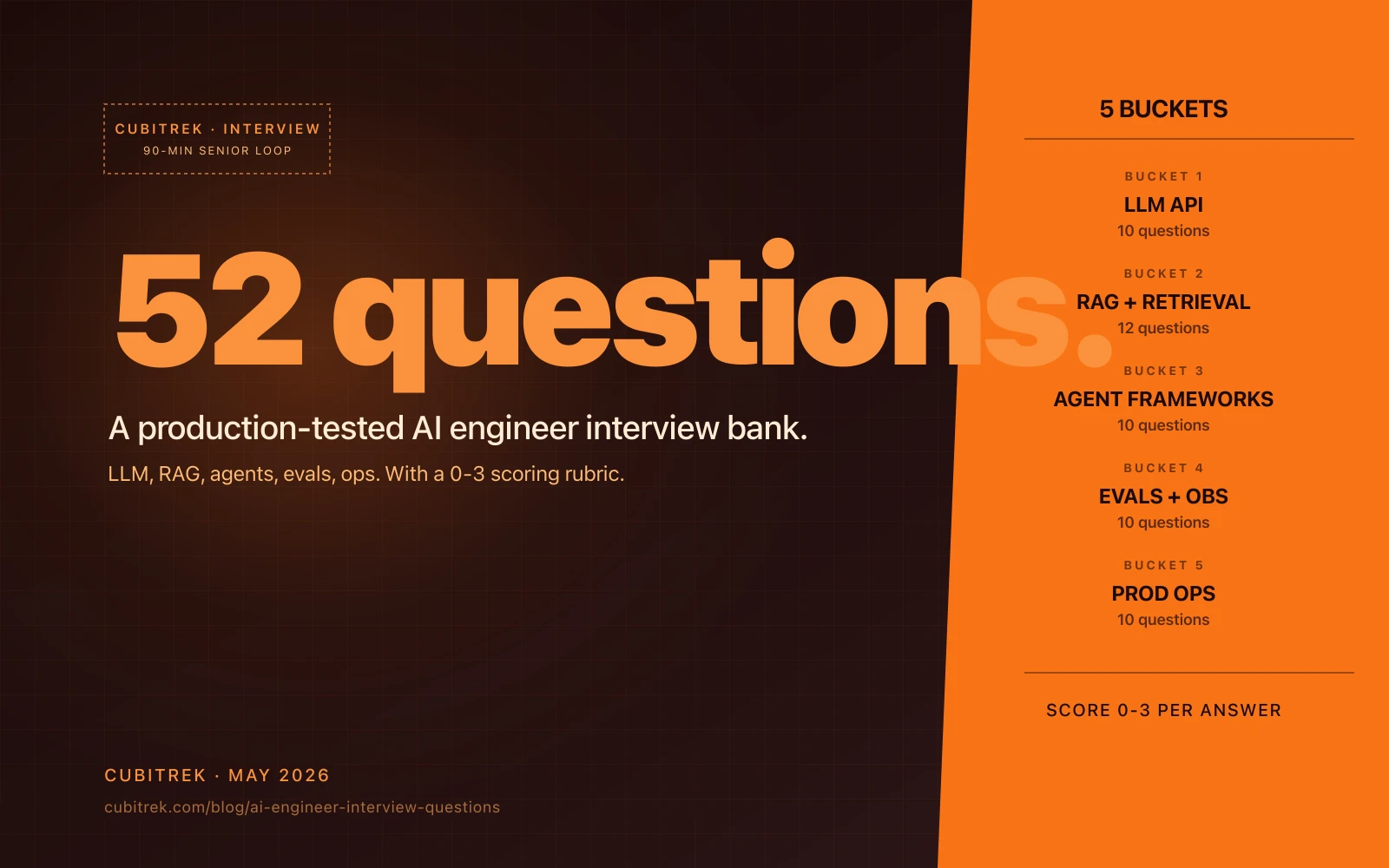
52 AI Engineer Interview Questions
52 real AI engineer interview questions across LLM API integration, RAG and retrieval, agent frameworks, evaluation and observability, and production operations. With scoring rubric and what good answers look like. Used at Cubitrek to pre-vet every staff-augmentation candidate.
Faizan Ali KhanReady when you are
Want Cubitrek to run Mobile App Development for you?
We install mobile app development programs for growing companies across the US and Europe. Book a call and we'll come back with a one-page plan in 72 hours.