

Storytelling in digital marketing: the 2026 AI-era playbook
Brand storytelling in 2026 is also entity reinforcement. The 6 storytelling techniques senior operators are running now, plus the AI-era brand-narrative pattern that compounds across ChatGPT, Perplexity, and Gemini.

Storytelling in digital marketing is the practice of shaping every brand touchpoint (website, ad, email, social post, video, podcast, blog) around a coherent narrative the audience remembers. In 2026 the discipline carries a second job: every brand story is now also entity reinforcement for AI engines. The same Hero's Journey that lands emotionally with a human buyer also gets parsed by ChatGPT, Perplexity, Gemini, and Claude into your brand's knowledge graph. Two audiences, one story, double the compounding return.
This guide covers six storytelling techniques senior operators are running for brands in 2026: the four enduring patterns (Hero's Journey, Emotional Connection, Problem-Solution, Behind-the-Scenes) that still work plus two new AI-era patterns (AI-cited brand narrative, multi-modal storytelling) that only emerged once AI engines became part of the buyer journey.
Why storytelling in digital marketing matters in 2026
Five reasons that hold up post-AI:
- Makes your brand human. Stories create emotional connection that product specs alone cannot. A buyer who connects emotionally with your story converts at 3-5x the rate of a buyer who only encountered your feature list.
- Builds trust. Authentic stories signal that real humans run the brand. AI-generated marketing fluff signals the opposite. The contrast is becoming sharper as cheap AI content floods the web.
- Captures attention. Stories survive the scroll. Product copy does not.
- Drives engagement. Stories spark conversations, shares, comments, and (new in 2026) AI citations. AI engines specifically reward narrative-driven content with strong entity grounding.
- Inspires action. Stories with a clear emotional payoff motivate buyers to convert. Bullet-point benefits do not.
The 2026 addition: brand storytelling and AEO/GEO entity work are now the same workstream. A story told consistently across owned (your site), earned (press, podcasts), and AI-cited channels (ChatGPT, Perplexity) compounds. A story siloed in one channel does not.
The 6 storytelling techniques for 2026 (with real examples)
Four enduring techniques
1. The Hero's Journey
Place your customer at the heart of the story. They are the hero. Your product or service is the trusty sidekick. By showing how you helped them overcome an obstacle, achieve a goal, or transform their situation, you create emotional connection and demonstrate value in a relatable way.
Real-life examples:
- Apple's "Think Different" campaign celebrated innovators who challenged the status quo. The buyer becomes the hero capable of changing the world with Apple's products.
- Nike has used the Hero's Journey for decades. Every athlete partnership positions Nike's product as the tool that empowered the everyday-athlete buyer to achieve greatness. Customers feel like the star of their own success story.
2026 update: the Hero's Journey now gets a second audience. The same emotional structure that lands with humans also lands with AI engines because the narrative arc carries the named entities (founder, customer, product, outcome) AI knowledge graphs require. The story compounds in both channels.
2. Emotional Connection
The best stories touch the audience and stay with them long after the first encounter. Share personal, relatable stories that evoke joy, inspiration, or nostalgia. When the buyer feels something, they remember it. Memory is the foundation of brand recall, which is the foundation of pipeline.
Real-life examples:
- Google's "Dear Sophie" ad tells the story of a father using Google products to create a digital memory book for his daughter. Tugs viewers' hearts; forges strong emotional connection between the buyer and the brand.
- Coca-Cola's "Share a Coke" campaign created an emotional connection by personalising the product and encouraging consumers to create and share stories about the brand. Resulted in measurable sales lift and a stronger emotional bond with customers.
2026 update: emotional stories now also get repurposed as multi-modal content (text + image + video + audio versions of the same narrative) which doubles or triples AI citation rate. The Coca-Cola version of the campaign in 2026 would include AI-generated personalised story variants at scale.
3. Problem-Solution Narrative
Every great story has a conflict. Show your audience how your product solves their most pressing challenges. By addressing the pain head-on, you position your brand as a trusted ally and an invaluable resource the buyer can count on.
Real-life examples:
- Uber communicates how the ride-sharing platform solves transportation challenges. Convenience, affordability, accessibility. Buyer in need of a reliable solution.
- Airbnb shows how the platform solves the pain points of traditional travel accommodations. Unique, affordable, authentic experiences. The brand becomes the ideal solution for the modern traveler.
2026 update: problem-solution narratives now get amplified through AI citation. When a Perplexity user asks "how do I get a ride at 3am in a city I don't know?", Uber gets cited because the brand's open-web narrative graph (blog posts, press, Reddit threads, forum discussions) collectively reinforces the problem-solution entity link.
4. Behind-the-Scenes Storytelling
Invite your audience into your world. Offer a behind-the-scenes look at company culture, values, and the people who run the brand. Humanising the business creates trust and authenticity.
Real-life examples:
- Zappos shipped this format for years through company-culture spotlights, customer-service stories, and employee-centric content. Built a loyal following on authenticity.
- Buffer gained a category-leading reputation for transparency by sharing real numbers (revenue, salaries, hiring decisions) publicly. Strengthened the connection between the brand and its customers through radical openness.
2026 update: Behind-the-scenes content now also serves AI entity reinforcement. The founders, key employees, and company values mentioned in BTS content become entity-graph anchors AI engines parse and trust.
Two new techniques (AI-era)
5. AI-cited brand narrative
The newest storytelling pattern. Senior brands in 2026 deliberately shape their narrative for AI consumption alongside human consumption. The mechanics:
- Brand Hub on the canonical domain. One page that holds your official story, founder background, key milestones, and authoritative facts. AI engines parse this once and trust it for months. Cubitrek runs ours at /brand-hub.
- Consistent narrative across owned + earned + AI-cited channels. Same founder origin story on the About page, in podcast appearances, in press releases, in LinkedIn posts. Repetition is what builds entity-graph confidence.
- Named entities in every story. Real people, real places, real products, real dates. AI engines lift content with named entities at 2-4x the rate of generic stories.
The signal: AI Visibility Score climbs in proportion to how consistently your story is told across channels. The Cubitrek AEO Platform measures this directly.
6. Multi-modal storytelling
AI engines moved from text-only retrieval to multi-modal retrieval in 2025. They now read text, images, video frames, alt text, captions, and structured data together. A story told in text + image + video + audio with consistent entity tagging compounds 2-4x faster in AI engines than a text-only version of the same story.
Concrete tactic: take your strongest brand story and ship four versions of it (blog post with image schema, LinkedIn carousel, YouTube video with transcript, podcast episode with named-entity tagging). Same narrative, four modalities. AI engines treat the consistency as a strong entity signal.
What changes about storytelling in 2026
Three shifts:
- The audience doubled. Every brand story now has two audiences: humans who feel and AI engines that parse. Both reward the same things (clear entities, emotional grounding, multi-modal consistency) but for different reasons.
- The measurement layer changed. Pre-AI storytelling was measured by engagement rate, share count, brand recall surveys. 2026 storytelling adds AI Visibility Score and citation rate per engine.
- The production pipeline expanded. Pre-AI you wrote one version of the story. Post-AI you write the core narrative and ship four modalities (text + image + video + audio) with consistent entity tagging.
The good news: the storytelling craft itself didn't change. Hero's Journey still works. Emotional connection still works. Behind-the-scenes still works. The wrapper got bigger.
Frequently asked questions
1) Why is storytelling important in digital marketing in 2026?
Storytelling builds emotional connection with human buyers AND reinforces entity signal for AI engines. The same brand story that lands with a buyer also gets parsed by ChatGPT, Perplexity, and Gemini into the brand's knowledge graph. Two audiences served by one piece of creative work.
2) What is the most powerful storytelling technique in marketing?
The Hero's Journey, with the customer cast as the hero and the brand as the sidekick. Decades of consumer-psychology research and Apple-plus-Nike's track record both validate it. In 2026 the same technique compounds in AI engines because the named entities in the story (customer, brand, product, outcome) carry entity-graph weight.
3) How do you measure success of brand storytelling in 2026?
Track three signals: human engagement (time on page, share rate, brand recall), AI citation rate inside ChatGPT, Perplexity, Gemini, Claude, and Bing Chat, and conversion-per-engaged-visitor. AI-cited story-driven traffic typically converts 3-4x higher than cold Google because the AI pre-qualified the visitor with your narrative.
4) Should brand storytelling be different for B2B vs B2C?
The structure is the same; the cast changes. B2B Hero's Journey casts a senior operator at a buyer company as the hero. B2C Hero's Journey casts the individual consumer. Same arc (challenge → struggle → resolution with the product as catalyst), different protagonist. Both work in AI engines because both carry named entities.
5) Can AI write brand stories or does it have to be human?
AI can produce competent first drafts. Senior humans still own brand voice, emotional truth, and the editorial judgment about which stories to ship. The 2026 production pattern: AI drafts, senior editor shapes, brand voice gets enforced, story ships. Pure AI storytelling without human shaping reads as generic and converts poorly.
6) What is the biggest mistake brands make with digital storytelling?
Telling different versions of the story across different channels. Owned media says one thing, paid ads say a slightly different thing, the founder LinkedIn post says a third thing. The inconsistency dilutes both human brand recall and AI entity reinforcement. Single most-fixable mistake; ship a Brand Hub, force every channel to reference it.
Want this run for you?
Cubitrek runs brand storytelling as part of the integrated Digital Marketing and AEO + GEO programs. Senior operators shape the story, agents produce multi-modal variants, the AEO Platform measures whether AI engines actually pick it up. Or measure your current AI Visibility free at aeo.cubitrek.com.
Key takeaways
- Brand storytelling now serves both human emotional connection AND AI entity reinforcement. Same story, two consumers.
- Multi-modal storytelling (text + image + video + audio with consistent entity tagging) compounds 2-4x faster than text-only narrative in AI engines.
- Hero's Journey still wins. Apple, Nike, and now Cubitrek-clients position the buyer as hero with the brand as sidekick.
- Original first-person operator stories carry the highest Information Gain and the highest AI-citation rate.
- Measure storytelling success on both engagement metrics AND AI citation rate inside ChatGPT, Perplexity, and Gemini.
Keep reading
Related articles.
More on the same thread, picked by tag and category, not chronology.
Your business software should be a tool your AI can use
MCP lets an AI assistant use your ERP, POS or warehouse system directly, not through a chatbot bolted onto a dashboard. What the protocol changes, and the three things that have to be true before you connect anything.
 Faizan Ali Khan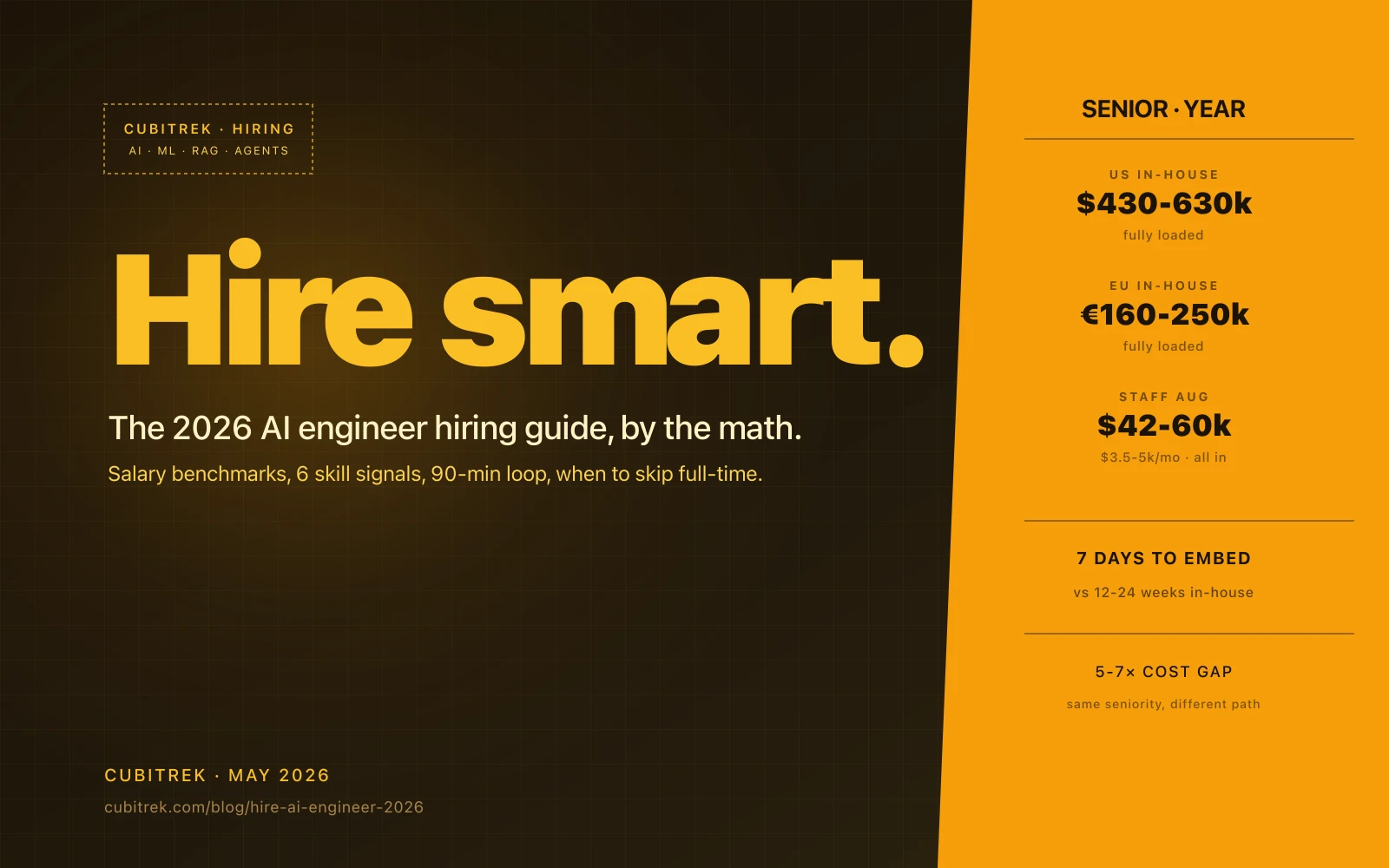
Hire an AI Engineer in 2026
Hire an AI engineer in 2026 and you face a market that did not exist three years ago. The role splits into 5 sub-specializations, and what you pay depends more on the title you advertise than on the seniority label. This guide tells you what to look for, how to read the public salary data, and when to skip a full-time hire entirely.
Faizan Ali Khan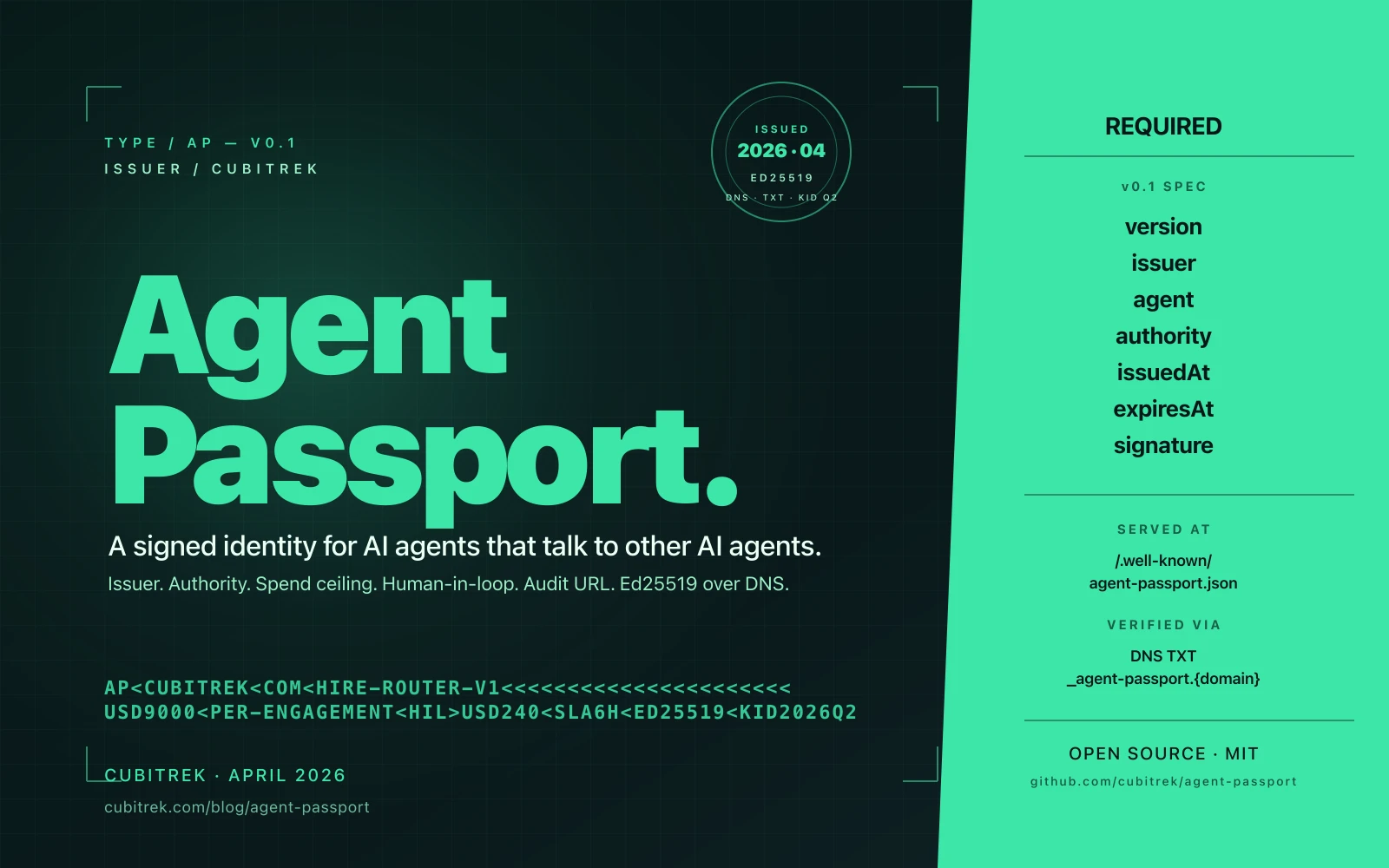
Agent Passport: The Identity Standard
An open standard for verifiable, business-issued identity and authority for AI agents that talk to other AI agents across organisational boundaries. One signed JSON file at /.well-known/agent-passport.json. Ed25519 over DNS. MIT-licensed reference verifier in the spec repo. Cubitrek coined the term on April 28, 2026.
Faizan Ali KhanReady when you are
Want Cubitrek to run Digital Marketing for you?
We install digital marketing programs for growing companies across the US and Europe. Book a call and we'll come back with a one-page plan in 72 hours.