Dominate with PMax: Optimize Google Ads for Peak Performance
Unlock the full potential of your Google Ads campaigns with Performance Max (PMax). By optimizing with AI, smart bidding, and dynamic creative strategies, you can drive better results and reach customers across Google’s


PMax (short for Performance Max) is Google Ads's AI-driven, goal-based campaign type that automates bidding, targeting, and creative placement across YouTube, Display, Search, Shopping, Discover, Gmail, and Maps from a single setup. Instead of building seven campaigns for seven Google surfaces, you build one PMax campaign, hand Google's machine learning your conversion goal, and the algorithm decides where, when, and to whom each ad asset is shown.
This guide covers what PMax is, how PMax bidding works, the four assets you must upload, the most common PMax mistakes, and the 2026 optimisation playbook senior performance marketers use to push PMax ROAS above 4×.
What is PMax? A working definition
PMax is short for Performance Max, Google Ads's machine-learning-driven campaign type launched globally in late 2021 and made the default for Smart Shopping + Local campaigns in 2022. The campaign combines smart bidding, automated targeting, and dynamic creative assembly into one goal-based campaign that runs across every Google ad surface at the same time.
The shorthand most marketers use is PMax. The full name is Performance Max. Both refer to the same campaign type inside Google Ads.
What does PMax actually do?
A traditional Google Ads campaign forces you to pick a single surface: Search, Shopping, YouTube, or Display. Each has its own targeting, bidding, and creative requirements. PMax collapses all of them into one campaign. You provide goals (conversions, target ROAS, target CPA), audience signals (customer list, in-market segments, custom segments), and a pile of creative assets (headlines, descriptions, logos, product feeds, video, images). Google's algorithm assembles ads on the fly and bids across every surface in real time.
The trade-off is control for reach. You lose the ability to micro-target specific placements; you gain access to every Google surface from a single budget pool. For most growth-stage advertisers, that trade is favourable.
What is Google Performance Max optimization and how does it work?
PMax sits on top of the same account fundamentals as everything else. If the search terms, conversion tracking and bidding targets underneath it are wrong, PMax will spend against them faster. The weekly Google Ads optimization loop covers those fundamentals.
The Performance Max campaign is one of the Google Ads types that enables advertisers to enhance their customers’ engagement, control campaigns automatically, and boost sales and revenue. What makes the campaign type different is that it combines smart bidding and targeting features into one single goal-based campaign across the whole Google Network.
Machine learning drives the Pmax campaign, which divides ads between different platforms on your behalf. Since the audience’s preferences change over time and place, the right ads will be displayed in various forms.
The main aim of the Performance Max campaign is to enable advertisers to enlarge their market presence. Performance Max’s algorithm optimizes ad delivery for higher conversions, making smart bidding a powerful choice.
Where are Performance Max ads displayed?
Performance Max ads are highly adaptable in that they can appear on any of Google’s advertising channels, being naturally adjusted to every one:
- YouTube
- Display
- Search
- Shopping
- Discover
- Gmail
- Maps
Performance Max ads get optimized automatically
Your job is to upload different designs that will suit and fit each advertising platform, for example, images, videos, logos, and ad copy that would attract traffic to your brand or products, Google takes over the rest, i.e. optimization. With your materials, Performance Max makes impression-based ads that may even include several combinations in response to the user’s interaction with the ad unit to be most effective for conversions and conversion value. The more resources or materials you provide, the more possibilities you have to advertise in various ad formats, which you can get on the Google network.
Performance Max automates bidding and budget strategy.
Performance Max utilizes machine learning to optimize conversions and automation to maximize your budget and business value. The desired goal is reached through smart bidding, which means manual bids are unavailable, and through the data about the audience you input. As is widely known, smart bidding is fully automatic, but you can always guide the bidding by setting a particular target CPA or ROAS.
You can select the campaign’s focus:
- Conversion Value (where you can set the target ROAS), if you have different conversion goals with diverse values.
- Max Conversion (the target CPA function allows you to define) your goal, while all the goals of iterations are of the same value.
Suggestion: If your account has a lot of historical data, you can immediately target CPA or ROAS, which you want to achieve. If the account is new, you should start with “Maximize Conversions,” which will let the system collect information. When you always have these actions, you can set tCPA or tROAS to meet your desires.
Performance Max automatically pinpoints the advertisement campaign issues
Performance Max is a useful diagnostic insights tool that alerts you whenever there’s a potential issue. They might include account, billing, campaign statuses, policy violations, ad strength, budget, etc. This instrument will also offer recommendations to fix the following errors if they arise.
AI in Performance Max
AI has changed the digital marketing landscape with its innovative solutions, and its impact is most evident in Performance Max campaigns.
Performance Max is a groundbreaking advertising program that uses artificial intelligence to optimise your presence across Google’s network. This allows you to reach your target audience and improve conversion rates effectively.
By leveraging artificial intelligence with Performance Max, advertisers can ensure their campaigns are data-driven and sustainable. They can use analytics to generate cost-effective bids, generate real-time auto-targeted ad units, and build dynamic video content, which results in more conversions and lower ad bills.
Including generative AI into Performance Max will enable you to quickly create and scale new assets, allowing you to be more imaginative with new and unique ideas. Using generative technology to create new headlines, descriptions, and images is a great advantage that presents the possibility of designing various campaigns. Moreover, the image editing tools in Performance Max aid in the easy exploration of the different image versions that raise the impact and the insight taking off.
2025 Google Ads Trends: What to Expect
Greater Automation Integration
- Automation will dominate the digital advertising landscape.
- Expect advanced algorithms that enhance campaign management.
- Increased use of automated bidding, targeting, and creative optimization.
More Predictive Analytics
- The role of predictive analytics will grow.
- New tools to help advertisers predict customer behavior.
- Smarter decisions on audience targeting, creative choices, and budgeting.
Privacy-Focused Advertising
- Data privacy will be a priority for Google Ads.
- Systems will be refined for privacy-compliant data collection.
- Machine learning will be used to predict user intent without violating privacy standards.
Conclusion
PMax (Performance Max) is the most aggressive automation step Google Ads has ever made. The brands that win it treat it like a portfolio manager treats an algo: clean inputs (assets, signals, conversion data), strict guardrails (negatives, exclusions, tROAS), and a weekly review of asset-group performance. The brands that lose it set it and forget it.
Need a senior performance marketer to run PMax for you? See Cubitrek's Performance Marketing for SaaS program. Or talk to an operator via contact. A founder replies inside one business day.
Frequently asked questions about PMax
1) What is PMax in Google Ads?
PMax stands for Performance Max. It is Google Ads's AI-driven, goal-based campaign type that runs ads automatically across YouTube, Display, Search, Shopping, Discover, Gmail, and Maps from a single setup. You provide conversion goals + audience signals + creative assets; Google's algorithm handles bidding, targeting, and placement.
2) What does PMax stand for?
PMax is shorthand for Performance Max, the full name of the campaign type inside Google Ads.
3) Is PMax better than a traditional Search campaign?
It depends on the goal. PMax is better for advertisers who want broad-funnel reach across every Google surface from one budget pool. Traditional Search remains better for advertisers who need precise control over keywords, audiences, and ad copy at the query level. Most mature accounts run both: PMax for prospecting + remarketing volume, Search for high-intent bottom-of-funnel queries.
4) How does PMax bidding work?
PMax only supports automated bidding strategies: Maximize Conversions, Maximize Conversion Value, target CPA, and target ROAS. Manual bidding is unavailable. You guide the algorithm by setting your conversion goal + (optionally) a target CPA or target ROAS the algorithm should aim for.
5) Where do PMax ads appear?
YouTube, Display, Search, Shopping, Discover, Gmail, and Maps. PMax automatically distributes your creative assets to the surface and format Google's algorithm predicts will convert best for each impression opportunity.
6) What are the four assets every PMax campaign needs?
Headlines (5-15), long headlines (5), descriptions (4-5), and visual assets (15-20 images, 5 videos, 5 logos). Plus audience signals (your customer list + in-market segments + custom segments) and a product feed if you sell physical or digital products.
7) Should new accounts start with PMax?
Generally no. New accounts without conversion history feed PMax too little signal to optimise from. Start with a Search campaign + Smart Shopping (or standard Shopping) for the first 30-60 days to accumulate conversions, then graduate to PMax once your account has 50+ recorded conversions per month.
8) What is the most common PMax mistake?
Setting it up and forgetting it. PMax requires weekly asset-group reviews, regular negative-keyword updates (via the brand-exclusion list), and ROAS-target adjustments as the algorithm gathers data. Accounts that "let Google run it" routinely waste 20-40% of spend on low-intent placements.
9) Can I see which placement my PMax budget is spending on?
Partially. PMax reporting is famously opaque: Google shows aggregated insights, not per-placement breakdowns. The "Insights" tab now surfaces top-performing audience segments and search terms, but you still cannot see exact spend per individual placement (e.g. specific YouTube channels). Workarounds exist via the Search Categories report.
10) How is PMax different from Google Smart Shopping?
PMax replaced Smart Shopping in 2022. Smart Shopping ran ads across Shopping + Display + YouTube + Gmail. PMax runs ads across all of that PLUS Search and Discover, with a more sophisticated audience signal layer and dynamic-asset assembly. Migration was forced; Smart Shopping is no longer available to create.
Want senior operators running PMax in your ad account today? See Cubitrek's Performance Marketing program or book a call via contact.
Key takeaways
- Master Google Performance Max (PMax) to boost your advertising success. Leverage AI-driven strategies, smart bidding, and dynamic creative optimization to reach and convert custome…
- What Is Google Performance Max Optimization and How Does It Work?
- Where are Performance Max ads displayed?
- 2025 Google Ads Trends: What to Expect
Questions people ask about this
Sourced from client conversations, Search Console, and AI-search citation monitoring.
- The Performance Max campaign is one of the Google Ads types that enables advertisers to enhance their customers’ engagement, control campaigns automatically, and boost sales and revenue. What makes the campaign type different is that it combines smart bidding and targeting features into one single goal-based campaign across the whole Google Network.
- Performance Max ads are highly adaptable in that they can appear on any of Google’s advertising channels, being naturally adjusted to every one:
Keep reading
Related articles.
More on the same thread, picked by tag and category, not chronology.
Google Maps Ads: What You Can Buy
There is no Google Maps campaign type. Google states you cannot serve ads exclusively in Maps. Here are the four Maps ad formats, the campaigns that produce each one, what you must link first, how the inventory bills, and when the spend is not worth it.
Samrina Khan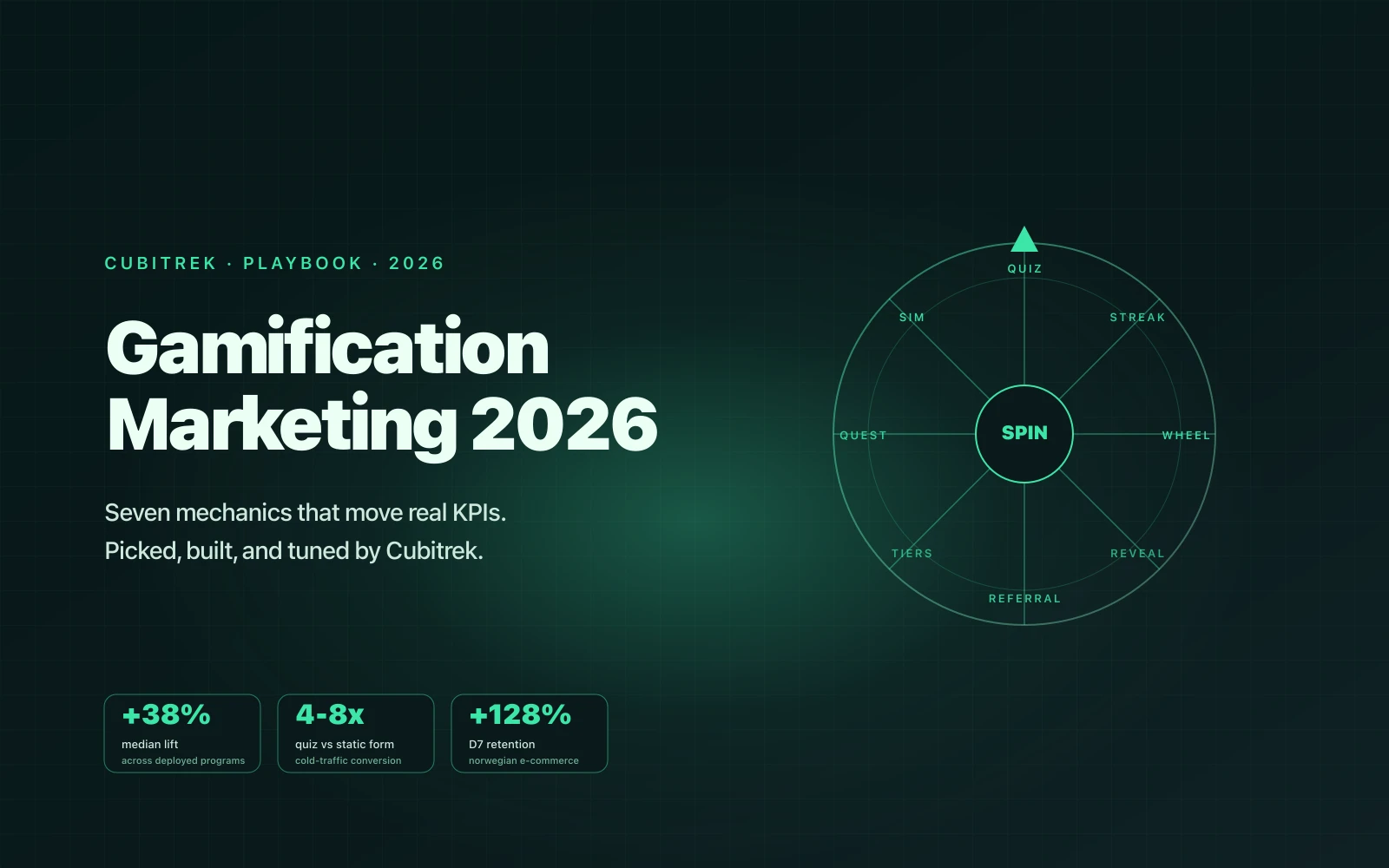
Gamification Marketing 2026 Playbook
Seven gamification mechanics that move real marketing KPIs in 2026. Quizzes, spin wheels, streaks, tier programs, onboarding quests, two-sided referrals, and learning sims.
 Faizan Ali Khan
Gamified SaaS Onboarding
The implementation guide. Why gamified onboarding works (the boring research-backed part), the four mechanics that move SaaS activation, and a Cubitrek case study with 78 percent lift in net new paying customers.
Faizan Ali KhanReady when you are
Want Cubitrek to run Performance Marketing for you?
We install performance marketing programs for growing companies across the US and Europe. Book a call and we'll come back with a one-page plan in 72 hours.