Quizzes, Spin Wheels, and Scratch Cards: The Lead-Magnet Mechanics That Outperform Forms 4x
Static forms convert at 2 to 4 percent on cold traffic. Quizzes, spin wheels, and scratch reveals convert at 12 to 38 percent. The short, sharable version: when each mechanic wins, when it loses, and the reward economy that determines lead quality.

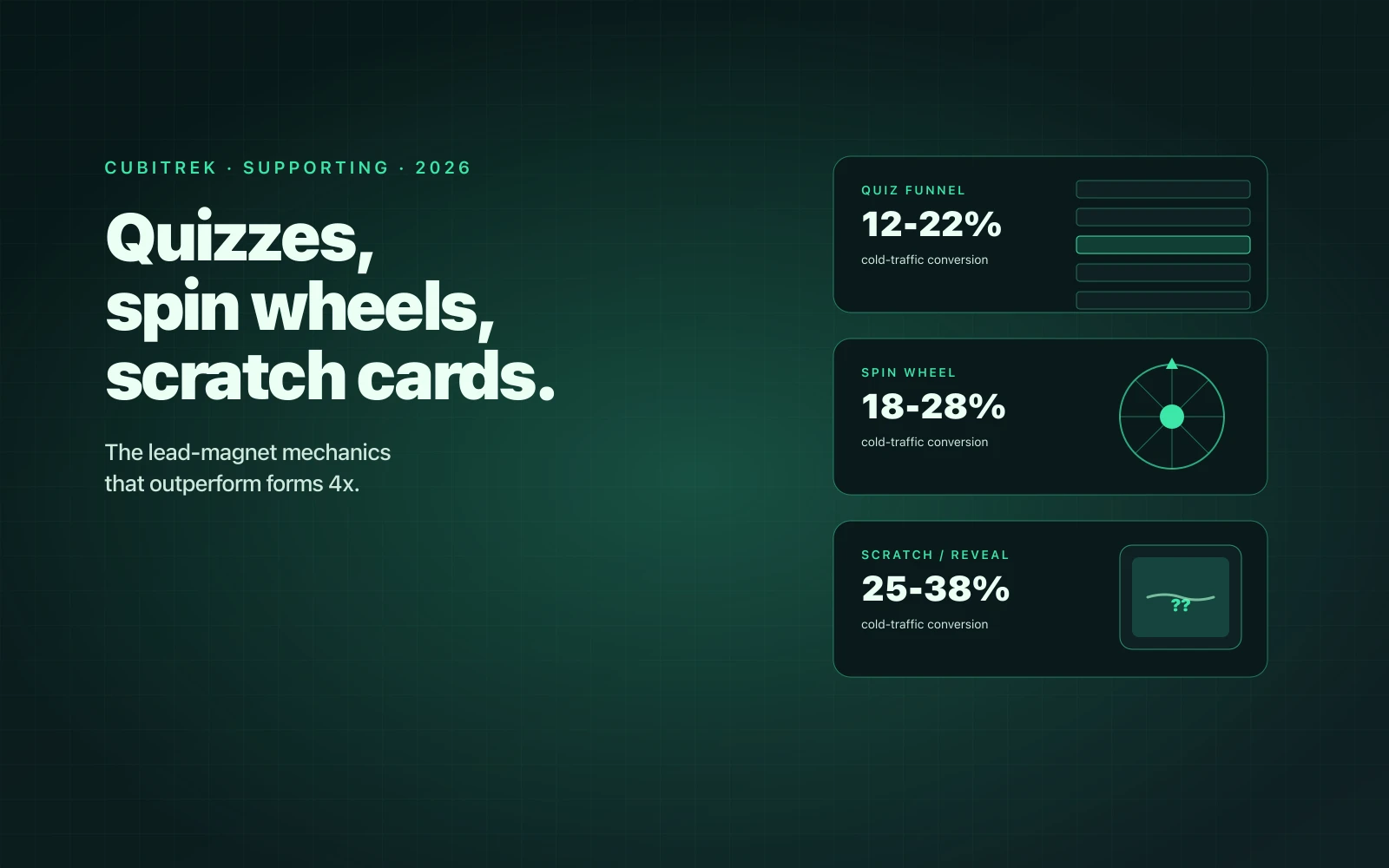
A static lead-magnet form on cold traffic converts at 2 to 4 percent across B2B SaaS in 2026. The same traffic, sent to a quiz, a spin wheel, or a scratch reveal, converts at 12 to 38 percent. The mechanics are public knowledge, the implementation is not. This is the short, sharable version: when each one wins, when it loses, and the reward economy that determines whether the email you capture is worth anything.
The benchmark numbers
Lead-magnet mechanics, conversion rate on cold traffic
The headline conversion rate is half the story. The other half is lead quality, which depends entirely on the reward economy and how well the mechanic segments visitors.
Quiz funnels: when they win
A quiz funnel is a 6 to 10 question multiple-choice quiz that segments visitors and returns a personalised result. The email is captured at the result step, not before. The personalisation is the payoff for completing the quiz.
Best deployments.
- Product discovery on e-commerce. "Find your perfect mattress in 60 seconds." Casper, Warby Parker, and Sephora are the canonical examples.
- B2B product matching. "Which CRM tier fits your team." HubSpot's website grader is the same pattern, applied to SEO.
- Financial qualification. "Find your retirement-savings archetype." Wealthsimple and Betterment use this well.
- Health and wellness assessment. "Skin-type quiz" on cosmetics, "fitness archetype" on fitness apps.
The reward economy that converts. A genuine personalised result. Either a tailored product recommendation, a useful 3-page benchmark report, or a curated email sequence specifically tied to the answers given. A generic PDF emailed to every quiz-completer underperforms a static form, because the user gave more information for the same payoff.
The four design rules that matter.
- The first question is easy and inviting, not demographic. "Which of these best describes your team" beats "What is your job title".
- Questions 2 to 7 are segmenting, not data-collection. Each answer should change the result, not just go into the CRM.
- The result page is the reward. Personalised, visually polished, immediately useful.
- Email captured at the result step ("Send a copy to your inbox?"), not before.
When quizzes lose. When the result is generic, when there are too many demographic questions, when the user does not believe the personalisation is real. Trust dies fast in this format.
Spin-the-wheel reveals: when they win
A spin-the-wheel is a visible wheel with weighted slot probabilities tied to email capture. The user enters an email, gets a spin, and the spin lands on something with real value (typically a discount tier, occasionally a free product, sometimes a content unlock).
Best deployments.
- E-commerce email capture, especially DTC. Shein, Gymshark, Glossier all run versions.
- Exit-intent recovery on shopping carts. The wheel becomes the last attempt to keep the visitor.
- High-traffic blog email capture, when paired with content (an exclusive guide as one of the wheel slots).
- Event registration, where the spin reveals the level of access (general admission, VIP, behind-the-scenes).
The reward economy that converts. Variance matters. A wheel with 8 slots all containing "10 percent off" feels rigged. A wheel with 6 slots of small wins (5 percent off, 10 percent off, free shipping, a free sample), 1 slot of a big win (free product, 50 percent off), and 1 slot of "try again" creates the variance that keeps the mechanic working.
The four design rules that matter.
- The visible wheel must look like the actual wheel. Users notice if the slots they see do not match the spins they get.
- The "big win" slot is rare but visible (1 in 8 odds, not 1 in 1000). Users can tell when the big win is theatre.
- The reward arrives instantly, not in a "we will email you the code" delay.
- Frequency capping per visitor. Not every visit gets a spin; daily or weekly cooldowns make the spin feel earned.
When spin wheels lose. When the rewards are identical (just a 10 percent off code dressed up), when the cooldown is missing and visitors realise they can spin infinitely, when the wheel sits on every page rather than at clear capture moments.
Scratch cards and mystery box reveals: when they win
A scratch card or mystery box is a hidden reward the user reveals by interaction (scratching, opening, tapping). The user usually has to enter an email before revealing, or trade the email to keep the reveal.
Best deployments.
- Holiday and seasonal campaigns where the reveal is part of the brand moment.
- Beauty and FMCG, where on-pack QR codes lead to digital scratch cards as a CRM-acquisition layer.
- Lifecycle email reactivation. "Open your monthly mystery reward."
- Subscription-box brands where the reveal is the brand promise made tangible.
The reward economy that converts. Hidden rewards work because of curiosity, not optimised expected value. Even when the average reward is small, the act of revealing produces a dopamine response that static rewards do not. The reward distribution still has to be honest enough to survive a second visit.
The four design rules that matter.
- The reveal animation matters. A static "you got 10 percent off" defeats the mechanic. A scratching animation or a slow box-opening animation is part of the reward.
- Variable rewards across visits, not the same reveal every time.
- The trade is clear up front. "Enter your email to scratch" is more honest and converts better than mid-reveal email demands.
- One reveal per visitor per cooldown window. Repeated reveals dilute the magic.
When reveals lose. When the reward is the same on every reveal (instantly seen as theatre), when the animation is skippable and feels like a UI delay, when the email demand interrupts the reveal moment.
The reward economy that determines lead quality
Conversion rate is the easy number. Lead quality is the hard one. A spin wheel can capture 24 percent of cold traffic and produce leads worth one-tenth of a static-form lead. The mechanic is not the cause; the reward is.
We use a four-tier filter to evaluate the reward economy of any gamified lead capture.
Tier 1: Functional rewards tied to the product. A discount on the product the visitor is browsing, a free trial, a free credit toward a paid feature. Highest lead quality, because the reward only matters to people who care about the product.
Tier 2: Curated content with explicit value. A 3-page benchmark report, a personalised checklist, a video walkthrough specifically tied to quiz answers. Medium-high lead quality. Worse than functional rewards, better than generic content.
Tier 3: Generic discount codes or content. "10 percent off your first order" or "the free guide everyone gets". Moderate lead quality. The leads convert at lower rates downstream because the reward did not pre-segment for fit.
Tier 4: Sweepstakes and pure-cash rewards. "Enter to win an iPad" or "$1000 sweepstakes". Highest top-of-funnel conversion, lowest lead quality, frequently worst case. The leads sign up for the prize, not the product.
The mechanic determines the form. The reward determines the value. We have lost track of how often we audit a high-converting spin wheel that is producing nearly worthless leads because the reward economy was never designed.
How to pick between quiz, wheel, and reveal
The mechanic that fits your funnel depends on three variables.
Variable 1: Personalisation potential. If the answer to "what does this user need" depends on multiple inputs, use a quiz. If everyone gets a similar reward, use a wheel or reveal.
Variable 2: Reward variance you can offer. Quizzes work with a single, deeply personalised result. Wheels need 6 to 8 distinct rewards across slots. Reveals need a hidden surprise that varies enough across visitors to sustain interest.
Variable 3: Cold-traffic intent. Quizzes do better on warm and intent-driven traffic (someone actively researching mattresses). Wheels and reveals do better on cold or impulse traffic (someone scrolling, ad-distracted).
Quick decision matrix
| Quiz funnel | Spin wheel | Scratch / reveal | |
|---|---|---|---|
| Cold traffic conversion | 12-22% | 18-28% | 25-38% |
| Lead quality on Tier 1 rewards | High | High | Medium-high |
| Best fit | Product matching, B2B | DTC e-commerce, exit intent | Lifecycle, FMCG, CRM |
| Build complexity | Medium | Low | Low-medium |
| Personalisation depth | High | Low | Low |
| Compliance overhead | Low | Medium | Medium-high |
Why a quiz beats a four-field form
A four-field form is cheap to fill in and tells you nothing, so qualification moves to the sales call, which is the most expensive place to do it. A segmenting quiz changes the trade: the visitor answers more questions because each one earns them a more useful result, and every answer routes the lead before anyone picks up the phone.
The benchmark ranges in this post are industry figures, not client results, and they are labelled as such.
Cubitrek case study: lead quiz on a B2B SaaS
The setup. A mid-market B2B project management SaaS with a marketing site converting at 4 percent on the trial signup form. The form had four fields and no segmentation.
What we shipped. An 8-question segmenting quiz titled "What is your team's project-management archetype?" Returns one of six archetypes (with names like "The Spreadsheet Refugee" and "The Notion Rebel") and a personalised 3-page PDF report. Email captured at the result step.
Result. Quiz conversion 38 percent (vs 8 percent on the previous form, the form replaced was on a higher-intent page). Lead-to-SQL rate up 64 percent because the archetype answer pre-qualified buyer fit. SDR call books filled three weeks faster than before.
The quiz is now the standard top-of-funnel mechanic for the client. The static form is gone.
What this connects to
Lead-magnet gamification is one of seven mechanics in the 2026 gamification marketing playbook. It pairs naturally with gamified onboarding for SaaS (the quiz captures the lead, the onboarding quest activates them) and with the referral and paid-ad combo we documented in the Temu growth strategy case study.
Frequently asked questions
1) Will gamified lead magnets attract spammy or fake emails?
Some, yes. We ship every program with email validation (real-time MX check, disposable-domain blocklist, and a soft confirm-link sequence). After validation, the spammy capture rate sits below 4 percent across our deployments.
2) Can we run this on Shopify or WordPress?
Yes. We have shipped on Shopify, WooCommerce, WordPress, Webflow, and custom Next.js. The only stack-specific consideration is real-time spin-wheel responsiveness; on slow themes we sometimes ship the wheel as a Cloudflare Workers sidecar.
3) How is this different from the popups we already have?
Popups display the same offer to every visitor. Gamified lead magnets earn the email by giving back something the popup could not (personalisation, variance, surprise). Conversion is 3 to 10 times higher across our deployments.
4) Will this overlap with our existing paid program?
It feeds it. The quiz becomes the ad creative, the spin wheel becomes the landing page mechanic. Server-side attribution (Meta CAPI, Google Enhanced Conversions) keeps the paid algorithm fed correctly.
5) How long until the lift fades?
The static lift fades at roughly the same speed as any creative. We ship the AI tuning agents to keep reward weights, copy, and design variants fresh, which sustains the lift in our data for 18 to 36 months. Programs without active operations fade faster.
Key takeaways
- Conversion rate is the easy number. Lead quality is determined by the reward economy, not the mechanic.
- Functional rewards tied to the product produce the highest lead quality. Sweepstakes produce the lowest.
- Real reward variance is what makes a spin wheel keep working past visit two. Eight slots of identical coupons get spotted as theatre fast.
- Compliance review matters. Spin wheels and prize promotions can become regulated gambling promotions if poorly designed, especially in the US, UK, and EU.
Questions people ask about this
Sourced from client conversations, Search Console, and AI-search citation monitoring.
- Some, yes. We ship every program with email validation (real-time MX check, disposable-domain blocklist, and a soft confirm-link sequence). After validation, the spammy capture rate sits below 4 percent across our deployments.
- Yes. We have shipped on Shopify, WooCommerce, WordPress, Webflow, and custom Next.js. The only stack-specific consideration is real-time spin-wheel responsiveness, on slow themes we sometimes ship the wheel as a Cloudflare Workers sidecar.
- Popups display the same offer to every visitor. Gamified lead magnets earn the email by giving back something the popup could not (personalisation, variance, surprise). Conversion is 3 to 10 times higher across our deployments.
- It feeds it. The quiz becomes the ad creative, the spin wheel becomes the landing page mechanic. Server-side attribution (Meta CAPI, Google Enhanced Conversions) keeps the paid algorithm fed correctly.
Keep reading
Related articles.
More on the same thread, picked by tag and category, not chronology.
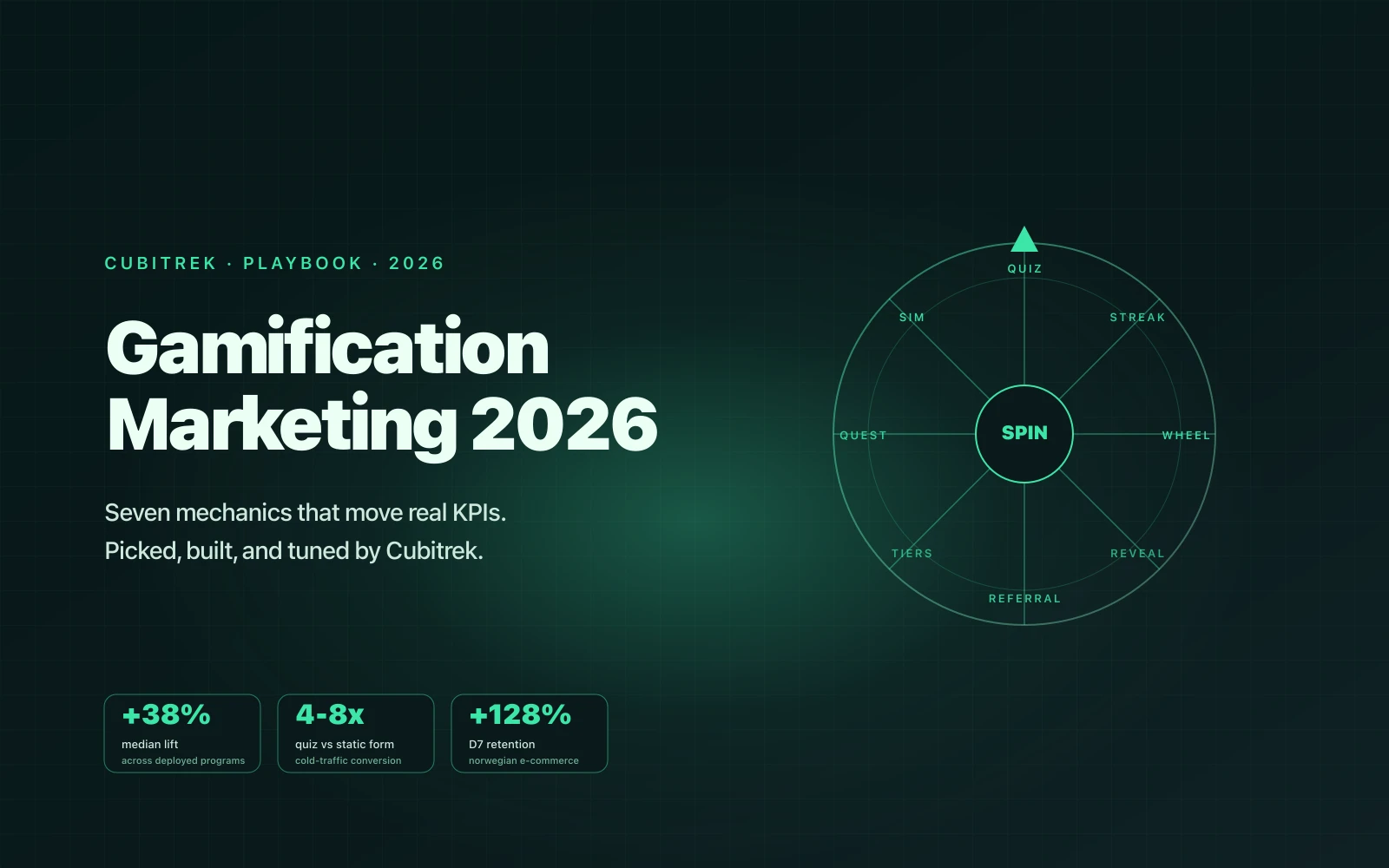
Gamification Marketing 2026 Playbook
Seven gamification mechanics that move real marketing KPIs in 2026. Quizzes, spin wheels, streaks, tier programs, onboarding quests, two-sided referrals, and learning sims.
Faizan Ali Khan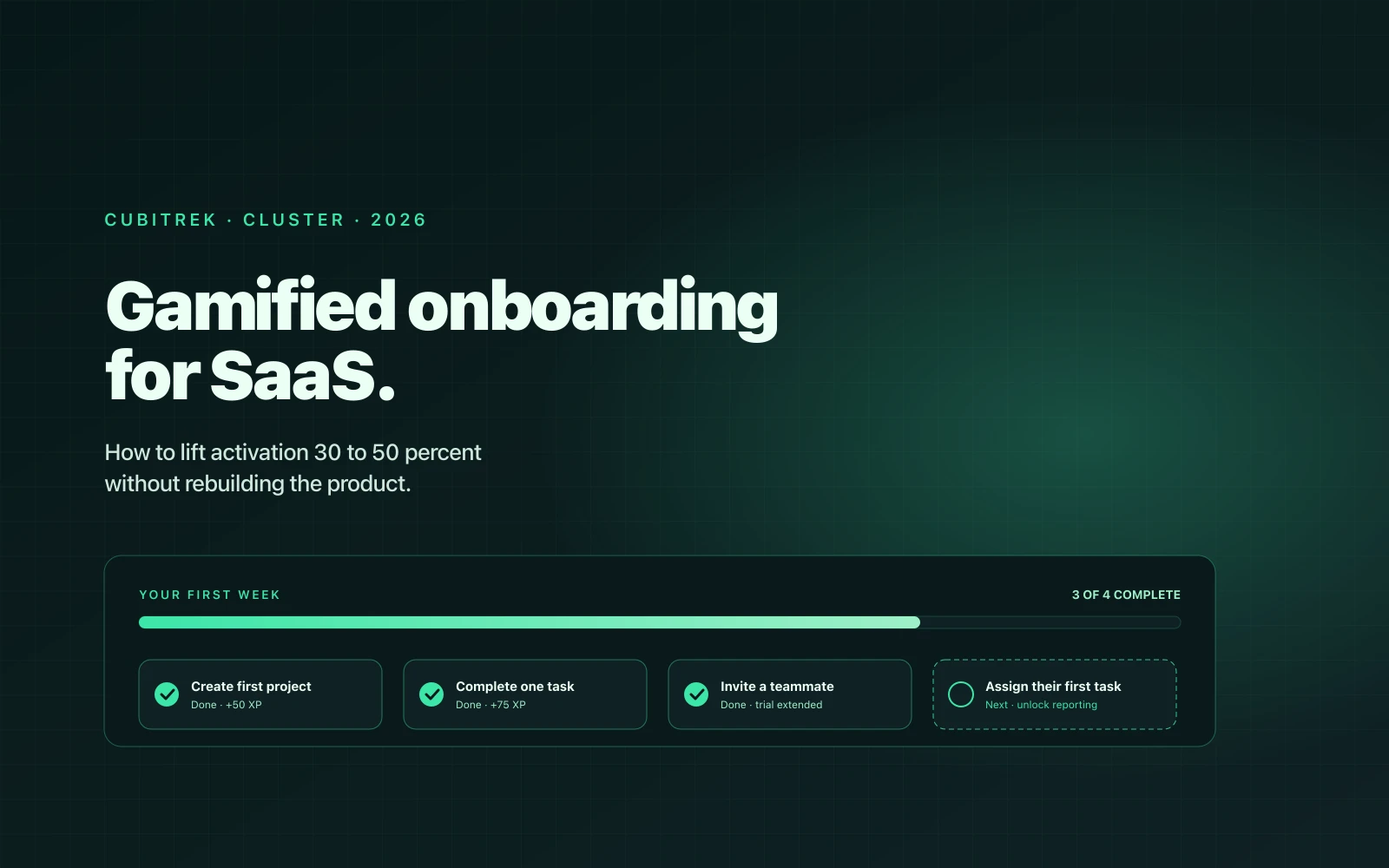
Gamified SaaS Onboarding
The implementation guide. Why gamified onboarding works (the boring research-backed part), the four mechanics that move SaaS activation, and a Cubitrek case study with 78 percent lift in net new paying customers.
Faizan Ali Khan
How Temu Used Gamification, Referral & Paid Ads to Explode in a New Market
How Temu grew with in-app games, referral rewards and heavy paid ads, what changed after US duty-free imports ended in May 2025, and what is still safe to copy.
 Samrina Khan
Ready when you are
Want Cubitrek to run Gamification for you?
We install gamification programs for growing companies across the US and Europe. Book a call and we'll come back with a one-page plan in 72 hours.