OpenClaw Alternatives: 12 Options Compared by Senior Operators (2026)
An honest comparison of 12 OpenClaw alternatives across code-first runtimes and open-source agents (LangChain, CrewAI, Microsoft Agent Framework, Hermes Agent), visual workflow tools (n8n, Zapier, Make, Lindy), and hosted agent products (Vellum, AgentGPT, AutoGPT). Written by engineers who ship OpenClaw to production.

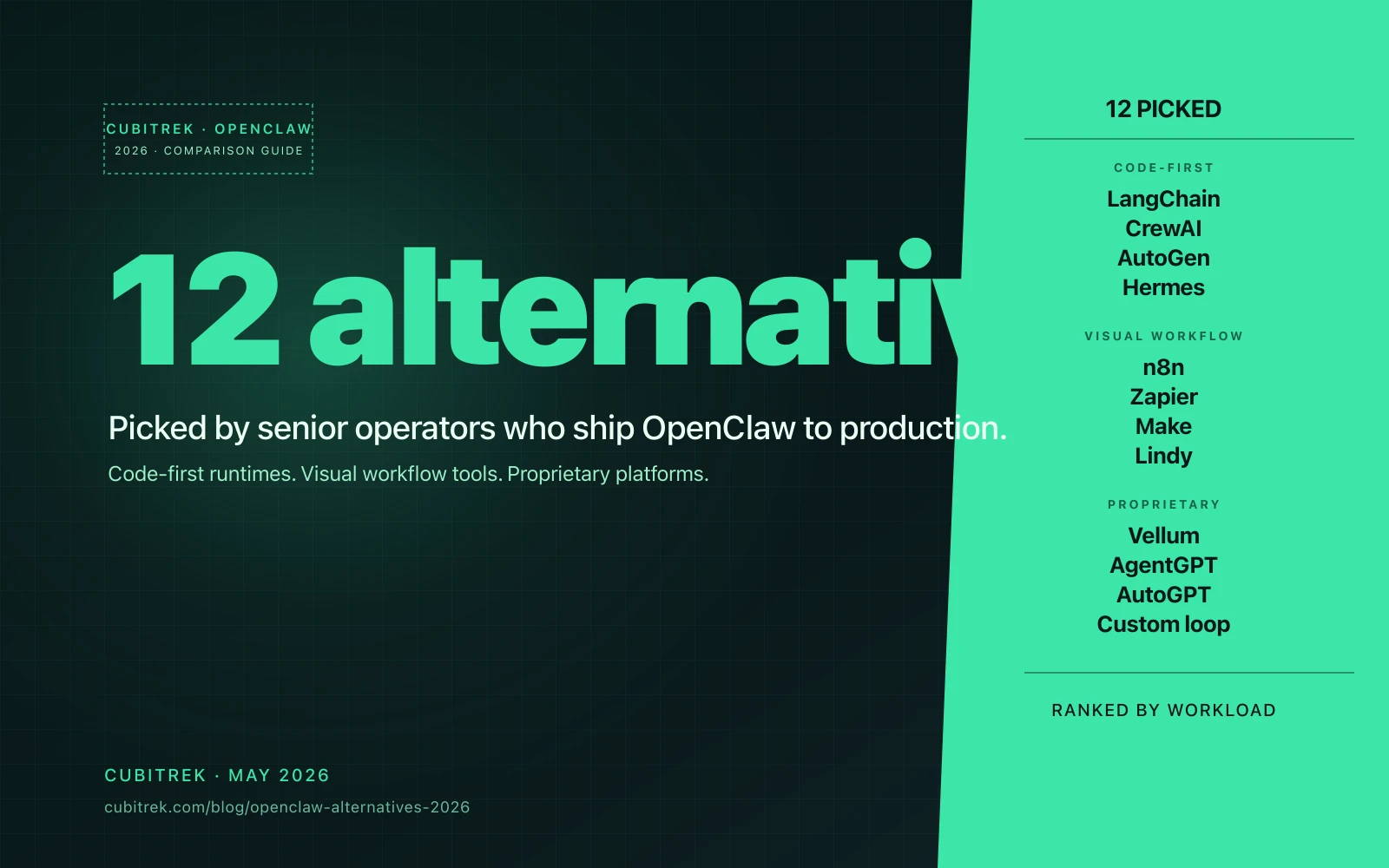
OpenClaw alternatives worth evaluating in 2026 break into three clean buckets. Code-first runtimes and open-source agents that compete head-on (LangChain, CrewAI, Microsoft Agent Framework, Hermes Agent). Visual workflow tools that now ship their own AI agents (n8n, Zapier, Make, Lindy). And hosted agent products aimed at the same buyer (Vellum, AgentGPT, AutoGPT). This guide is written by senior operators who ship OpenClaw to production for revenue teams. The verdict on each alternative is honest, not promotional.
Why people search for OpenClaw alternatives
Three reasons come up:
- OpenClaw is too code-first for their team. They want a visual workflow tool with AI features layered on, not a self-hosted Node.js gateway they have to run, update, and secure.
- Security and upkeep. OpenClaw had published 722 GitHub security advisories, 14 rated critical, by 2 October 2026, and it shipped 11 releases in September 2026 alone. Its docs treat each gateway as one trust domain, so teams serving users who do not trust each other run one gateway per tenant.
- They evaluated OpenClaw and prefer the abstractions in a competing framework. LangGraph's checkpoint model, CrewAI's role-based agents, or Hermes Agent's self-improving skills each appeal to a specific buyer.
All three are legitimate reasons to look elsewhere. Below is what we recommend for each.
The 12 OpenClaw alternatives that matter in 2026
Code-first runtimes and open-source agents (head-on alternatives)
1. LangChain plus LangGraph
Who picks it: engineering-heavy teams that want maximum control over the agent graph and need stateful workflows with checkpoint recovery.
Where it wins over OpenClaw: graph-based flow control with native checkpointing. If your agent needs to pause for human review on step 4 of 12 and resume cleanly two days later, LangGraph's state model handles this with less custom code than OpenClaw.
Where it loses to OpenClaw: longer time-to-first-skill. LangChain's flexibility comes from being a library, not a runtime. Production deployment requires you to assemble FastAPI, observability, security, and skill versioning yourself. OpenClaw ships those out of the box.
Best for: custom multi-step workflows where the graph is novel.
2. CrewAI
Who picks it: teams building multi-agent systems with clean role separation (researcher, writer, reviewer, closer).
Where it wins over OpenClaw: role-based agent abstractions feel natural for content production, research crews, and customer-success workflows. The agent collaboration model has cleaner ergonomics than rolling your own supervisor in OpenClaw.
Where it loses to OpenClaw: ecosystem depth. OpenClaw's skill catalog grew faster through 2025-2026. CrewAI is competitive on framework primitives, behind on plug-and-play integrations.
Best for: crews of 3-7 specialized agents collaborating on knowledge work.
3. Microsoft Agent Framework (successor to AutoGen)
Who picks it: .NET and Python teams on Microsoft's stack. AutoGen is now in maintenance mode, and Microsoft points new users to Agent Framework, which reached 1.0 in April 2026.
Where it wins over OpenClaw: a supported SDK with stable APIs and long-term support for building multi-agent workflows, with MCP tools, into your own services.
Where it loses to OpenClaw: it is a library, not a ready assistant; you build the chat front end, hosting, and memory yourself.
Best for: agents built into .NET or Python products.
4. Hermes Agent (Nous Research)
Who picks it: teams that want an OpenClaw-style agent that lives in chat apps, with built-in memory and skills it writes from experience.
Where it wins over OpenClaw: a built-in learning loop, plus optional paid Hermes Business and Hermes Enterprise plans from Nous Research, announced in September 2026.
Where it loses to OpenClaw: a smaller community (about 251K GitHub stars against OpenClaw's 391K on 2 October 2026). Both cores are free and MIT-licensed.
Best for: teams that want a self-improving personal agent, with a vendor plan available if they need one.
Smaller and hardened options. If OpenClaw's attack surface is why you are leaving, two projects are worth a look. NanoClaw (MIT) is a lightweight alternative that runs in containers for security. NVIDIA NemoClaw (Apache-2.0) runs agents such as OpenClaw and Hermes more securely inside NVIDIA OpenShell. Teams staying on OpenClaw can add OpenClaw Enterprise, a free, self-hosted control plane announced on 29 September 2026.
Visual workflow tools (overlap on simple use cases)
5. n8n
Who picks it: technical teams that want a visual workflow tool they can self-host with no per-task pricing.
Where it wins over OpenClaw: visual canvas for the workflow logic. Easier handoff to operations people who do not write Python. AI features added through 2025 made it more competitive on agent-style workloads.
Where it loses to OpenClaw: n8n's AI Agent node does choose its own tools, but it runs inside a workflow you design on a canvas, while OpenClaw is a standing assistant people message directly. n8n's license is fair-code, not OSI open source.
Best for: orchestrating deterministic flows between SaaS tools. If you are leaving one of these, the migration section below is the part to read.
6. Zapier
Who picks it: non-technical operators in marketing, sales, and support who want point-and-click automation.
Where it wins over OpenClaw: lowest barrier to entry in the entire category. Sign up, click, automate. 9,000+ app integrations, plus Zapier Agents and Zapier MCP.
Where it loses to OpenClaw: every Zap step, AI action, and MCP call draws on one shared task allowance. On license price alone Zapier is cheaper at most volumes: its list price for 50,000 tasks a month is $289 to $598.50.
Best for: quick-win automations under 10,000 tasks per month or for non-technical teams.
7. Make (formerly Integromat)
Who picks it: visual-workflow builders who outgrew Zapier's pricing and want more sophisticated flow logic without going code-first.
Where it wins over OpenClaw: strong visual flow editor with branching, error handling, and credit-based pricing (credits replaced operations as Make's billing unit).
Where it loses to OpenClaw: Make AI Agents is still in beta, and its agents run inside scenarios you design rather than as a standing assistant.
Best for: mid-volume scripted automation with light AI bolt-ons.
8. Lindy
Who picks it: ops and support teams that want pre-built AI agents (email triage, meeting scheduler, CRM updater) without building from scratch.
Where it wins over OpenClaw: templated agents that work out of the box. Faster path to first value if your use case matches a Lindy template.
Where it loses to OpenClaw: it is a closed, hosted product, so workflows and data live with the vendor, and pricing scales with usage. It is no longer templates only: teams can save custom skills and connect MCP servers.
Best for: ops teams that want a managed agent without the build effort.
Hosted agent products (commercial competitors)
9. Vellum
Who picks it: people and small teams who want a hosted personal assistant. Vellum relaunched in May 2026 as a personal AI assistant, with cloud plans at $30, $100, and $200 a month.
Where it wins over OpenClaw: fully hosted, so there is no gateway to install or patch.
Where it loses to OpenClaw: a monthly subscription for the hosted plans, against OpenClaw's free core.
Best for: individuals who want an assistant without running a server.
10. AgentGPT
Who picks it: developers exploring autonomous agents who want a hosted playground.
Where it wins over OpenClaw: zero setup. Type a goal, watch an agent run.
Where it loses to OpenClaw: essentially a hosted demo, and unmaintained: its GitHub repository is archived, with the last code push on 29 April 2025.
Best for: prototyping a goal-driven agent idea. Not for production.
11. AutoGPT
Who picks it: teams that want a visual, low-code agent builder they can self-host or run on AutoGPT's paid hosted platform.
Where it wins over OpenClaw: a visual builder for agents that run on demand, on a schedule, or from a trigger.
Where it loses to OpenClaw: the platform code is under the Polyform Shield License, which is source-available rather than open source, and the hosted platform is paid.
Best for: scheduled or triggered business workflows built visually.
12. Custom hand-rolled agent loop
Who picks it: teams with one very specific high-volume agent workload where framework overhead matters (latency-critical, cost-critical, compliance-critical).
Where it wins over OpenClaw: zero framework tax. Direct LLM API calls, your own loop, your own state management.
Where it loses to OpenClaw: you rebuild observability, security, skill management, and integrations from scratch. The build itself is fine; the operating cost of a custom stack with no skill ecosystem behind it is brutal.
Best for: one mission-critical agent at extreme scale. Not the default choice.
Migrating from Zapier or Make
Most teams arriving here are not starting fresh, they are leaving a per-task pricing model that stopped making sense at volume. Three things to know before you port anything.
Do not port one-for-one. A Zap is a fixed sequence; an agent decides. Rebuilding a 14-step Zap as a 14-step agent workflow keeps the brittleness and adds a model. Take the outcome the Zap produces and describe that instead.
Move the highest-volume automation first, not the most complex one. The per-task saving is where the volume is, and a simple first migration teaches you the failure modes cheaply.
Keep the old one running until the new one has been right for a month. Run them in parallel against the same trigger and compare outputs. This is the step people skip and regret.
How to pick between OpenClaw and an alternative
Three diagnostic questions decide it cleanly:
-
Does your workflow need LLM reasoning at every step, or just at one or two steps? Reasoning at every step means OpenClaw, LangGraph, CrewAI, or Microsoft Agent Framework. Reasoning at one or two steps means n8n, Zapier, or Make with an LLM bolt-on.
-
Will the agent need to operate real applications (browser, file system, third-party APIs)? Yes means OpenClaw, LangChain, or a custom loop. No means CrewAI or Microsoft Agent Framework are equally fine.
-
What does your team look like operationally? Engineer-heavy teams pick code-first runtimes. Ops-heavy teams pick visual or templated tools. The platform should match the team that will own it on day 90, not just day 1.
OpenClaw plus managed ops fits mid-market teams that need an always-on assistant across chat channels, with data kept on their own servers. For simple, high-volume triggers, Zapier or Make usually costs less.
Honest places where alternatives beat OpenClaw
We ship OpenClaw to clients for a living and we will still tell you the truth:
- For agents built into a .NET or Python product: Microsoft Agent Framework is the cleaner fit.
- For 3-7 specialized agents collaborating on knowledge work with clean role separation: CrewAI's ergonomics are nicer.
- For buyers who want a vendor plan behind an open-source agent: Hermes Agent, through Nous Research, is a simpler purchase than OpenClaw, which has no paid tier.
- For non-technical teams that just need "automate the invoice approval": Zapier or Make beats OpenClaw on time-to-first-value because the visual canvas matches the team's existing mental model.
The point of an honest comparison is to find the right tool for the workload. Sometimes that is OpenClaw and sometimes it is not, and we will tell you which.
Want this run for you?
Cubitrek ships OpenClaw deployment, custom skills, multi-agent orchestration, and 24/7 managed ops. We also ship the alternatives above when they are the right fit. Talk to a senior engineer via contact for a 30-minute scoping call. We will tell you which platform to pick before you spend a dollar.
Key takeaways
- There is no single best OpenClaw alternative. The right pick depends on team skills and workload reasoning intensity.
- Code-first runtimes (LangChain, CrewAI, Microsoft Agent Framework) compete head-on with OpenClaw on AI-native workloads.
- Visual workflow tools (n8n, Zapier, Make, Lindy) now ship their own AI agents.
- Hosted products such as Vellum trade control for convenience; Hermes Agent is open source with optional paid plans.
- You can run two platforms side by side, such as OpenClaw for heavy work and Zapier for lightweight triggers.
Questions people ask about this
Sourced from client conversations, Search Console, and AI-search citation monitoring.
- No. The right alternative depends on your team's skills and the workload's reasoning intensity. Engineer-heavy teams gravitate to LangChain or CrewAI. Ops-heavy teams gravitate to n8n or Lindy. Teams that want a vendor plan behind an open-source agent look at Hermes Agent. There is no universal winner because the buyers are not universal.
- In 2026 the combination of open-source license, AI-native runtime, fast-growing skill ecosystem, and mature deployment story is uniquely concentrated in OpenClaw. Most alternatives win on one of those dimensions while losing on the others.
- Yes. Common pattern: OpenClaw for high-volume always-on agents, LangGraph or Microsoft Agent Framework for one or two specialized workloads, plus Zapier for lightweight triggers. The agents talk to each other over Model Context Protocol so the stack stays coherent.
- It depends on how many workflows move. A typical engagement migrates the 10 highest-volume workflows in 8 to 12 weeks, run by a senior Cubitrek engineer under the OpenClaw Managed tier. We quote after a short scoping call.
- Yes when deployed correctly. Our OpenClaw deployments ship with sandboxed execution, prompt-injection defenses, secrets management, role-based access, and full audit logging. SOC 2 and HIPAA duties sit with the organization that runs the system, so you show those controls in your own deployment. OpenClaw's docs treat each gateway as one trust domain and recommend one gateway per tenant for users who do not trust each other.
- The OpenClaw core is free. Hermes Agent's core is also free and MIT-licensed, with paid plans from Nous Research, and Vellum's hosted plans list at $30 to $200 a month. Compare total cost on your own volume: license, model usage, hosting, and the engineering time to run each one.
- You own the deployment. OpenClaw is open source, your skills are your code, your data stays in your cloud account. OpenClaw is now stewarded by the OpenClaw Foundation, a US 501(c)(3) non-profit with OpenAI as a major donor, which lowers that risk.
Keep reading
Related articles.
More on the same thread, picked by tag and category, not chronology.
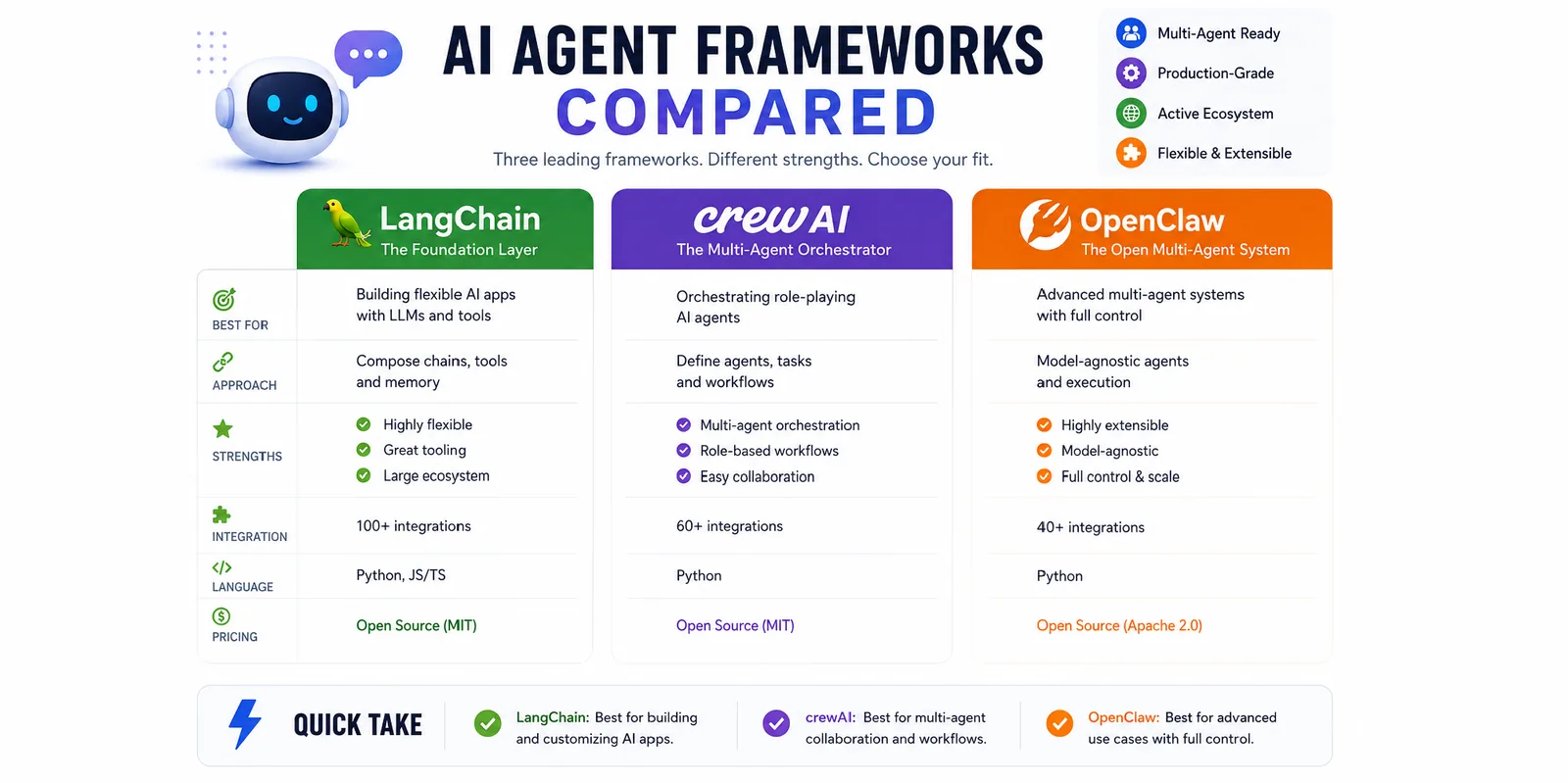
AI Agent Frameworks Compared: LangChain vs CrewAI vs OpenClaw
Detailed comparison of LangChain, CrewAI, and OpenClaw agent frameworks. Features, pricing, operating effort, and use case fit for enterprise AI agent development.
Faizan Ali Khan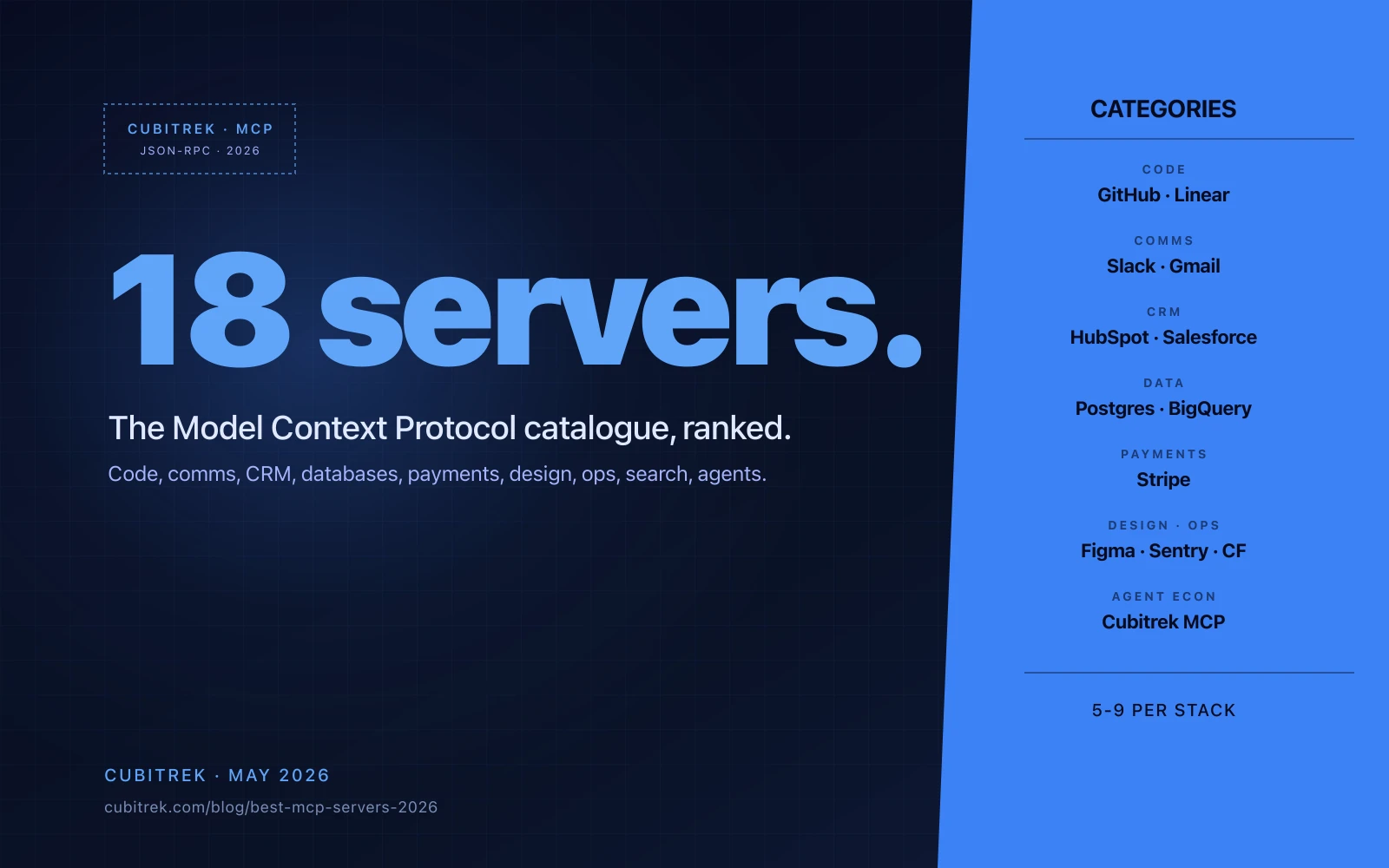
Best MCP Servers in 2026
Model Context Protocol servers are the connective tissue of the 2026 AI agent economy. The 19 best MCP servers across code, communication, CRM, databases, payments, design, observability, search, and the agent economy, ranked by category.
Faizan Ali Khan
What Is OpenClaw? The Complete Business Guide for 2026
OpenClaw is the fastest-growing open-source AI agent platform in history. This guide explains what it does, how businesses use it, what it costs, and how to get started in 2026.
Faizan Ali KhanReady when you are
Want Cubitrek to run OpenClaw Services for you?
We install openclaw services programs for growing companies across the US and Europe. Book a call and we'll come back with a one-page plan in 72 hours.