

Web design trends for 2026 (and the 2025 patterns still worth keeping)
Bento grids, scroll-driven storytelling and Core Web Vitals discipline are now table stakes. Here are the ten 2026 web design trends that move conversion, and the 2025 patterns still worth shipping.


The 2025 web design trends that mattered (bento grids, scroll-driven storytelling, Core Web Vitals discipline) are now table stakes. The trends that win into 2027 are about pages that read well to AI browsers such as ChatGPT Atlas, Perplexity's Comet and Gemini in Chrome before a human even loads them. Mobile devices produced 59% of worldwide page views in September 2026, and Core Web Vitals are one of the page experience signals Google's ranking systems use. Brands that ship a current site win two channels at once: human users and the AI agents researching on their behalf.
A word on method, because "2027 trends" lists are usually guesses. This guide separates three things and labels them: what is shipping and measurable today, what the browser vendors have formally committed to making interoperable during 2026 and will therefore be safe to design around in 2027, and what is genuinely not decided yet. Pantone's 2027 Color of the Year, for instance, is announced each December and does not exist at the time of writing, so it is not in this guide. Anything stated as a 2027 fact below links to the document that scheduled it.
This guide walks through the ten web design trends moving conversion and AI visibility now, what becomes safe to ship in 2027, and the engineering notes you need for each.
The numbers a redesign has to hit
October update: which of these held up
This guide was written in January. Ten months of shipping later, some of the ten held up and some did not, so here is the honest scorecard before the list itself.
The one we underrated: AI-readable design. It is listed tenth below and it should have been first. In June 2026 Google added a generative AI performance report to Search Console, rolled out to all sites worldwide by 31 August 2026, that shows how often a site's pages appear in AI Overviews and AI Mode. None of that exposure behaves like a classic visit, and none of it cares how the hero animates. It cares whether the page can be parsed, quoted and attributed.
What that changes in practice. Design decisions that were aesthetic in January are now retrieval decisions. Text baked into an image is invisible to an answer engine. A number that only appears after a count-up animation is a zero to a crawler that reads the server response, which is a mistake we found and fixed on our own site this year. Alt text and heading structure are no longer accessibility hygiene alone; they are how a machine decides whether you are worth citing.
Two trends aged worse than expected. Heavy WebGL heroes (trend 5) look increasingly expensive now that the same budget buys measurable AI visibility, and glassmorphism (trend 6) has become common enough to read as template rather than craft. Both still work when the brand earns them. Neither is a differentiator any more.
One external change worth knowing. Since 2 August the EU's transparency rules apply to realistic AI-generated imagery, and on 14 August Google made the visible watermark optional on its own image and video output while keeping the invisible one. If your 2026 redesign uses AI-generated photography, that is now a disclosure question and not only a taste question. We covered the detail in AI video labeling rules in 2026.
The 10 website design trends shaping 2026 and 2027
These are the trends our design and engineering teams are shipping for clients right now. Each one comes with the why, the how, and the metric to watch.
1. AI-personalized landing pages
Static landing pages are losing to AI-rendered variants that adapt copy, hero images, and CTAs to the visitor's intent in real time. Tools such as Webflow Optimize (Webflow bought Intellimize in April 2024) and custom middleware read referrer, location, time of day and prior behavior, then pick the hero variant before the page renders.
Why it matters: Visitors from paid social and from AI answers arrive with different questions. Test each variant against a static control on one KPI before you roll it out.
How to ship it: Start with three variants tied to the top three traffic sources (organic SEO, paid social, AI referral). Test for two weeks. Promote the winner. Pair this with the answer-block strategy from our AEO 101 guide so the same page also satisfies AI engines.
2. Warm, grounded color palettes
Pantone named Mocha Mousse, a warm brown, its color of the year for 2025, and Cloud Dancer, a soft white, for 2026. If your interface still runs on the cool-gray neutrals of 2022 to 2024, a warmer base or an off-white is the cheapest way to make it feel current.
Why it matters: Color contrast is a measurable accessibility signal (WCAG 2.2 requires 4.5:1 for body text at level AA). Since 28 June 2025 the European Accessibility Act has applied across the EU, and its scope includes e-commerce, so contrast is now a compliance check as well as a design choice. Warm palettes that hit contrast targets feel approachable AND pass audit.
How to ship it: Run your existing palette through axe DevTools or WAVE before you ship. If you fail contrast on more than 10% of the page, the palette needs work, not a tweak.
3. Expressive variable typography
Google Fonts lists more than 550 variable font families out of about 1,950 as of October 2026. That changed the economics of typography on the web: one variable file can carry weight, slant, optical size and width, which used to take a separate file for each style.
Inter, Mona Sans, Recursive and Fraunces are all variable families on Google Fonts. File size depends on how many axes and character sets you load, so subset to the ones you use.
Why it matters: Fonts affect LCP, and a late font swap shows up as layout shift (CLS). FID no longer counts: INP replaced it as a Core Web Vital on 12 March 2024.
4. Fluid, organic, asymmetric layouts
Bento grids and rigid 12-column layouts are giving way to organic, asymmetric flows with soft gradients and generous white space. The aesthetic borrows from print editorial and from the "humanist tech" movement that brands like Linear, Vercel, and Arc are pushing.
The danger: organic layouts that fail Lighthouse Cumulative Layout Shift (CLS). The fix is reserving height with aspect-ratio CSS or width/height attributes on every image and embed.
5. 3D and WebGL hero animations
Three.js, React Three Fiber, and Spline made 3D heroes cheap to produce. The current practice is to lazy-load the WebGL canvas behind a static poster image, so the poster, not the 3D scene, is what a slow phone loads first.
What to measure: add-to-cart rate and LCP on a mid-range Android phone, against a page without the 3D widget.
6. Glassmorphism 2.0 with backdrop-filter
The frosted-glass aesthetic is back, but with proper browser support this time. backdrop-filter: blur(12px) now works in Safari, Chrome, Firefox, and Edge without a polyfill. Designers are layering translucent cards over rich gradients to create depth without heavy borders.
Engineering note: backdrop-filter is GPU-expensive on low-end Android. Test on a Moto G Power before you ship to all users.
7. Scroll-driven storytelling and view-transitions
Scroll-driven animations shipped in Chrome 115 in 2023 and in Safari 26 in September 2025. They are not yet in every major browser, so treat them as an enhancement. Same-document view transitions have worked in every major browser since Firefox 144 shipped them in October 2025. Together they replace most of the JavaScript and IntersectionObserver code that scroll storytelling used to need.
This is the biggest "free win" of 2026. Page-to-page transitions used to require Next.js + Framer Motion + careful state hydration. Now @view-transition { navigation: auto; } in the CSS of both pages gives a multi-page site those transitions in Chromium browsers and Safari 18.2 and later. The old <meta name="view-transition"> tag no longer does anything.
8. Dark mode as the system default
prefers-color-scheme has worked in all major browsers since January 2020. 2026 sites that ship light-mode-only look dated.
How to ship it: Use CSS custom properties (--bg, --fg, --accent) for everything color-related. One media query flips them all. Avoid hard-coded hex colors anywhere outside :root.
9. Sustainable and low-carbon web design
The median mobile home page weighed 2.6 MB in 2025, up from 2.4 MB in 2024. As of October 2026, Website Carbon, which uses version 4 of the Sustainable Web Design Model, puts the average page at about 0.36 g of CO2e per view, or 43 kg a year for a site with 10,000 monthly page views.
2026 sustainability moves: WebP/AVIF images, Brotli compression, lazy-loaded video, edge caching, and dropping the third-party analytics scripts most marketers do not use.
10. AI-readable design (the hidden 2026 trend)
This is the one most agencies miss. Your site is being read by the major answer engines (ChatGPT, Perplexity, Gemini, Claude, Bing Copilot) that ingest visual content via image-to-text models. If your hero image lacks an alt attribute, the AI sees nothing. If your H1 is shipped as a Lottie animation, the AI sees nothing. If your value prop is locked inside a Figma-exported PNG, the AI sees nothing.
The 2026 mandate: every visual element must have a text equivalent the AI can read. That is design work, not just dev work. See our nested JSON-LD guide and Brand Hub framework for how we ship this on every Cubitrek redesign.
What a rebuild changes
The trends above are not decoration. A 2019-era theme on a modern connection loses on three fronts at once: Core Web Vitals, because the CSS and image pipeline predate the metrics; AI visibility, because there is no schema graph and the alt text is empty; and conversion, because the layout was designed for a screen size that is no longer the median.
Rebuilding fixes all three at the same time, which is why the work is worth doing as one project rather than three. We are not publishing client figures for it here, because the ones that matter belong to the client.
Measure the rebuild against a baseline taken before launch: field Core Web Vitals, AI citations for a fixed set of prompts, and conversion rate.
What becomes safe to ship in 2027
Most trend lists guess at next year. There are two published sources that tell you instead, and both are worth knowing because they turn "is this safe yet?" into a lookup rather than an argument.
Baseline tells you when a feature is safe. A feature is "newly available" when, in Google's words, it "is supported by all of the core browsers, and is therefore interoperable". It becomes "widely available" when "30 months have passed since the newly interoperable date". That 30-month gap is the practical answer to how long to wait: a feature that reached newly available in mid-2024 is widely available around the end of 2026, which is why several of the techniques below stop being risky next year rather than today.
Interop tells you what is being fixed next. Interop 2026 is run by representatives from Apple, Google, Igalia, Microsoft and Mozilla, and its focus areas are the things all engines have agreed to make work the same way this year. Progress is measured by Web Platform Tests pass rates on a public dashboard, so it is a commitment you can check rather than a roadmap promise.
The focus areas named in the announcement that bear directly on design work:
Interop 2026 focus areas that change what you can design
| Focus area | What it unlocks | Design consequence |
|---|---|---|
| Anchor positioning | Tethering an element to another without JavaScript | Tooltips, menus and popovers that stay put, with no positioning library |
| View transitions | Animated transitions, including across documents | App-like navigation on an ordinary multi-page site |
| Scroll-driven animations | Animation tied to scroll position, off the main thread | Scroll storytelling without the jank that made it a Core Web Vitals risk |
| Dialogs and popovers | Native modal and popover semantics | Accessible overlays without a third-party component |
| Container style queries | Components responding to context, not viewport | Genuinely reusable components across layouts |
| contrast-color() | A foreground color chosen for contrast automatically | Fewer hand-checked contrast failures in design systems |
Four further areas are listed as investigations rather than commitments: accessibility testing, JPEG XL, mobile testing and WebVTT. Investigation means the group is working out whether and how to tackle them, so do not plan 2027 work around those four.
The practical reading for a 2027 roadmap: anchor positioning, view transitions and scroll-driven animations are the three that change what a marketing site can do without shipping JavaScript to do it. All three already work in some engines, which is exactly why they are on the list. Check the dashboard before you commit, not the blog posts.
Sources: Baseline and Interop 2026, both read 12 October 2026.
How to apply these trends without breaking your site
Designers and product leads ask the same question every quarter: "How do I ship the new trends without slowing the site or confusing returning users?" Three rules that work:
- Ship in test groups. Do not redesign the whole site at once. Pick one high-traffic page, ship the new aesthetic, measure for two weeks against a control, then roll forward.
- Treat performance as a design constraint. Set a budget (200KB JS, 100KB CSS, 1.8s LCP target) and reject any design that does not fit. Tools like Calibre and SpeedCurve give you the dashboard.
- Measure both human and AI engagement. Old-school redesigns measured bounce and conversion. 2026 redesigns also measure AI citation rate and answer-engine inclusion. Pair Google Analytics with an AI visibility listener for the full picture.
Let's discuss it over a call.
Key takeaways
- Put every important word in server-rendered HTML, with alt text on every image.
- Use the CSS @view-transition rule for page transitions; the old view-transition meta tag no longer does anything.
- Treat color, type and motion trends as optional, and accessibility and Core Web Vitals as requirements.
Questions people ask about this
Sourced from client conversations, Search Console, and AI-search citation monitoring.
- AI-readability. Every other trend (color, type, 3D, dark mode) loses to a site that ships clean schema, alt text and a Brand Hub an AI engine can cite, because AI agents increasingly sit upstream of human discovery for B2B and high-consideration B2C purchases. Note that this does not mean special markup: Google states there are "no additional requirements to appear in AI Overviews or AI Mode, nor other special optimizations necessary". It means the ordinary work of being indexable, readable and quotable.
- Check Baseline rather than guessing. A feature is "newly available" once it "is supported by all of the core browsers, and is therefore interoperable", and "widely available" once "30 months have passed since the newly interoperable date". Separately, Interop 2026, run by Apple, Google, Igalia, Microsoft and Mozilla, names the features all engines have agreed to make work the same way this year, including anchor positioning, view transitions, scroll-driven animations, dialogs and popovers, container style queries and contrast-color(). Progress is measured publicly on the Web Platform Tests dashboard.
- It has not been announced. Pantone announces each Color of the Year in December of the preceding year, so the 2027 colour is not public at the time of writing. The current one is Cloud Dancer, a soft white, for 2026. In practice this matters less than it sounds: pick a palette your brand can live with for at least three years and refresh accents annually. The base brand colour should not chase the colour of the year.
- For B2B SaaS and high-AOV e-commerce, usually yes. Three variants tied to your top three traffic sources is the minimum viable test, and it should be run against a static control before any rollout. Below that traffic level the engineering and measurement cost usually exceeds the lift, and you cannot attribute the result anyway.
- It depends on traffic and content velocity rather than on fashion. WordPress is fine if you ship under 50 pages and post weekly. Next.js or Astro wins when you need sub-2s LCP at scale, custom interactivity, or deep schema, because the performance ceiling is higher. Moving platforms to chase a trend rather than a constraint is the most expensive version of this decision.
Keep reading
Related articles.
More on the same thread, picked by tag and category, not chronology.
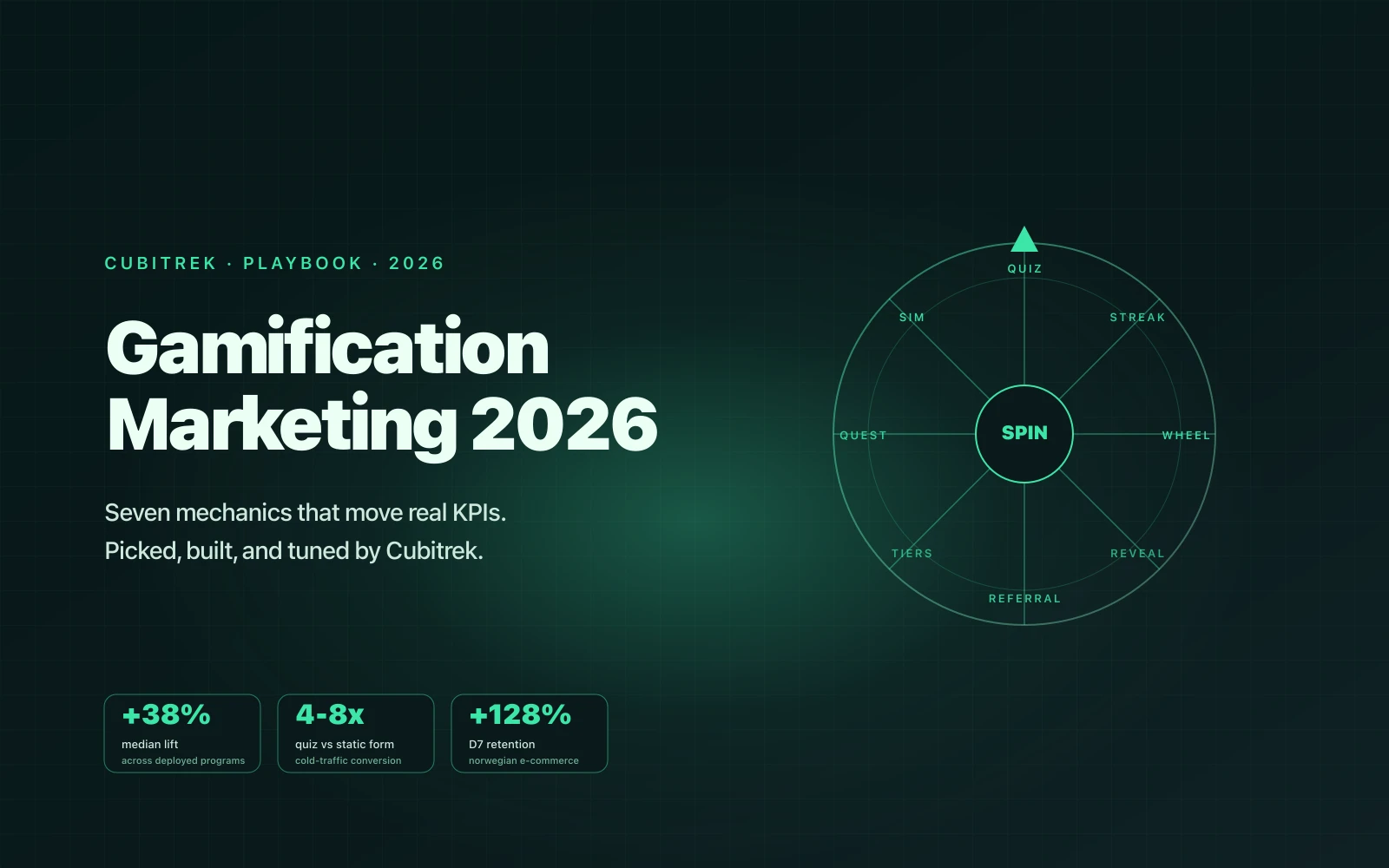
Gamification Marketing 2026 Playbook
Seven gamification mechanics that move real marketing KPIs in 2026. Quizzes, spin wheels, streaks, tier programs, onboarding quests, two-sided referrals, and learning sims.
Faizan Ali Khan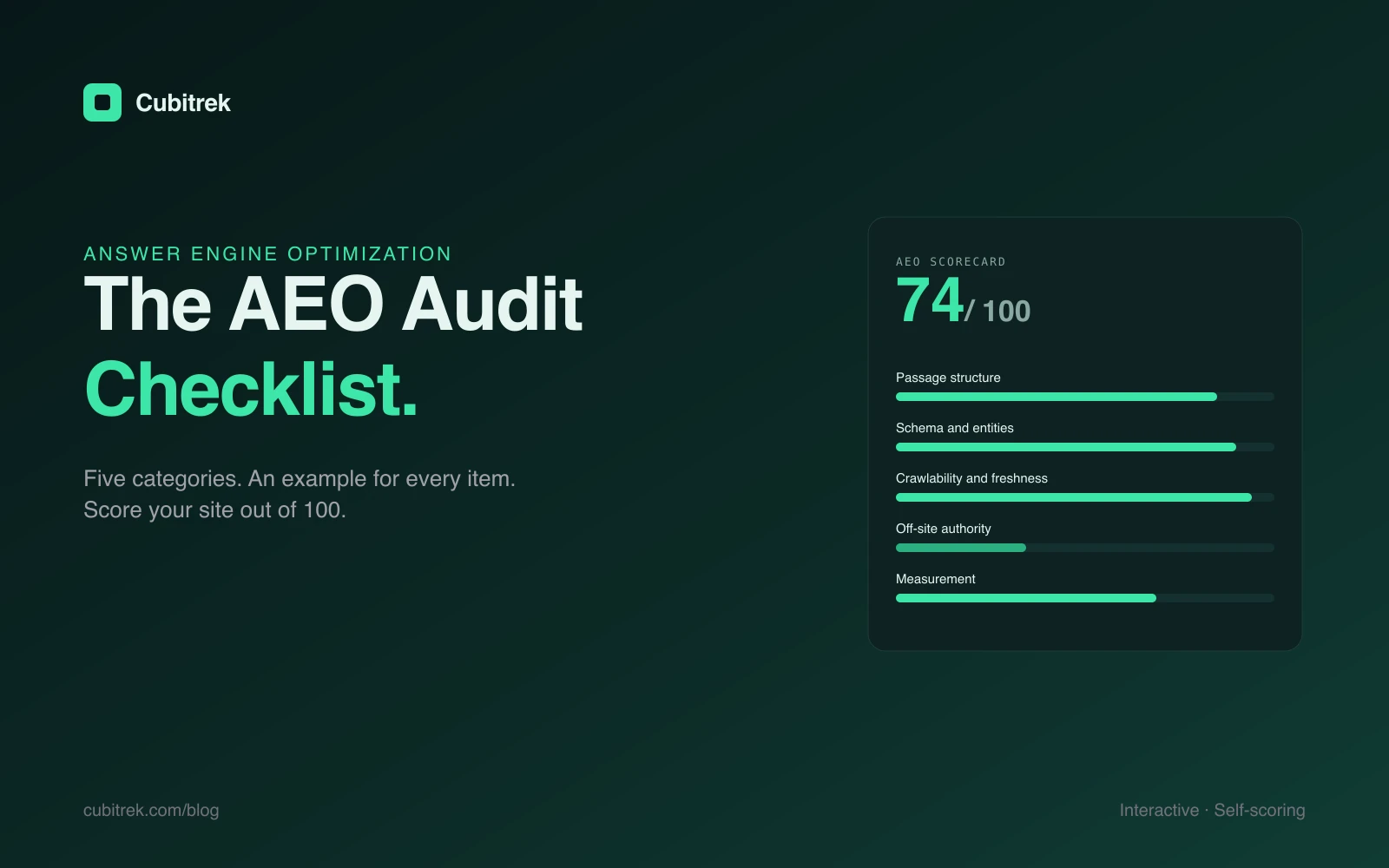
The AEO Audit Checklist
An interactive AEO audit with a weak-versus-strong example for every item, real audit scores, and a live self-scoring widget. Grade your site in five minutes.
Faizan Ali Khan
AI Automation for Marketing: Email, Social & Content Workflows
AI automation handles 60-70% of marketing execution: email campaigns, social media, content creation, and analytics. Free your team to focus on strategy.
Faizan Ali KhanReady when you are
Want Cubitrek to run Website Development for you?
We install website development programs for growing companies across the US and Europe. Book a call and we'll come back with a one-page plan in 72 hours.