

API-First SEO: Preparing Your Data for Autonomous Agents
The era of human-centric SEO is ending. Learn why forward-thinking CTOs are pivoting to “API-First SEO” to ensure their product data is structured, discoverable, and transactive for the emerging wave of autonomous purcha


The next major battleground for product discovery won’t be fought on a Search Engine Results Page (SERP). It will be fought within the probabilistic depths of Large Language Models (LLMs) and the execution loops of autonomous agents.
For two decades, “SEO” has meant optimizing HTML, CSS, and JavaScript for human eyeballs and Google’s indexing crawlers. We built visually appealing storefronts and engineered the underlying code to provide just enough semantic clues for search engines to understand context.
That paradigm is rapidly becoming obsolete. We are entering the era of “machine customers”, autonomous purchase bots, procurement agents, and personal AI assistants tasked with executing transactions on behalf of humans. These agents do not care about your hero banner, your font choices, or your reactive UI framework.
The technical reality driving this shift is simple: Agents don't read HTML; they read APIs.
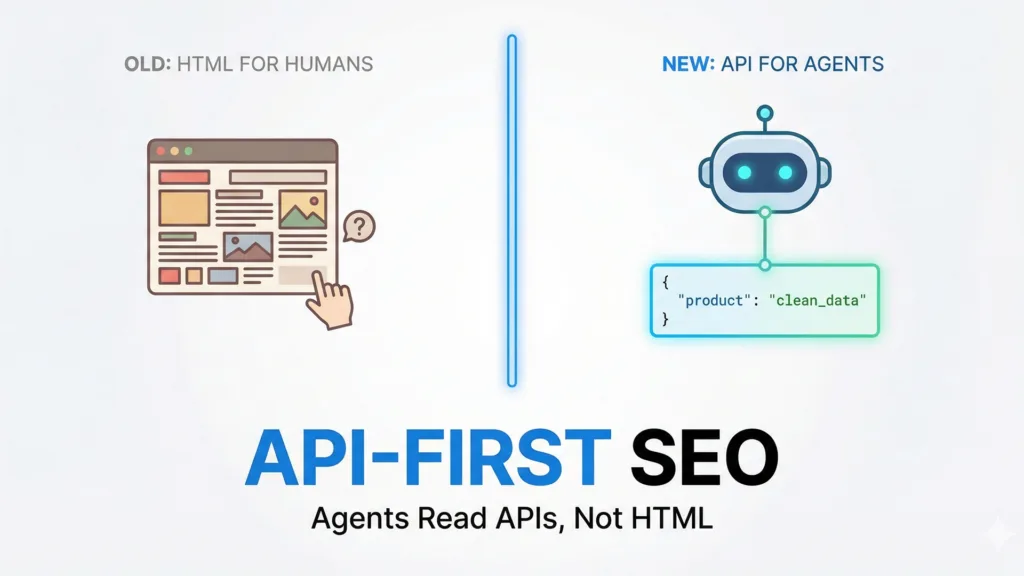
For CTOs and product leaders, this requires a fundamental strategic pivot. To “rank” in the agentic economy, you must cease viewing your API as merely an internal utility or a partner integration tool. Your API is now your primary public storefront. This is API-First SEO.
The Failure of HTML for Machine Consumption
Currently, when an LLM-driven agent attempts to browse a typical e-commerce site, it encounters significant friction.
Modern web applications are hostile environments for bots. They are heavy with client-side JavaScript hydration, complex DOM structures, dynamic class names (thanks to CSS-in-JS), and anti-scraping countermeasures.
For an agent to extract a product’s price, availability, and specifications from this environment, it must:
- Render the full page in a headless browser (high latency/compute cost).
- Visually analyze the DOM to guess which elements contain relevant data.
- Parse unstructured text, hoping to differentiate between a product title and a related item recommendation.
This process is brittle, expensive, and probabilistic. Agents forced to “scrape” visual front-ends are prone to hallucination and transaction failure. If an agent cannot deterministically ascertain stock levels or pricing, it will abandon your platform for a competitor that offers a frictionless data path.
Defining API-First SEO
API-First SEO is the strategic practice of structuring, documenting, and exposing your core product and service data via public-facing APIs designed specifically for machine ingestion.
It is the move from “human-readable” to “machine-actionable.”
In traditional SEO, we optimized for keywords and backlinks. In API-First SEO, we optimize for schema definition, query efficiency, and deterministic data contracts. The goal is simple: when an autonomous agent asks, "Where can I buy X tailored to Y constraints?", your API returns the answer in a split second.
Architectural Imperatives for the Agent Economy
To prepare your infrastructure for this shift, engineering leadership must prioritize the following architectural pillars in their public API strategy.
1. Strict Adherence to Standardized Schemas
LLMs are powerful, but they thrive on structure. Don’t invent proprietary data formats if standard ones exist.
Your API output should map tightly to established vocabularies like Schema.org. When an agent requests product details, the JSON response should use recognized properties (e.g., offers, aggregateRating, sku, availability: InStock). That reduces cognitive load on the agent and lets it interpret your data without guesswork.
If you are in a specialized niche, adopt industry-standard protocols (e.g., automotive standards, real estate RETS/RESO) within your API response structure.
2. The GraphQL vs. REST Consideration for Agents
While REST is ubiquitous, GraphQL offers significant advantages for autonomous agents regarding bandwidth and compute efficiency.
An autonomous purchasing agent often needs a very specific slice of data perhaps just the stock level and current price of five specific SKUs to compare against a competitor. A typical REST implementation might force the agent to fetch five full product objects, over-fetching massive amounts of irrelevant descriptions and metadata.
A well-implemented GraphQL schema allows the agent to query exactly what it needs in a single round trip. This speed advantage translates directly to “ranking” higher in an agent’s decision loop, where latency is often penalized.
3. Semantic Documentation as Interface
For human developers, API documentation explains how to connect. For AI agents, the documentation explains what is available and why it matters.
We need to move toward “semantic documentation.” Ideally, your API should be describable via the OpenAPI Specification (OAS). This allows LLMs to ingest the entirety of your API’s capabilities programmatically.
Furthermore, endpoints must be richly described. Don’t just label a field price. Document the currency, whether it includes tax, and any conditional logic associated with it. The clearer the semantic map, the more confidently an agent can execute a purchase.
4. Designing for Transactional Certainty
The ultimate goal of an autonomous agent is often to execute a transaction. Your API must support this without forcing a fallback to a web UI.
This means exposing transactional endpoints (add to cart, calculate shipping, finalize order) that are reliable and idempotent. You also need rate-limiting and authentication strategies that can tell the difference between malicious DDoS traffic and high-frequency, legitimate agentic purchasing behaviour.
The Strategic Payoff
The transition to API-First SEO is not merely a technical optimization; it is a defensive and offensive strategy for the next decade of commerce.
By exposing your data in a structured, agent-friendly manner, you remove the reliance on third-party aggregators and search engines to interpret your offerings. You create a direct channel to the high-intent “machine customers” of the near future.
The companies that insist on locking their data behind heavy HTML front-ends will become invisible to the AI ecosystem. The companies that treat their API as their premier storefront will dominate the era of autonomous commerce.
Let's discuss it over a call.
Key takeaways
- The technical reality driving this shift is simple: Agents don't read HTML; they read APIs.
- The Failure of HTML for Machine Consumption
- Defining API-First SEO
- Architectural Imperatives for the Agent Economy
Keep reading
Related articles.
More on the same thread, picked by tag and category, not chronology.
AI SEO Services: The Real Work
An agency owner's account of what sits under the AI SEO label: the four kinds of work in a real engagement, which three are verifiable and which one is not, and the cases where you should not buy it at all.
Faizan Ali Khan
AI Video Labeling Rules in 2026
Europe's transparency rules and California's provenance rules both became enforceable on 2 August 2026. What applies in the EU, US, UAE and Pakistan, which videos actually attract penalties, and what it means for agencies and the companies that hire them.
 Samrina Khan
How to Choose an AEO Agency
The buyer's side of answer engine optimization: the four layers a real program covers, twelve questions with the answers that should worry you, what it costs, and the cases where hiring anyone is the wrong move.
Faizan Ali KhanReady when you are
Want Cubitrek to run AEO & GEO for you?
We install aeo & geo programs for growing companies across the US and Europe. Book a call and we'll come back with a one-page plan in 72 hours.