

GEO 101: A Simple Guide to Winning in the AI Search

When a customer searches for your services today, they are increasingly met with a singular, authoritative answer at the top of the screen rather than a list of blue links. This is not just a UI change; it is a structural collapse of the traditional search ecosystem. If your brand is not mentioned within that AI-generated response, you are effectively invisible.
This new era is Generative Engine Optimization (GEO). While traditional SEO was a game of ranking for clicks, GEO is a battle for citations within the model’s synthesis. In this guide, we break down how to transition from traditional visibility to “Answer Engine” dominance.
1. What is GEO?
Generative Engine Optimization (GEO) refers to the practice of optimizing content so that it appears prominently in generative AI engines such as ChatGPT, Perplexity, Claude, Bing AI, and Google’s AI Overviews.
Traditional SEO focused on the index, getting a crawler to find a page and rank it. GEO focuses on synthesising and enabling the Large Language Model (LLM) to select your data as a trusted source to generate an answer.
Why is Traditional SEO No Longer Sufficient for AI Search?
Most advanced LLMs now use Retrieval-Augmented Generation (RAG). This process pulls live data from the web to verify answers. While this has dropped hallucination rates from 60% to roughly 3–5%, it has also created a “Star Economy.” AI models prefer to cite a “single primary source” or the top 5–10 authoritative entities in a category. If you aren’t an “Elite Entity,” your traffic could decline by 50% or more as AI assistants bypass your website to give users direct answers.
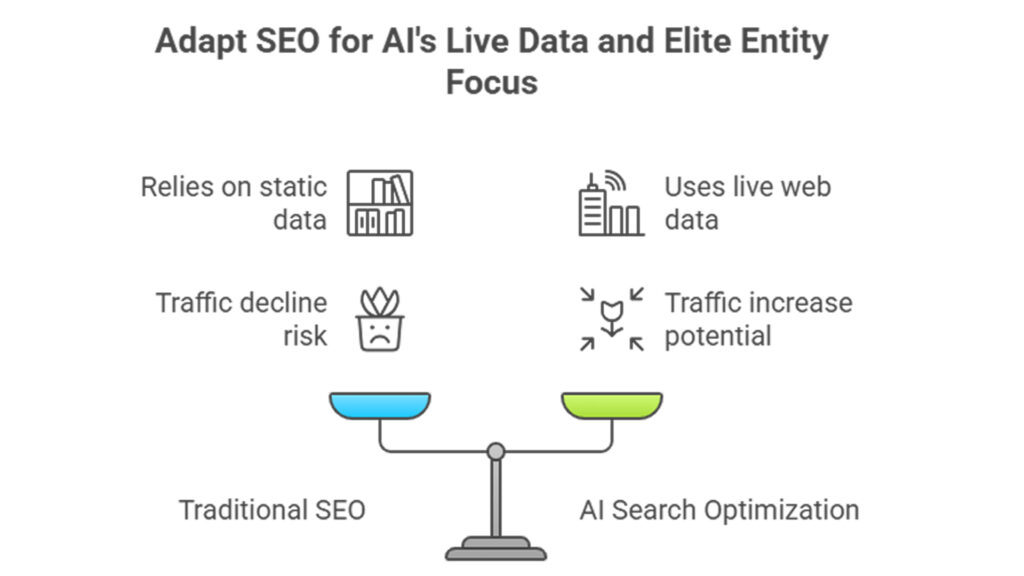
The image illustrates the shift from traditional search to AI-driven discovery. It contrasts relying on static, historical information (Traditional SEO) with using real-time, live web data for fact verification (AI Search Optimization). It highlights the risk of invisibility, showing that sticking to old methods can lead to traffic decline as AI often bypasses standard websites to provide direct answers. At the same time, it demonstrates the reward of authority: businesses that optimize for AI (GEO) can become “Elite Entities,” gaining higher visibility and significant organic traffic growth.
2. Five Pillars of a Generative Engine Optimization Strategy
To remain visible in 2026, brands must focus on these optimization strategies. Successful generative engine optimization strategies are built on these five pillars:
I. Semantic Depth over Keyword Density
AI models process concepts, not strings. Instead of targeting “commercial insurance,” you must build a semantic cocoon of expertise. This means covering the entire thematic graph from risk assessment and policy underwriting to historical claim data.
II. Information Gain & Originality
AI systems are programmed to avoid redundancy. If your content is just a summary of what already exists, you will receive a “zero vector” penalty. You must provide Information Gain, unique data, original case studies, or proprietary research that the AI cannot find elsewhere.
III. Technical Crawlability: Server-Side Rendering (SSR)
Many AI crawlers struggle with heavy JavaScript. If your site relies on client-side rendering, your content is invisible to the LLM. Using Server-Side Rendering ensures that the “raw data” is immediately accessible for AI ingestion.
IV. Entity-First Content
Queries are now interpreted by identifying underlying entities (People, Places, Things). Your content must explicitly link your brand to trusted entities in the Knowledge Graph.
V. User Interaction & Engagement Signals
In modern GEO, performance is driven by user intention and interaction. Generating a visit is only half the battle; the length of stay and the depth of interaction tell the AI that your site is a high-value source for its next synthesis.
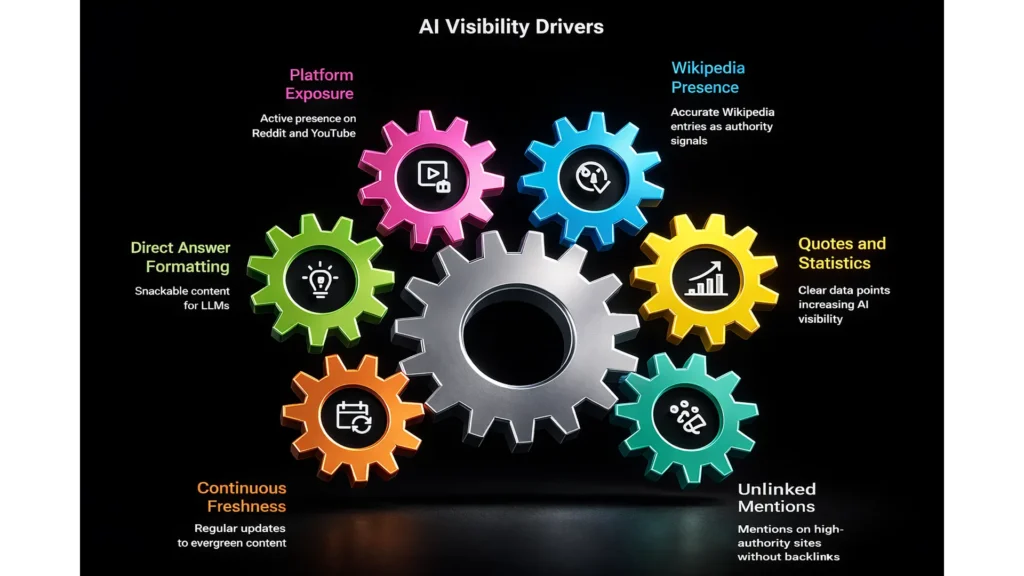
3. The 6 Tactical Drivers for AI Visibility
Research has identified specific patterns that increase the likelihood of being cited by an AI engine. Implementing these generative engine optimization tools and tactics is essential:
- Unlinked Mentions: In the GEO era, a mention of your brand on a high-authority site (like a news outlet or niche forum) carries weight even without a backlink.
- Quotes and Statistics: Studies show that pages with clear data points have 30–40% higher visibility in AI responses. AI loves “hard facts.”
- Wikipedia & Wikidata Presence: These are the primary training sets for LLMs. An accurate Wikipedia presence is a massive authority signal.
- Platform Exposure: Active presence on Reddit and YouTube is critical, as AI engines increasingly prioritize “human-generated” discourse for real-world recommendations.
- Direct Answer Formatting: Structure your sections with a clear definition in the first 2 sentences. Use tables, FAQs, and bulleted lists to make the content “snackable” for the LLM.
- Continuous Freshness: AI agents favor the most recent data. Regular updates to your “evergreen” content are no longer optional.
4. Measuring Success: The New KPIs
You cannot use Google Search Console to track your GEO performance. Instead, you need generative engine optimization software that monitors:
- Share of Model (SOM): How often your brand is cited compared to competitors.
- Brand Sentiment: Is the AI describing your services positively or neutrally?
- Crawl Frequency: Tracking AI bot activity (like GPTBot) in your server logs.
For those serious about tracking, Semrush has launched an AI Visibility Toolkit that allows you to monitor your brand across different generative engines. It’s the best way to see if you are becoming a “Star” or becoming invisible.
Cubitrek Success Stories In Scaling AI Visibility in E-Commerce and Financial Services
We help brands enter new markets by using smart AI tools to understand exactly what local customers are searching.
Case Study 1: E-commerce Visibility & Eco-Friendly Intent
For a leading Norwegian e-commerce company, Cubitrek demonstrated the ability to dominate a new market despite a language barrier by leveraging advanced semantic analysis tools to deeply understand the Norwegian audience and local search intent.
- Strategy: We implemented a high-authority Product and Offer schema specifically designed for their reused iPhone category.
- Tactics: This schema highlighted the environmental benefits of buying reused hardware to reduce carbon footprints, aligning the brand with “eco-friendly” and “sustainability” entities favored by AI models.
- AI Visibility Tip: To maximize visibility, we recommend utilizing Product Schema nested with MerchantReturnPolicy and AggregateRating, while explicitly using the itemCondition: https://schema.org/UsedCondition property to clearly signal the value proposition to AI agents.
- Result: The brand moved beyond a simple listing to become a primary recommendation for sustainability-focused queries in AI shopping assistants.
Case Study 2: Trusted Authority for US Financial Consulting
For a US-based financial consulting firm, Cubitrek bridged the gap between complex regulatory requirements and user-friendly digital content.
- Strategy: We cross-referenced all content against official US accounting standards and regulatory sets to ensure the highest level of reliability and trust.
- Tactics: Our team extracted dense technical information and translated it into semantic structures that both human audiences and AI models could easily parse.
- Market Shift: We moved away from traditional keyword-only targeting, recognizing that AI tools now analyze content semantically rather than just scanning for specific words.
Result: By following modern marketing rules for focused, intent-based search, we achieved a 32% increase in sales-qualified leads.
Conclusion:
Search has moved from a list of blue links to a conversation. In this new landscape, you are either the source or you are silent.
Blocking AI bots is not a strategy; it is digital suicide. The only way forward is to build content that is too valuable, too original, and too well-structured for an AI to ignore. Whether you are building a semantic cocoon or engineering your brand’s “Share of Model,” the time to act is now.
Ready to future-proof your visibility? At Cubitrek, we specialize in the technical and strategic shift to AEO and GEO. Let us help to dominate your brand in the AI search.
Frequently Asked Questions (GEO & B2B Strategy)
1. What is generative engine optimization?
GEO is the process of optimizing digital content so that it is accurately retrieved, synthesized, and cited by AI models (like ChatGPT and Google Gemini) when providing direct answers to users.
2.How can generative engine optimization improve SEO?
GEO and SEO are synergistic. By focusing on semantic depth and structured data, you improve your traditional rankings while simultaneously increasing the chances that your content is featured in “AI Overviews,” which are the new high-visibility positions on SERPs.
3.How do I optimize my content for generative engines?
The most effective way is to use a generative engine optimization course or framework that prioritizes:
- Structured Data (JSON-LD).
- Q&A formats that mimic natural conversation.
- High “Information Gain” through original research.
- Clear headings that use “Entity” language.
4.Is generative AI the future of search engine optimization?
Yes. We are moving toward a “Zero-Click” world where search is agentic. SEO will evolve into the management of a brand’s presence within the world’s shared Knowledge Graphs.
5.How does GEO affect visibility in results like ChatGPT?
In platforms like ChatGPT, you aren’t fighting for a link; you’re fighting to be part of the “context window.” This is achieved through strong brand mentions on third-party sites and a clear “Entity” identity that the AI can verify through RAG.
6.How can we leverage AI-generated visuals for SEO without hurting originality?
Use AI visuals (like those from DALL-E or Midjourney) as augmentations, not replacements. Ensure every AI-generated image includes highly descriptive Alt Text and is accompanied by original charts or proprietary data visualizations that provide “Information Gain.”
7.How can I generate more CTR in an AI-world?
Focus on Intent-Led content. If the AI provides a summary, your content must provide the next step (tools, calculators, or deep-dive whitepapers) that the AI cannot replicate. This pulls the user from the AI interface to your site.
8.How does SEO impact lead generation for B2B companies in 2026?
In 2026, B2B buyers use AI assistants as “digital sales personnel.” If your brand is cited in a “Comparison of B2B Software,” you are part of the consideration set. SEO now provides the “Trust Fabric” that makes these AI recommendations possible.
9.How can local SEO be weaved into a general website theme?
Use Semantic Localization. Instead of repetitive city pages, integrate city-specific entities (local landmarks, regional regulations, or community projects) naturally into your pillar content using structured Geo-Schema.
10.How do AI copy generators improve SEO writing?
Tools like the Cubitrek Content App act as a solution provider by ensuring content meets “AI Optimization Scores.” They help humans scale content while maintaining the semantic structure that LLMs require for citation.
11.How can a B2B SEO agency help you generate qualified leads?
Leading generative engine optimization companies move beyond keywords. They engineer your “Share of Model,” ensuring your brand is the cited authority for high-intent B2B queries, which directly feeds your sales funnel.
12.How important is SEO for lead generation in the insurance sector?
In the insurance sector, trust and E-E-A-T (Expertise, Experience, Authoritativeness, Trustworthiness) are everything. AI models are highly cautious in “Your Money or Your Life” (YMYL) categories. Without deep technical SEO and a strong “Entity” presence, insurance brands will be excluded from AI-generated recommendations to protect the user.